


A Substack bestseller, Italy with Antonio offers honest guides for moving to, traveling in, and understanding Italy from a native Italian. A paid article every Monday and a free one every Thursday, with deeper resources for paid members, including print-ready PDF and ePub downloads. Join over 2,000 subscribers!
Growing up, we took the bus every summer to the nearby beach. Until I was nine, that meant Ostia Lido, near Rome. We then moved to Montegiorgio in the Marche region, whose closest beach was Porto San Giorgio, so that became our summer beach town.
Realistically, both were fine. Nothing wrong with either beach. But by Italian standards, neither was anything to write home about. I have some nostalgic attachment to both, which makes me personally rank them higher than they should be.
And that’s the problem. Ask ten Italians what the best beaches in Italy are, and they’ll vaguely point at Sardinia before stating with confidence that the beach town they have been going to for 20 years is where it’s at.
That’s not how we roll in this publication. When opinions get loud, I like to reach for data and settle things in a more or less scientific way.
In this case, there isn’t an official ranking, so I’m going to create a meta-ranking myself, based on reputable sources, each measuring something related to the quality of the beaches.
Namely:
Guida Blu by Legambiente and Touring Club Italiano. This one awards up to five “vele” (sails) to coastal towns on the basis of clean waters, landscape protection, sustainable tourism, and overall environmental involvement by the local council. It’s as close as it gets to an official ranking, but it scores towns rather than individual beaches. This is why my title doesn’t say “Italy’s best beaches” flat out.
Bandiera Blu, the famous Blue Flag you’ve heard of from me and other outlets. You might have even seen it flying at beaches you visited. 257 comuni (municipalities) earned one this year. This doesn’t rank anything, but it’s a certification that tells us something about a given beach. Specifically, the presence of lifeguards, facilities, accessibility, environmental management, etc.
Europe’s 50 Best Beaches is an international ranking as voted by travel experts. Nine Italian beaches made the cut in 2026.
Finally, the European Environment Agency, which rates the water at every official bathing site in Europe. It monitors thousands of these sites in Italy, and 90.8% of the coastal ones are rated excellent. This acts as a filter for us.
How I ranked them
To create this ranking of Italy’s best beach towns, I started with the twenty towns awarded five sails, scored by their position in the Guida Blu.
Then, I added a bonus for any town whose beach appears on the European list.
Finally, the water quality test eliminated only one town from the top ten, Castiglione della Pescaia in Tuscany, for having two sites rated only “sufficient,” which left it below the high Italian average. Maratea, Basilicata’s only town on the Tyrrhenian Sea, took its place.
As a result, every town in the final top ten list scores 100% excellent on water quality.
The Blue Flag did not act as a filter; instead, I simply mention when the beaches of a given town have it. This is intentional. Otherwise, we’d be cutting out beautiful coves, punishing the town for not installing a bar and a lifeguard in preserved, wild areas.
The podium
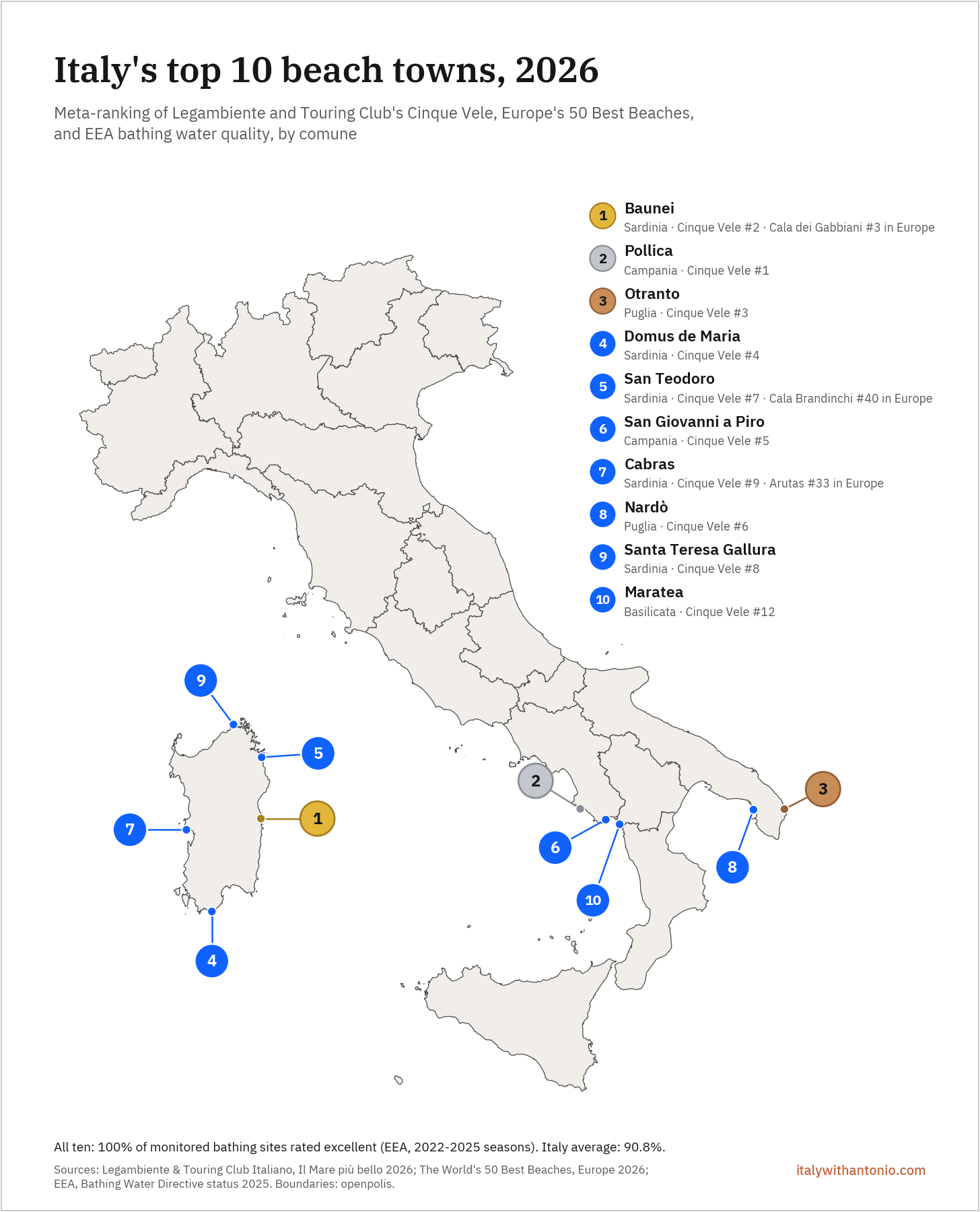
In list format:
Baunei, Sardinia
Pollica, Campania 🩵
Otranto, Puglia
Domus de Maria, Sardinia
San Teodoro, Sardinia 🩵
San Giovanni a Piro, Campania
Cabras, Sardinia
Nardò, Puglia 🩵
Santa Teresa Gallura, Sardinia 🩵
Maratea, Basilicata 🩵
(A blue heart indicates it’s a town with Blue Flag beaches.)

Baunei takes the gold by a good margin. It’s ranked second in the Guida Blu, and it’s home to Cala dei Gabbiani, the third-best beach in Europe according to this year’s list. Cala Goloritzè, named the best beach in the world in 2025, is also in Baunei.
Interestingly, neither of those two beaches is an official EEA monitoring site. But their neighbors Cala Mariolu and Cala Sisine are, and they pass with flying colors. So I wouldn’t worry about that.

Pollica, in Cilento, takes silver. It’s number one in the Guida Blu, but none of its beaches made the European list, so Baunei overtakes it in this meta-ranking. Otranto, on the eastern tip of Puglia, takes bronze.
Now, the part that is rather obvious once you take a look at the map above: every single town is in the south of Italy. If you want fantastic beaches, that’s where you need to go. Also, yes, Sardinia is unbeatable in this regard. Five of the ten finalists are on the island. If you’ve ever visited, you won’t be surprised in the least.
I suspect Liguria not making the cut will upset a few people. If you are aiming for beautiful beaches in the north, that’s where you should look. It has more Blue Flags than any other region, 35 this year.
The ones foreigners love
Three beaches in particular didn’t make the cut but are internationally appreciated for their beauty, so it’s worth mentioning them:
La Pelosa in Stintino (Sardinia) is 10th in Europe.
Tuerredda in Teulada (Sardinia) is 13th.
Cala Coticcio on Caprera (Sardinia) in La Maddalena is 19th.
Gorgeous beaches with clean water. They just didn’t score high enough in the Guida Blu to make the top 10.
Did your favorite Italian beach make the list? Feel free to share your top picks in the comments below.
Mildly upset that upset that no beaches in Le Marche made it on to the list but thats because of home bias 😁