


Italy with Antonio. Honest guides for moving to, traveling in, and understanding Italy from a native Italian. Three articles a week, with deeper resources for paid members. Join 1,000+ subscribers.
Run my relocation filter on Tuscany, and it spits out 34 towns. Tuscany has many comuni (municipalities), 273 to be exact, but 34 still feels like a laundry list. The whole point of this series is to hand you a shortlist.
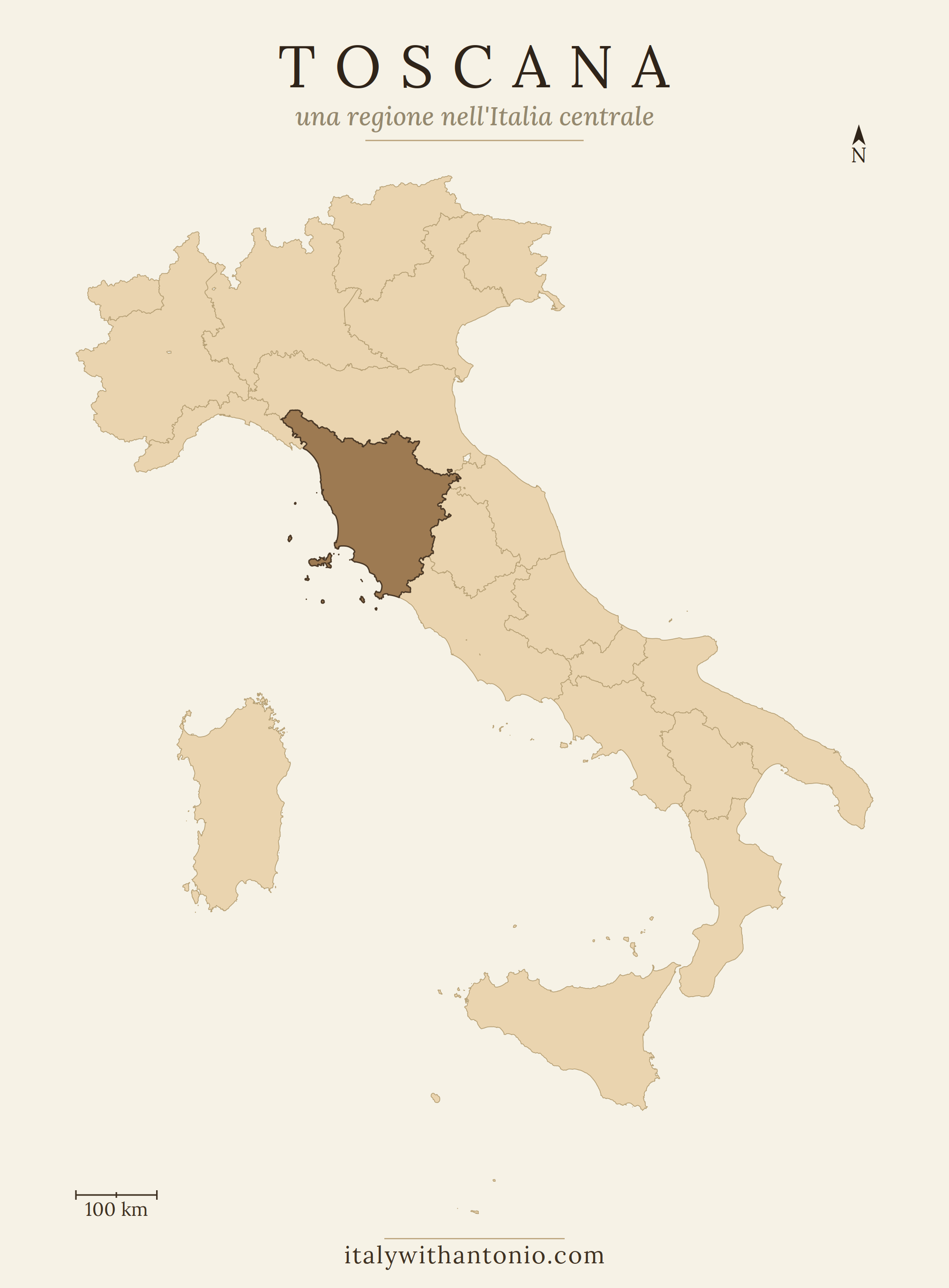
It’s the opposite of the problem I encounter in many regions. Tuscany hands us three dozen places that clear the bar with ease. It's a nice problem to have, but still a problem. A list that long ceases to be useful.
So, for a region this generous, I’ll do the reverse of what I do with nearly empty ones. Instead of relaxing the rules, I’m going to make them stricter.
Specifically, the two nice-to-have criteria become mandatory for Tuscany. Namely, having a train station in town and being within 30 minutes by car of a capoluogo (a provincial capital).
This takes us from 34 to 18 comuni. Then, per the framework's rules, I'll pick the ten I'd shortlist for myself. And you still get the full list of 18 candidates for your perusal.
What Tuscany is actually like to live in
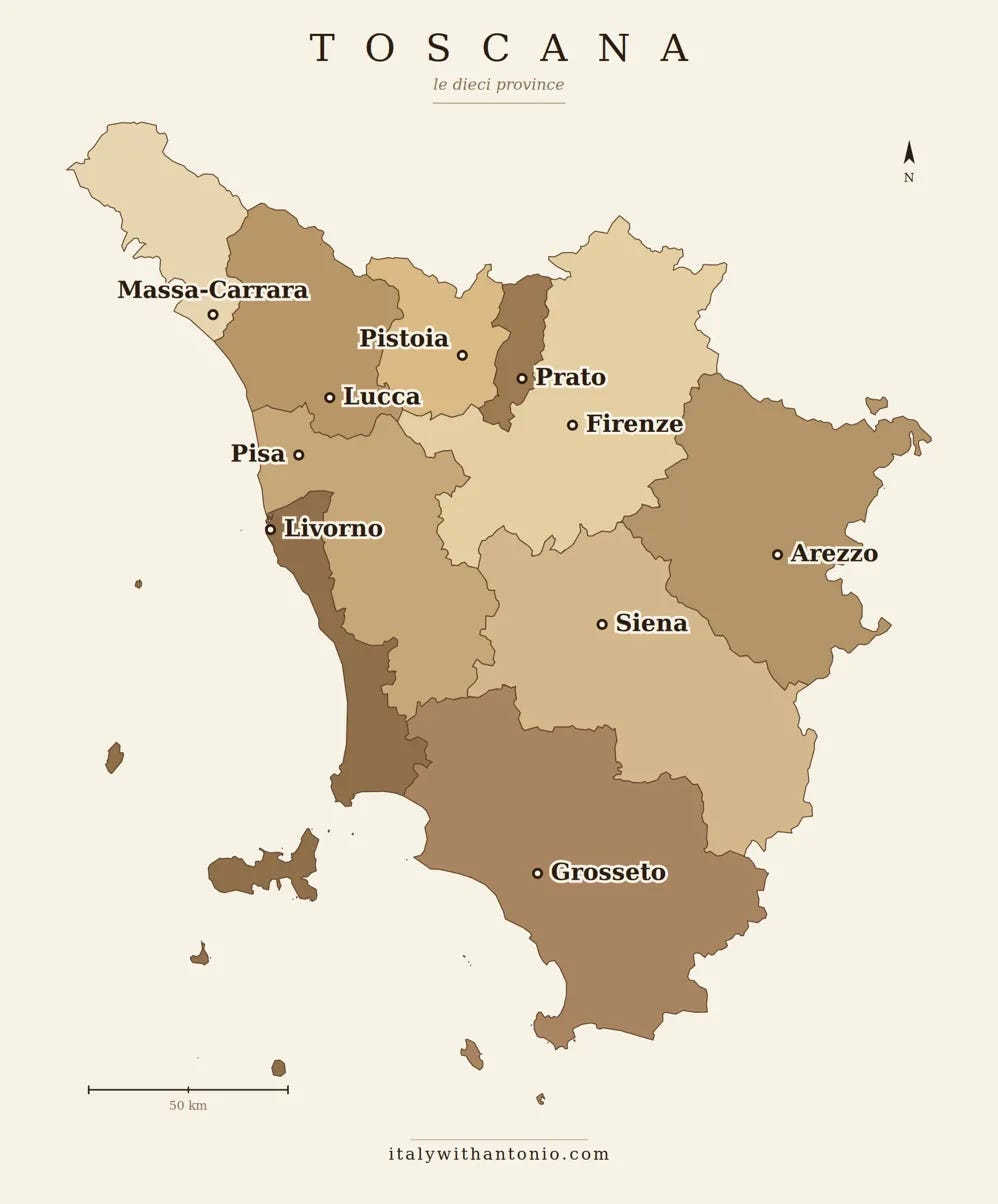
Toscana (Tuscany) has 273 comuni split across ten provinces. Technically, Florence is a città metropolitana, one of fourteen cities in Italy with a special designation rather than the ordinary provincial classification. But it’s essentially a province contributing shy of a million people to Tuscany's 3.66 million population.
Tuscany has a far more industrial economy than the wine-and-cypresses image would have you believe. Gold in Arezzo. Leather tanning in Santa Croce sull’Arno. Paper and tissue in Lucca and Capannori. Vespas in Pontedera. Pharma and banking in Siena. Fabric in Prato. And so on.
The jobs exist in Tuscany. It’s not Molise. But the catch is that the majority of good jobs are in Florence, and Florence will price you out. The rest of the jobs around the region are… well, Italian jobs. So relatively low.
If you can find an industrial job in a town not depicted in the postcards, you can swing it. But the framework is really created for people who have independent means, are retiring here, or bring a remote job with them. If you want a local job in the tourist towns, it’s even worse. The tourist economy pays peanuts and does so seasonally.
Quality-of-life-wise, Tuscany does pretty well. The 2025 Sole 24 Ore ranks Siena 21st of 107 provinces, the best in the region, and first in Italy for women's quality of life, for the fifth year running.
Pisa 29th, Florence 36th, Arezzo 44th. The rest sit mid-table or lower, Pistoia down at 66th.
Tuscany's air is clean in the hills, the countryside, and along the coast. Certainly, far better than the air in the Po Valley to the north.
That said, two big basins trap winter smog and can be a concern for sensitive populations: the Florence-Prato-Pistoia plain and the Lucca plain (Capannori above all).
Earthquakes are real here, too, but the risk is far more localized than in Marche. In practice, most of Tuscany is not a major seismic risk you need to worry about. The main exception is the northern mountain valleys (Garfagnana, Lunigiana, Mugello), which sit on active Apennine faults where earthquakes have killed people.
The weather follows a similar geographic pattern. Inland, summers are hot and dry, with cool winters, except for Florence, which stews in its own basin and gets muggy. The mountains are cold and snowy. The coast is milder in both summer and winter.
Outside Florence, and to a degree, Pisa and Siena, plan on needing Italian. The English you hear in the centro storico of a tourist town disappears the moment you need help from a plumber, commercialista (an accountant), or even a doctor.
Tuscans are warm and welcoming, even if, next to the more understated Marchigiani, they carry a reputation for a certain local pride. But to be fair, this is the region that gave Italy both the Renaissance and its language.
The good things, like food, wine, beautiful landscapes, etcetera, are all there, of course, but I don’t think I need to sell you Tuscany on those grounds.
The filter applied to Tuscany
As a reminder, the filter we are using includes:
A population between 15,000 and 100,000
A full emergency room within 25 minutes
A high school in town
A full supermarket
Fiber internet
A stable population (under 5% decline over the past decade)
No extreme seismic exposure
Since this would yield too many towns, we are also enforcing the two nice-to-haves:
A train station in town
Within 30 minutes by car of a provincial capital (or one itself)
The seismic filter does nothing for us. No comune sits in Zone 1, and none is on the crateri disaster list. Flooding and landslides are more of a concern here, but even then, not a reason to cross off any towns.
The population floor kills a few of the postcard towns. San Gimignano has 7.5K residents and is out. So is Pienza with less than 2K. The decade-decline filter kills part of the coast and hill towns, including Cortona (down 7.7%) and Pietrasanta (5.9%).
We can screen the 34 survivors further by applying the train-station-in-town criterion. Not a tram to the city. Not a station that carries the town's name, but actually sits one town over.
And enforcing the 30-minute distance from a capoluogo (provincial capital) further narrows the field.
We are left with 18 cities, all independent and yet connected. I’ll list them below the fold and provide a quick overview of my ten picks. The ones I’d shortlist for myself if I were relocating to Tuscany.
Let’s start with an excellent first choice: Arezzo.
Arezzo: the city our strict filter is meant to find

Arezzo is an underdog. Tucked inland, it’s easy to overlook. Yet, it’s one of my first recommendations when people are looking for affordable Tuscany. It has a lot to offer for the price tag.
It’s a provincial capital of about 96,500 people. The decline is quite manageable at only 3% over the past decade. It has its own respectable hospital and really its own everything. The local industry is gold, and Arezzo handles a sizable chunk of the world's trade in it.
It sits on the main Florence-Rome train line, which makes it a well-connected choice. An hour from Florence. Two from Rome (though the occasional 1h 15 min ride exists).
You’ll also find an amazing antique market on the first Sunday of every month and the Saturday that precedes it. Fiera Antiquaria turns the entire centro storico into one of Italy's most celebrated antique markets.
It’s cheap for what it is. Asking prices run around €1,750/m² (idealista, spring 2026), in a dead heat with Pistoia for the cheapest Tuscan capital and barely over a third of Florence.
The catch is the basin: Arezzo bakes in August and fogs in January. Some will find it sleepy. But it’s sleepy with a fast train. And you’re not moving to Italy to live the Manhattan lifestyle, are you?
