

How to Get a Codice Fiscale as a Non-EU Citizen in 2026
Your 2026 guide on how to get a Codice Fiscale (Italian tax identifier) without a lawyer, without a visa, and without losing your mind at a consulate.

The codice fiscale (CF) is the identifier that determines whether the Italian system is aware of you.
Having a codice fiscale is a prerequisite for buying a property in Italy and for virtually everything else you’ll do when moving to Italy. Even newborns automatically get one, often before they leave the hospital.
Without it, you’ll be delayed or outright blocked from signing a lease, opening a bank account, getting an Italian phone number, closing on a property, starting a job, or signing up with the public healthcare system. I’m not exaggerating: you’ll struggle to get anything done.
To be clear, this has nothing to do with your immigration status. You still need the appropriate visa or residency permit if you plan to live in Italy.
The good news is that the codice fiscale itself is free. Getting it as an American or Canadian citizen in 2026 is where things become interesting, because consular practices changed in 2024, and most guides on Google haven’t caught up.
Don’t worry, though, I’m giving you the up-to-date playbook to get a codice fiscale. No lawyer required.
What the Codice Fiscale Actually Is
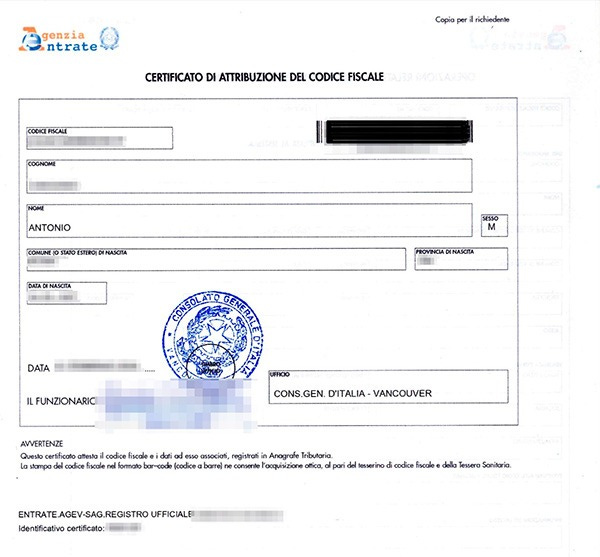
The codice fiscale is a 16-character alphanumeric identifier issued by the Agenzia delle Entrate, Italy’s revenue agency (yes, just as cuddly and friendly as the IRS in America and the CRA in Canada).
It’s generated from your first and last name, date and place of birth, and sex, using a public algorithm. If two people would receive the same codice fiscale, the agency steps in to disambiguate.
The canonical example of a codice fiscale for Mario Rossi (Italy’s John Doe) born in Rome on January 1, 1980, is RSSMRA80A01H501U.
Think of it as a Social Security Number in America or a Social Insurance Number in Canada, but normally handled by Italians with less secrecy, in part because anyone can calculate it with a few details about you.
Your landlord will want it. Your bank will want it. Your mobile carrier will want it. The notary handling your property purchase will want it.
It’s valid for a lifetime. It doesn’t expire, doesn’t need renewal, and doesn’t depend on where you live. You get one, and it’s yours forever.
Don’t confuse it with the partita IVA. The codice fiscale is personal. The partita IVA is commercial and required to invoice clients as a freelancer or run a company in Italy. Anyone who tells you a partita IVA is needed to buy a vacation home is confused.
What Changed in Mid-2024
Until mid-2024, the standard advice was: apply through your nearest Italian consulate, walk in or send an email, wait a few weeks, get your PDF certificate.
It mostly still works that way, but the priorities have shifted. What happened is that several Italian consulates, particularly in the United States, updated their internal guidance and started prioritizing Italian citizens and active visa applicants over foreign nationals who simply wanted a codice fiscale to buy a house or open a bank account.
The Embassy of Italy in Washington D.C. published the most explicit version: foreigners engaging in long-term activities in Italy are encouraged to first apply via a delegated representative in Italy, and Washington has gone as far as asking, in some cases, for written proof of a failed delegate attempt before processing such requests. Other consulates adopted the general idea without the same paperwork demand.
In practice, the response times vary widely now, from a few weeks at smaller consulates to several months of silence at the busiest US ones. Canadian consulates have generally stayed more responsive, particularly in Vancouver and Montreal.
This isn’t a scandal. It’s resource triage: a handful of consular staff, millions of dual citizens in North America, and a system that would rather the Agenzia delle Entrate handle this inside Italy.
Four Paths to Get Your Codice Fiscale
I’ll rank them by ease of process for a non-EU citizen this year.
1. Apply in person in Italy (easiest if you’re already going)
This is the easiest path, but only if you already have a trip scheduled.
Walk into any ufficio territoriale of the Agenzia delle Entrate. Bring your passport and the AA4/8 form. Some offices take walk-ins; others expect you to book an appointment through the Agenzia’s online portal. Either way, it’s quick.
The Ufficio Territoriale di Roma 2 Aurelio in Trastevere moves reasonably fast by Roman standards. Milan offices are efficient. Smaller provincial offices can be even quicker because the line is shorter. Naples, bless it, requires patience, a book, and possibly a prayer to San Gennaro.
The certificate is issued on the spot. That is the document you walk out with, and it’s all you need.
This option doesn’t work if you need the codice fiscale before you travel, for instance, to apply for a long-stay visa. And of course, if you aren’t travelling to Italy already, don’t make a trip just for that.
2. Your Italian consulate at home (still viable, inconsistently)
Still worth trying, especially from Canada and the UK, where consulates remain more responsive. Worth attempting elsewhere if you have time, since the service is free when it works.
Italy maintains consulates in dozens of cities across the major English-speaking countries. Apply only to the one that covers where you legally live: applications from outside a consulate’s jurisdiction usually get rejected without comment.
Google “Italian consulate [your nearest major city]” and find the one with jurisdiction over your address. What you want is the page on a .esteri.it domain. Anything else is a third-party guide, not the consulate itself.
To save you the first click, here are helpful links for some of the larger consulates and embassies serving English-speaking countries:
United States:
Los Angeles: https://conslosangeles.esteri.it/en/servizi-consolari-e-visti/servizi-per-il-cittadino-italiano/codice-fiscale/
Chicago: https://conschicago.esteri.it/en/
Houston: https://conshouston.esteri.it/en/
Philadelphia: https://consfiladelfia.esteri.it/en/
San Francisco: https://conssanfrancisco.esteri.it/en/servizi-consolari-e-visti/servizi-per-il-cittadino-italiano/altri-servizi/codice-fiscale/
Washington D.C.: https://ambwashingtondc.esteri.it/en/servizi-consolari-e-visti/servizi-per-il-cittadino-italiano/codice-fiscale/
Canada:
Ottawa: https://ambottawa.esteri.it/en/
Vancouver’s CF page has the clearest documentation of any Italian consulate I’ve read, which is a low bar but still cleared with impressive ease.
United Kingdom:
London: https://conslondra.esteri.it/en/servizi-consolari-e-visti/servizi-per-il-cittadino/codice-fiscale/
Edinburgh (covers Scotland and Northern Ireland): https://consedimburgo.esteri.it/en/
Australia:
Sydney (NSW only): https://conssydney.esteri.it/en/servizi-consolari-e-visti/servizi-per-il-cittadino-italiano/codice-fiscale/
Melbourne (Victoria, Tasmania, South Australia, ACT): https://consmelbourne.esteri.it/en/servizi-consolari-e-visti/servizi-per-il-cittadino-italiano/italian-tax-file-number/
Perth (WA and NT): https://consperth.esteri.it/en/
Canberra: https://ambcanberra.esteri.it/en/
New Zealand:
Wellington (for all of New Zealand): https://ambwellington.esteri.it/en/
Tax code applications to the Wellington embassy go in by email per the embassy’s instructions.
Documentation requirements are roughly consistent across consulates: (usually) signed AA4/8, a clean PDF scan of your passport, proof of residence in the consular district (driver’s license, utility bill, lease), sometimes a birth certificate, sometimes a short signed statement explaining why you need the codice fiscale. Read your consulate’s page before submitting. They do not chase incomplete applications.
3. Delegate someone in Italy (annoying but most reliable in 2026)
If you know anyone in Italy, a friend, your commercialista, a real estate agent handling your purchase, this is the fastest route short of you showing up in person.
You prepare a procura speciale (a special power of attorney) naming them as your delegate to submit Form AA4/8 on your behalf.
The process:
Sign the procura in front of a notary public in your home state or province.
Get it apostilled. In the US, by the Secretary of State in the state where the document was notarized. California, Ohio, New York each have their own office. A California POA cannot be apostilled in Florida.
In Canada, apostilles became available on January 11, 2024 when Canada joined the Hague Convention. Global Affairs Canada issues them, and so do several designated provincial authorities, including Ontario, Alberta, British Columbia, Saskatchewan, and Quebec. Where you got the document notarized determines which office processes the apostille.
Send the apostilled POA, a clean color scan of your passport, and the signed AA4/8 to your delegate in Italy.
They walk into any Agenzia delle Entrate office and submit it. You get your codice fiscale, often the same day.
Surprisingly, the process is fast once it hits Italy. Apostille turnaround in your home state is often the real bottleneck, not the Italian side.
What the heck is an apostille?
It’s a stamped certificate that proves a notarized document from one country is genuine, so officials in another country will accept it. In the US, it’s issued by your state’s Secretary of State, in Canada by Global Affairs Canada or your province, and it’s the slowest part of the whole codice fiscale process. Order it the day you notarize.
4. Pay a delegate service (€100 to €200)
If you have no contacts in Italy, no trip planned, and your consulate has gone quiet, a paid delegate service does what your cousin would do: prepares the proxy, files it at the Agenzia, and sends you the PDF.
Studio Legale Metta and Smart Move Italy are two of the better-known options. Prices generally run from €100 to €200 per individual, plus whatever your local apostille costs.
The codice fiscale itself remains free. You’re paying for someone else’s time and the apostille logistics.
Worth it? If you’re trying to close on a house in Le Marche in thirty days and your consulate hasn’t replied in six weeks, yes. If you’re six months out from moving and have time to try other paths, no.
Bonus path for students: the Universitaly portal
Non-EU students pre-enrolling at an Italian university through universitaly.it automatically get a codice fiscale generated during the application. It appears on your student file and shows up in your visa documentation. If you’re coming to study, you almost certainly already have one. Check your pre-enrollment page before you email anyone.
The One Thing That Ruins Most Applications
Name spelling.
Your codice fiscale is generated algorithmically from your legal name as it appears on whatever document you present. If your passport reads “MARIA LUISA GARCÍA-LÓPEZ” and the form goes in as “Maria Garcia Lopez” you’ll get an incorrect code and run into issues down the line.
The Agenzia can fix it, but only after you’ve discovered the mismatch with another round of paperwork and delays.
Make sure you spell your name exactly as it appears on your passport. Accents and middle names included.
If you are a married woman, Italy will honor the name on your passport, whether it’s your maiden or married name (Italian women historically keep their maiden name on identity documents).
Dual citizens must apply as Italian citizens. If you’ve been recognized and have an Italian passport, use that one. The consulates require it, and the process is simpler.
What You’ll Actually Need
Form AA4/8, downloaded from the Agenzia delle Entrate in English. Fill in the fields digitally rather than handwriting them, since handwritten foreign names cause a high rate of data-entry mistakes. Then sign the form (either print and sign by hand, or digitally) and submit as a PDF. Note: a few consulates, notably Vancouver, use their own form (ASSI05) for foreign-citizen applications instead of AA4/8. Always check your specific consulate’s page before submitting.
A valid passport with at least six months of remaining validity, scanned as a single clean PDF. No phone photos of the data page with glare across your face.
For the consulate route: proof of address in the consular area, ideally a driver’s license or utility bill in your name.
A short written statement explaining why you need the codice fiscale. Buying property, opening a bank account in advance of relocation, applying for a visa. One paragraph is sufficient.
If you go the delegate route: the notarized and apostilled procura speciale plus the signed AA4/8 with the “third party request” box ticked.
What You Actually Receive
A PDF certificate of attribution. The same one I showed you in the “What the Codice Fiscale Actually Is” section. Not a card. The old plastic codice fiscale tesserino, the green-and-white card many older guides still photograph, is almost entirely extinct.
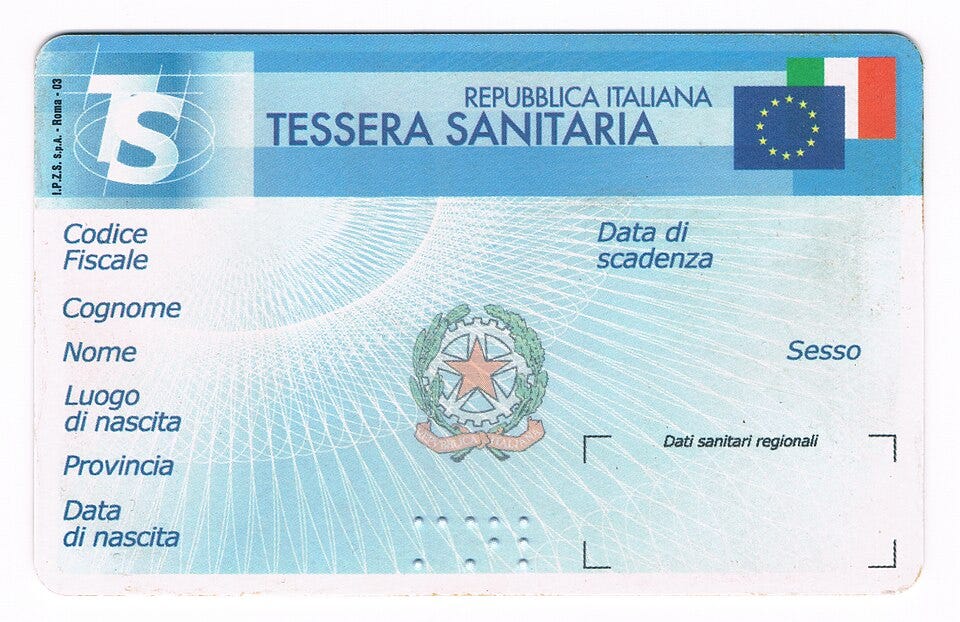
Today the codice fiscale lives on the Tessera Sanitaria, the credit-card-sized Italian health card. That card only comes after you register with the Servizio Sanitario Nazionale (SSN), the Italian National Health Service, which requires legal residency and a permesso di soggiorno or equivalent.
A non-resident applying through a delegate, a consulate, or a quick visit to the Agenzia in Italy gets the PDF version and nothing else.
Print it. Save it on your phone. Email it to yourself. The PDF has full legal validity for every transaction the card would cover. Notaries, banks, real estate agents, and the Agenzia itself all accept it without question.
The barcode on it is the same Code 39 barcode that’s on the plastic Tessera Sanitaria, so a pharmacist or any reader can scan it directly off your printout if needed.
Once you actually move to Italy and enroll in the SSN, they’ll issue you the Tessera Sanitaria, which arrives by mail to your registered address. It’s valid for six years (or matched to your permesso di soggiorno if shorter), and renewed automatically. Until then, the PDF is your document.
The Other Documents and Why You Don’t Need Them Yet
A note on the carta d'identità and the CIE (Carta d'Identità Elettronica). These come up because foreigners often confuse them with the codice fiscale or the Tessera Sanitaria.
They're separate documents and they're not for non-residents. The carta d'identità is the Italian national ID card, traditionally a paper booklet, now issued in electronic form (the CIE) since 2016, with a chip, biometric data, and the holder's codice fiscale printed on the back.
It's available only to Italian citizens and to foreign residents legally registered with an Italian comune, and it's issued by the comune itself, not by a consulate or the Agenzia delle Entrate.
A non-resident American or Canadian can't get one, and won't need one: your passport functions as your ID for every purpose during a visit or pre-arrival. Once you actually move to Italy and establish residency, you’ll become eligible to get a carta d’identità as well.
One Last Thing
Italy doesn’t particularly want you to need a codice fiscale unless you’re committed. The system rewards people who show up, physically or through someone they trust, with quick turnarounds. It “punishes” people trying to do everything remotely from a consulate inbox.
If you’re serious about a move or buying property, the codice fiscale is step one. It’s also the step you should do early, before you have a lease to sign or a notary deadline to hit. Do it now, while nothing depends on it. The whole thing becomes easier when it’s not on fire.
Are you considering getting a codice fiscale? Or have you been through the process already? Let me know in the comments.
Frequently Asked Questions
Do I need a codice fiscale before I travel to Italy?
Only if you’re signing contracts, opening bank or phone accounts, or closing on property.
If you’re going as a tourist and not in a rush to sign anything, you can get the codice fiscale at any Agenzia delle Entrate office once you land.
Non-EU citizens applying for a long-stay visa often, but not always, receive the codice fiscale during the visa or permesso di soggiorno process.
How long does it take to get a codice fiscale?
Immediate at an Agenzia delle Entrate office in Italy, generally under a week through a delegate in Italy once the apostilled POA has arrived, and anywhere from a few weeks to several months through a consulate, depending on the location and time of year.
Canadian consulates currently move relatively fast. Apostille turnaround in your state or province of residence is often the real bottleneck.
Can I use one of those online codice fiscale generators?
For casual purposes where someone just needs to type sixteen characters into a form, maybe. For anything official, no.
Those generators calculate the code based on the public algorithm, but the Agenzia delle Entrate maintains the actual register and handles collisions. Only an officially issued certificate is valid for notaries, banks, contracts, or the tax office. A generator-produced code will fail the first real check.
Also, many of those generators assume your place of birth is in Italy and won’t work if you are born elsewhere.
Does the codice fiscale expire or need updating?
Never expires. Valid for life. If you legally change your name, you can apply for a new code aligned with the new name. Otherwise, you get one, and you keep it for life. Address (or even citizenship) changes don’t affect the code.
Do I need a codice fiscale if I’m just thinking about moving to Italy?
No. A codice fiscale matters only when you’re about to do something concrete that requires one, like signing a lease, opening a bank account, closing on a property, or registering with the public healthcare system. Wait until you have a real reason or one upcoming reasonably soon.
And if you’re applying for a long-stay visa or pre-enrolling at an Italian university, the code is part of that process anyway.
Do I have to file taxes in Italy if I get a codice fiscale?
No. Having a codice fiscale doesn’t make you an Italian tax resident, doesn’t trigger any filing obligation, and doesn’t put you on any list. Tax residency in Italy is determined separately, based on where you actually live.
The standard rule under Italian law is that you become tax resident if you spend more than 183 days a year in Italy, register your residence at a comune, or have your “centro degli interessi vitali” (center of vital interests) there.
None of those are triggered by holding a CF. Americans in particular hear “tax code” and start worrying. The codice fiscale is closer to a Social Security Number than to a tax filing. Many foreign nationals hold one for years without ever owing Italy a euro.
What are the downsides of getting a codice fiscale?
Almost none. The code is free, lifelong, doesn’t expire, and creates no obligation by itself. The realistic downsides are practical: time and money spent on the apostille, possibly a fee to a delegate service. There’s no scenario where having a CF actively hurts a non-resident. The risks come from what you do with it (signing contracts, declaring residency, taking on a job), not from the code itself.
What if I’m an EU citizen, like a Dutch or German national?
The process is simpler. EU and Schengen citizens can apply with just a valid passport or national ID card, and no power of attorney apostille complications.
You have three options: walk into any Agenzia delle Entrate office in Italy with your ID and the AA4/8 form, apply through your nearest Italian consulate at home (the consulates serving major Dutch, German, French, Belgian, and other EU cities all process EU citizen requests routinely), or delegate someone in Italy with a simple power of attorney that doesn’t need an apostille between EU member states.
The “try a delegate first” pressure that some consulates apply to non-EU applicants doesn’t really apply to you. EU citizens are processed as a matter of course.
Understand Italy before you arrive.
New posts every Monday, Wednesday, and Friday: cultural pieces and step-by-step guides for people planning a move.
Paid subscribers get every post; free subscribers get a large selection.
I had the issue with the name attached to my codice fiscale not matching my passport (passport has my middle name and the codice fiscale didn’t). I didn’t know about the issue until I went to the anagrafe to register for residency and they couldn’t do it because of the mismatch. By that time I had already used the codice fiscale to register my lease and a number of other things “official”. Luckily, adding my middle name didn’t change the codice at all so a simple correction at the agenzia was all that was needed. It takes some getting used to now having to go by both my first AND middle name for everything here!
I am an Italian citizen(jure sanguis , so I unfortunately don’t speak Italian). Probably in 2013 when I spent some months in Rome, I got a Códice Fiscale, and you reminded me to take a look for it.
Alas, I seem to have no record of it. I never actually used it. Any idea how I would find out that number? If I use an online generator would it give me the actual number?
Thanks for your informative posts and any help you can offer.