
The Cogne Murder: Italy’s First Trial by Television
The Cogne murder took a three-year-old’s life and convicted his mother. It's also the cultural watershed that taught Italian TV to turn a trial into theater.
Italy with Antonio. Honest guides for moving to, traveling in, and understanding Italy from a native Italian. Three articles a week, with deeper resources for paid members. Join 1,500+ subscribers.
Montroz (in the town of Cogne) is a hamlet in the Aosta Valley. Think peace, fresh air, and snow-capped roofs.
A three-year-old was bludgeoned to death here.
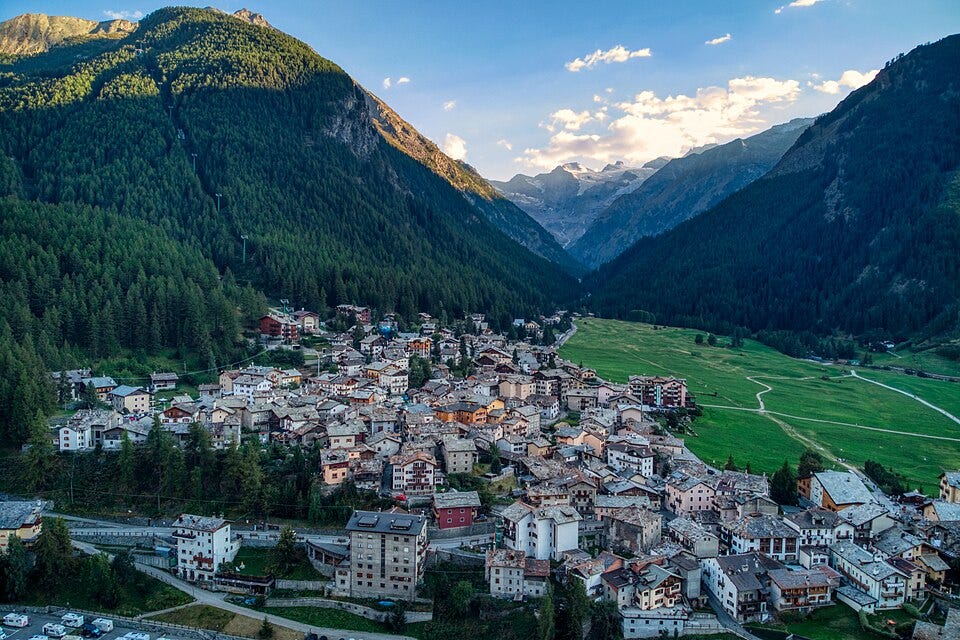
A little after 8 am on the morning of the 30th of January 2002, a local woman named Annamaria Franzoni started the usual school-day ritual of taking her eldest son for a short three-hundred-meter walk to the school bus stop.
At 8:28 am, she frantically called for an ambulance. She also placed a call to the family doctor who lived next door. When she had returned home, she went upstairs to discover a gruesome scene. Her three-year-old son, Samuele Lorenzi, was in bed upstairs, covered in blood.
That heartbreaking phone call opened the Delitto di Cogne (the Cogne Murder). It also led to the most followed crime story Italy has ever seen.
Cogne is the case that taught Italian television a trick it never unlearned: how to turn a dead child and a wrecked family into a cardboard model of a house wheeled onto national television.
The events in Cogne on 30 January 2002
The facts are simple, but the timeline is crucial to the whole case.
Stefano Lorenzi, Samuele’s father, had left for work. Annamaria stayed home caring for their two young boys like any other day. The six-year-old, Davide, went off to school while little Samuele stayed home in bed.
By her own account, Franzoni walked Davide to the bus stop, was away only a few minutes, and came back to find Samuele clinging to life in the parents’ bed with severe head trauma.
His little body had been brutally struck seventeen times. The walls, bed linens, floor, and surfaces of the bedroom were sprayed with blood in the savage attack.
Curiously, there was blood in a basin of water that someone had used to wash his face. Samuele was urgently flown to nearby Aosta by helicopter, but tragically, he was declared dead at the hospital.
Here is the fundamental problem that three courts and the public spent six years debating. The family home showed absolutely no evidence of a break-in. No items of value were taken, damaged, or even moved. The only adult inside the home that morning was Annamaria.
An even more challenging aspect of this case was the narrow window of time in which a stranger could have entered, killed a sleeping child, washed the boy’s face, and slipped away unseen. This was, depending on whose stopwatch you trust, somewhere between approximately eight minutes and almost none.
The defense built everything on those eight minutes. An intruder, in and out undetected, in the time it takes to walk a kid to the bus.
The prosecution built its case on this timing and the mother’s blood-stained pajamas and clogs.
The part that outlived the trial
Within weeks, the case stopped being an investigation and became a television format. The case was discussed in bars, living rooms, and every piazza. Every week, more details and speculation were released like a weekly episode in an ongoing crime drama.
On Rai 1, the journalist Bruno Vespa wheeled out a plastico (a scale model) of the Lorenzi home. This detailed model featured rooms, stairs, and a small bed. The model home was built in such a way that a studio audience could easily follow the competing theories like a board game.
His show, Porta a Porta, had found its signature object. Vespa would go on to build plastici for half the tragedies of the next two decades, from Avetrana to the Costa Concordia. Cogne was just the first.
After initial reluctance, Franzoni did the talk-show circuit in an effort to plead her innocence to an entire country. She freely wept on camera. On the Maurizio Costanzo Show, the host drew out of her, on live air, that she was pregnant again. This pregnancy came less than a year after Samuele died.
After one televised interview, with the camera still running, she was overheard asking the crew whether she had cried too much. This very question followed her into the courtroom.
We Italians have a phrase for what this became: giustizia spettacolo, justice as show business. Criminologists turned into regular household names from their TV appearances. The studio became a second courtroom for the viewers, louder than the first and bound by none of its rules.
It’s the same public and argumentative streak that makes Italy relitigate its own twentieth century out in the open. Only here it was targeted at a family in the worst week of its life, with many forgetting it is a real case with a real victim.
If you’ve ever wondered why Italian true crime feels so theatrical next to the American variety, this is the headwater. Cogne is where the country learned it couldn’t look away, and decided it shouldn’t have to.
The pajamas, the clogs, and a forensic first
In Italian, an unresolved crime is a giallo, a “yellow,” after the yellow covers of the cheap Mondadori paperbacks that began in 1929. These affordable paperbacks provided a steady diet of mystery to their hungry audience of readers.
Cogne quickly became il giallo di Cogne without the flimsy cover. Except, legally, it wasn’t a mystery at all. Annamaria was convicted in Aosta in 2004, again on appeal in Turin in 2007, and definitively by the Cassazione (Italy’s supreme court) in 2008.
Franzoni was not taking psychiatric medication and reportedly suffered a panic attack a few hours before the killing. Whether that was significant remains impossible to know. What convicted Annamaria Franzoni, however, was blood, and according to the prosecution’s forensic experts, the specific pattern of it.
The morning of the murder, she had been wearing a set of light blue pajamas and a pair of zoccoli (clogs), and both carried Samuele’s blood. The Carabinieri’s forensic lab, the RIS unit from Parma, argued the stains were spatter, thrown off at the moment of the blows.
According to the prosecution’s forensic experts, these were not the smears of a distraught mother picking up her son, but the telltale signs of a full-blown assault.
To prove this theory, they used bloodstain pattern analysis. They read the size, shape, and angle of each droplet to determine where everyone stood. This technique had barely been seen in an Italian courtroom before.
This made Cogne the case that popularized bloodstain pattern analysis in Italian courtrooms. That’s the part that ages well. The circus that forgot the murdered young victim in favour of television drama is the part that dated badly.
Two things in this case were never settled. The weapon was never found, and theories ranged from a ladle to a fireplace tool, a pan, and just about every other household item imaginable. People speculated for years, but nothing was ever found, and no one established why. The courts convicted her without an established weapon or motive.
People hear “weapon never found” and reach for reasonable doubt. In Cogne, it cuts the other way. The judges reasoned that an outsider to the home would have no reason to carry the weapon off the property and every reason to run. On the other hand, someone living in the house had every reason to make it vanish. Absence became supporting evidence.
My own thoughts after researching (for what it’s worth): the idea of the eight-minute intruder always asked too much. A stranger walks into a locked house, in a hamlet where everyone knows every car, kills a sleeping toddler, leaves not a trace of himself, and takes the weapon, all inside the time it takes to come back from a bus stop. Three courts didn’t buy it, and I don’t either.
That doesn’t mean every question was answered, only that the alternative explanation always required greater leaps of faith.
But I’d rather tell you the science was strong than pretend the case had no holes. To be fair, it had them, and Franzoni has spent twenty years living in them.
Her husband and family, to this day, proclaim her innocence. Stefano never left her side or showed any feelings of doubt about his wife’s innocence.
The villagers turn on the family
Cogne, on any ordinary day, is considered a great place. Shy of fourteen hundred people, it is the gateway to Gran Paradiso (Italy's oldest national park) and sits in a region that lands near the top of Italy's annual quality-of-life rankings for safety and calm.
The village was accustomed to welcoming ice climbers and trail runners, not television crews and crime reporters. That stark contrast is part of why the case detonated the way it did.
Another forgotten aspect was that the Lorenzis weren’t from the valley. They were residents there, but did not have deep roots in the community. Husband and wife both came from the hills around Bologna, hundreds of kilometers south. They had met in Cogne and settled in to start their family. To the villagers, they were new arrivals, not natives.
A remote Alpine community closes fast when locals begin to be pulled into the crime. When the family lawyers began pointing at neighbors, suggesting a local had done it, the village’s sympathy went cold fast.
Feelings of betrayal formed as the new arrivals they previously welcomed began to point fingers at native residents. Franzoni accused a neighbor of direct involvement. She was later convicted of calunnia (criminal slander) over it, though the sentence eventually lapsed under the statute of limitations. The baseless accusation went nowhere, but the damage didn’t.
Cogne, for its part, got the kind of fame no quiet village wants. People drove up to photograph the infamous house. The family eventually left, likely realizing they were no longer embraced by the community, and to be closer to relatives in the Bologna area.
If you visit Cogne today for the majestic Gran Paradiso, the ibex, and the eighty kilometers of cross-country trails, you will quickly discover no locals will bring the delitto up.
In 2014, after her release, Mayor Franco Allera stated, “The news leaves us absolutely indifferent; it is the last of our thoughts. Our community has left this old story behind.”
The place spent twenty years becoming a hiking destination again instead of a crime scene. That’s the local version of justice: being allowed to be a place with its own unique identity again.
Where Annamaria Franzoni is now
Franzoni served approximately six years in prison in Bologna. In 2014, she was moved to house arrest in her family home in a mountain village 40 km away from Bologna.
By 2019, her sentence was formally over, and she has been a free woman for years. At various points, she has assisted the family business by running an agriturismo (a working farm that takes paying guests) with her family. She remains married, and their two surviving sons are now grown men.
She has never confessed. Not once, across three trials, a published book, and a small library of television appearances. Her line has always stayed constant: an intruder killed Samuele.
The Cogne villa has stayed in the family, through a bitter fight with her former celebrity lawyer (the controversial former undersecretary Carlo Taormina) over unpaid fees that at one point put the house under threat of a court-ordered auction.
She has gone back to it periodically. There are reports of her returning to the house where it happened, flowers in the windows, and the garden kept.
The law is finished with the delitto di Cogne. It decided what it could decide, beyond a reasonable doubt, and left the question of “why” frustratingly unanswered.
Sadly, what lingers isn’t the verdict but the plastico. A country watched a scale model of a dead child’s bedroom get wheeled around a television studio and decided it wanted more of that, not less.
Following this, every Italian crime since has arrived with its own model, its own studio criminologists, and its own audience of amateur investigators. “Tutti criminologi” (all criminologists) is a common criticism on social media for the latter.
Cogne is where Italy learned to watch a private and horrible event as a national television spectacle and call it news. The murders are always the story, and the victims the main characters, but sadly, they become secondary to the theatrics.
Italy, minus the filters.
New posts every Monday, Wednesday, and Friday: cultural pieces and in-depth guides for people planning a move or simply in love with Italy.
Paid subscribers get every post; free subscribers get a large selection.


The first time I watched a documentary about a crime in Italy , I couldn’t understand how much the media got involved and how the accused went on TV. In Ireland, no court event is televised. Journalists must stay outside the building and different court rules can be applied, like the name of the accused cannot sometimes be released. It’s jarring seeing what happens in Italy, a circus occurs. Do Italians themselves see a problem with it? Is there a backlash to the media?