


Italy with Antonio. Honest guides for moving to, traveling in, and understanding Italy from a native Italian. Three articles a week, with deeper resources for paid members (including this article as a downloadable PDF and ePub for offline reading). Join 1,500+ subscribers.
Last week I published an article on how to buy Italian books outside of Italy. Within it, I also promised you a ladder of Italian book suggestions from elementary level all the way to challenging material best left for later on in your journey.
Most lists of easy Italian books ignore the two walls you’ll face. Let’s start with those.
The two walls
I don’t speak French, but Italian is a fellow Romance language with some vocabulary and structural similarities. This affords me the ability to guess the meaning of very simple French, but I hit a wall pretty quickly as I have not formally studied or immersed myself in the language.
Let’s put it to the test. I took the following intro from a French children’s book:
Laissez-moi vous raconter l’histoire d’un Poulet. Ses amis l’appellent Petit Poulet. Petit Poulet vit dans une petite maison de poulet normale, dans une petite ville normale.
Without cheating, this is what I think it means:
Let me tell you the story of a chicken. Called the Small Chicken by his friends. Small Chicken lived in a small house of normal chickens, inside a small normal (something).
The real translation is:
Let me tell you the story of a chicken. His friends call him Chicken Little. Chicken Little lives in a normal little chicken house in a normal little town.
I don’t speak French, but Italian mostly carried me through.
Now let’s try the same with the French novel Madame Bovary by Gustave Flaubert:
Nous étions à l’étude, quand le proviseur entra, suivi d’un nouveau habillé en bourgeois et d’un garçon de classe qui portait un grand pupitre. Ceux qui dormaient se réveillèrent, et chacun se leva comme surpris dans son travail.
There it is, the first wall. I recognize some words, but I have no idea what those sentences mean. Something about a boy (garçon) in class (classe). The first wall determines what counts as easy on every list out there. It’s the decoding wall.
Can you translate the marks on the page into concepts in your head? If the author uses dialect, “easy” is out. If they use words even Italian kids wouldn’t know these days, the book doesn’t make the cut. Long, syntactically creative sentences? Out as well.
The mistake is stopping at the first wall, because the second one is more insidious. The wall of depth.
It’s the wall that makes a book with simple words and short sentences inscrutable, because the meaning lives in the silence between what’s said, like melodies that would collapse without their pauses.
The perfect example is one of my favorite novels, A ciascuno il suo by Leonardo Sciascia. It’s a short book. The vocabulary is plain, and a C1 reader will rarely reach for the dictionary. And yet the meaning lives in the words nobody says, in irony that is never spelled out, in the cultural fabric of the Sicily it describes.
You can look up every word and still miss the book.
I’ll present one line from the book as evidence. But first, some context without too many spoilers: a pharmacist and his hunting companion have been murdered. A rumor is spreading that a young girl was the pharmacist’s lover, and the murder might be because of the affair. Her engagement gets cancelled overnight. The prospective mother-in-law visits her to hand back the gifts, and on her way out, she loudly exclaims:
«Ogni male non viene per nuocere. E non potevano ammazzarlo prima che mio figlio si infilasse in questa casa?»
A B2 reader can translate every word:
Every cloud has a silver lining. And couldn’t they have killed him before my son got himself into this house?
Objectively, they won’t even need a dictionary for this, as long as they are familiar with the common proverb. And yet, if the translation is all they took from it, they’re missing the sentence.
What the words don’t spell out is how in the Sicily of the time, the honor of the fiancé was on the line. How a whisper would permanently label the girl as a harlot and her man as a cornuto (a cuckold).
How the importance of this perception is greater than the life of a murdered man, so much so that she wishes he had died earlier. And above all, the importance of delivering it loudly to the neighbors within the warmth of a popular proverb.
The vocabulary was the easy part. The meaning behind it is the wall that blocks you.
I didn’t want to rely on my opinion alone and tell you, “trust me, bro.” So I did something slightly overzealous for a simple recommendation list: a morphological analysis of each book I wanted to recommend. Sentence length, word frequencies, density of each tense, and Gulpease score, the readability index Italian schools use. The full results are in the table below.
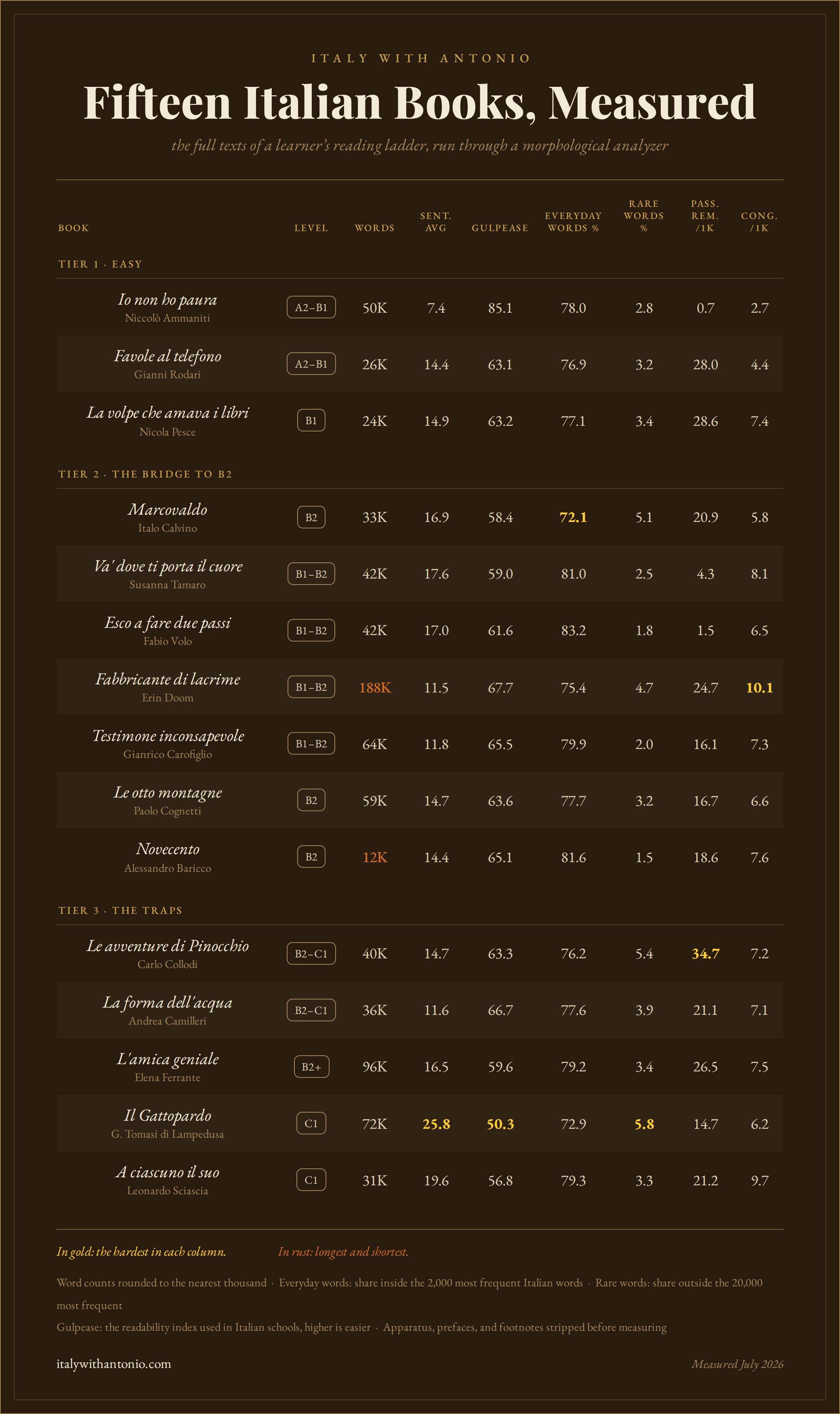
This largely led to a confirmation of my intuitive understanding of the relative difficulty of each book, but also a couple of interesting discoveries I’ll talk about.
The ladder below is built with the two walls in mind, and divided into three tiers. Tier 1 has no walls worth mentioning. Tier 2 raises the first wall to a height you can still climb. Tier 3 is the trap: prestigious books you will be tempted by, guarded by a wall of the first or second kind, too tall and too slippery for most learners. Tackle them if you’re a comfortable C1 reader or come back to them when you’re ready.
For each book, I’ll show you the Common European Framework of Reference (CEFR) level based on my own judgment as a long-time Italian teacher and the morphological measurement I did on the books. (If you don’t know where you stand, test your Italian level on Linguetto for free.)
Tier 1: Easy Italian books
Read these books extensively. A second reading at this level often teaches you more than the first. Don’t worry about looking up every single word. The goal is flow and getting the gist of things. Use the dictionary only when a specific word you don’t understand is critical for the plot.
Graded readers (A1-C1). These are books written for learners and labeled A1 to C1. Alma, ELI, and Black Cat publish full series but are mostly found in Italian stores. Olly Richards’ Short Stories in Italian for Beginners is the version you can likely grab at your local bookstore. If your reading comprehension is not yet at B1 level, I’d focus on these. Get the paper versions and annotate them as you need.
Io non ho paura by Niccolò Ammaniti (A2-B1). The story is told by a child, so the language is disarmingly simple. The topic and emotional load are heavy, but the Italian within is objectively easy. Italian kids read it in middle school. Pair it with Salvatores’ 2003 film.
Favole al telefono by Gianni Rodari (A2-B1). A traveling salesman calls his daughter every night and tells her one story. Simple language (it’s meant for kids) and short stories capped at two pages. This makes it accessible despite the playful made-up words here and there that you’ll need to watch out for.
La volpe che amava i libri by Nicola Pesce (B1). A fox in the Siberian taiga steals books from the village to read through her hibernation. It’s a modern fable some reviewers argued was “inspired” by a Russian tale. Meant for kids but appreciated by adults as well. At any rate, this one is great to master passato remoto. Of the 15 books I measured, only Pinocchio uses this tense more often. Bonus points to this book for being available as a cheap Social DRM ePub.
One more move that could pay off: read the Italian versions of books you already read in your native language. The Italian is often simpler due to fewer native idioms, plus knowledge of the plot will assist your understanding. Don’t consider it cheating. It’s a smart hack.
Tier 2: the bridge to B2
Dictionary out, folks. We are now entering first wall territory. The effort to get through these books will pay dividends and greatly expand your vocabulary.
Marcovaldo by Italo Calvino (B2). Twenty short stories of a few pages each about a laborer’s adventures in a northern industrial city. Everybody classifies this as an easy read, as it is meant for Italian readers 9 and older; yet, my analysis shows that it uses the lowest percentage of everyday words of all fifteen books on the list.
The real wall here takes dictionary work because Calvino names precisely everything in the city: plants, tools, birds. You’ll need the dictionary on page 1. Re-read each story before moving to the next.
Va’ dove ti porta il cuore by Susanna Tamaro (B1-B2). A grandmother, aware of her imminent death, writes one long letter to her granddaughter who’s traveling to America. The first wall is moderate, but understanding the full depth of the emotions and family dynamics introduces a mild second wall that earns the B2 in the estimated rating. This was big in the 90s, so you’re also reading a piece of modern culture.
Esco a fare due passi by Fabio Volo (B1-B2). Nico is a radio DJ allergic to adulthood, but life doesn’t care about his reluctance to accept responsibilities. This book is very conversational. Italian critics don’t take Volo seriously. Ignore them. He’s not Cesare Pavese or Umberto Eco, but his books are perfect for teaching you the language.
Fabbricante di lacrime by Erin Doom (B1-B2). This is an interesting one. It’s a gothic romance that came out chapter-by-chapter on the Wattpad social writing platform (the one where a lot of questionable romance novels appear). Yet, it became the best-selling book in Italy in 2022, and the 2024 Netflix adaptation was the first Italian film to top the platform’s global chart for non-English-language movies.
If the genre appeals to you, this is a great choice because the prose is simple, the pages turn themselves, and the book is relatively large. Which means it gives you volume, and that’s exactly what you need at this level.
Plus, it serves as a good introduction to congiuntivo, having the highest density of the tense of all books on the list.
Testimone inconsapevole by Gianrico Carofiglio (B1-B2). A legal thriller in Bari, written by a former anti-mafia prosecutor. It’s credited with inventing the Italian courtroom novel genre. The language is formal but also repetitive, which is quite useful for your learning purposes. It’s the first in a series, so if you enjoy it, you’ll have plenty more to chase it with.
Le otto montagne by Paolo Cognetti (B2). Two boys, one from the city and one from a hamlet under Monte Rosa, establish a friendship that develops at altitude each summer. It won the Strega Prize in 2017, the highest literary award in Italy. It’s a serious book you can brag about having read. The writing is excellent, but the sentences are sparse and relatively accessible for a B2 reader. Pair it with the slow but also excellent movie.
Novecento by Alessandro Baricco (B2). A monologue about a talented pianist adopted by a ship worker. Born on an ocean liner, he never gets off the ship. Only 66 pages, yet full of lyricism. The quickest read on this list for a B2 reader. Pair it with the film, La leggenda del pianista sull’oceano, for full emotional understanding.
Tier 3: the traps
We are now in the section where the walls get tall. These books are a trap, or at least a challenge, as they look approachable but they are not. When one of them stops you, make note of which wall stopped you, as the fix is different depending on which.
Le avventure by Pinocchio by Carlo Collodi (B2-C1). This is the most recommended beginner book on the internet, and it’s a flat-out terrible recommendation for a beginner. Unless you read a simplified version, Pinocchio combines 1883 Tuscan words that Italian kids wouldn’t understand with the highest use of passato remoto on the list (a tense that is largely being disused by modern Italian, especially when spoken).
La forma dell’acqua by Andrea Camilleri (B2-C1). Camilleri’s series of books on Inspector Montalbano is extremely popular in Italy. On the surface, it’s an accessible series of books, but for a foreign learner this is the case of a tall and strong first wall. Camilleri mixes Italian and Sicilian dialect. The analyzer found one word in 25 to be outside of the Italian vocabulary it used. And even that undersells the linguistic difficulty. For example, Camilleri uses the word “spiare” (to spy) to mean “to ask” as Sicilian dialects do.
L’amica geniale by Elena Ferrante (B2+). L’amica geniale series developed into four volumes. It’s now an international bestseller that was adapted into a TV series as well. The language is relatively simple, so the books remain approachable by less fluent Italian readers. However, this is pure second wall. The Naples that permeates each novel must be experienced in person to truly understand the novels. A B2 reader can begin to understand the unspoken messages and the social fabric assumptions. Below that level, you miss much of the book.
Il Gattopardo by Giuseppe Tomasi di Lampedusa (C1). This book was rejected by Einaudi and Mondadori. The author died, and a year later, Feltrinelli published it. It became the best-selling novel in Italian history. Lampedusa never got to see it. Nor did he, obviously, see how successful the Netflix series became in 2025, leading to a new wave of international readers.
This book captures both walls. It uses long sentences with relatively difficult words. The analysis shows it is the most difficult book, linguistically, in the whole list. But the difficulty doesn’t end there. The book mourns something that’s never said outright. The historical context is captured but never fully spelled out. Nor is the Sicilian mindset that justifies the characters’ actions.
It takes a genuine C1 reader to tackle this.
A ciascuno il suo by Leonardo Sciascia (C1). One of my favorite novels and what inspired this article. A shy professor, school smart not street smart, naively gets interested in the circumstances of the death of two acquaintances in a small Sicilian town. He starts asking questions the locals would rather not be asked.
As mentioned earlier, it’s a short book (115 pages) with plain, standard vocabulary. The sentences, though, run long, and the Gulpease score sits near the bottom of the list, so a first wall does exist to some degree.
Still, none of that is what truly stops you. You can clear every word and every long sentence and miss the whole book, because the second wall is very tall. And wall two does not show up on a morphological analysis.
What this demands is not more Italian; it is more Sicily.
How to climb the two walls
Track which wall stopped you as you approached these, because the fix is different. If the meaning of words or dense syntax throws you, you need more pages at your current level. Tackle more books on the list.
If you understand each sentence but the meaning of the book remains foggy, you might need more Italy. Watch more movies, read the newspapers, dive more into its history, visit the country if you can. You need to acquire more of the context that supports those sentences.
Then one day you will reread A ciascuno il suo and hear the pauses, the omertà in the air, the irony never spelled out.
That is the day the second wall comes down.
I didn't even get My Brilliant Friend in English. I bought it in Italian and reread the first two chapters alternately in Italian then English four times and suddenly I figured out what the authors was trying to say. But I didn't have the heart to keep going at A2... I'm hoping one of these choices might be a better match!! Thank you!
Super helpful, thanks!
I'm a B1-B2 reader and I ran into those devilish "2nd Wall" issues you raise when I recently read "La briscola in cinque" by Marco Malvaldi. Slang, jokes, specialized vocabulary, a hair of tuscan dialect...oof! I almost gave up - set it aside for 6 months before finishing it - and despite my love of gialli, won't be reading another in that series any time soon. On the other hand I ripped through "Il Custode" by Niccolò Ammaniti because the writing was reasonably simple despite a complex theme.
How do you think "A ciascuno il suo" compares to "Una storia semplice" in terms of accessibility? I loved "Una storia semplice" but it was indeed slow reading.