


A Substack bestseller, Italy with Antonio offers honest guides for moving to, traveling in, and understanding Italy from a native Italian. Three articles a week, with deeper resources for paid members (including the print-ready PDF and ePub downloads of this article). Join over 2,000 subscribers!
Everybody knows Italy has deep Catholic roots. Yet Italy has a strange relationship with the Church.
On one hand, the Lateran Pacts of 1929 established several close ties between Italy and the Catholic Church. On the other hand, in 1984, Roman Catholicism ceased to be Italy’s official religion.
It’s the country of endless crucifixes and statues of the Virgin Mary, and also the country that curses God (and the Virgin) with bestemmie (expressions likening holy figures to pigs).
Amidst these contradictions live Italians’ beliefs. A subscriber asked to take a look at the data, and I was happy to oblige.
What made this research challenging is that Istat, the Italian National Institute of Statistics, doesn’t directly ask about religion in its census and stopped tracking religious affiliation decades ago. So I had to tackle it through multiple sources and use the best proxies Istat publishes to figure out the what and where of religion in Italy, as well as developing trends.
On the surface, almost everyone is Catholic in Italy. According to Church figures, about 96% of people in Italy have been baptized Catholic. The trouble with that number is that the Catholic Church tends to baptize babies, and unless you go out of your way to be removed, they never stop counting you even if you don’t practice or believe anymore.
Amusingly, I was baptized around 10. The other kids in school started calling me the Devil when they found out, which understandably accelerated the process of me getting baptized. Plus, Baptism was necessary for First Communion, an important rite most Italian children go through. And being gifted a mountain bike con cambio Shimano (with Shimano shift gears) was always a possibility for First Communion.
Italy is a country that counts olive trees more carefully than believers. So we don’t really know how many people are actually practicing Catholics, but we have two relatively recent numbers that get us in the ballpark.
An Ipsos 2023 survey found that 61% of Italians are Catholic, 7% other Christian, 2% other faiths, and 28% non-religious. That number tells us how people identify, not if they actually attend church regularly. Plus, it only polled about a thousand adults and was capped at people below 75 years old, and we know older people skew more religious.
However, we can pair it with Istat’s finding in 2021: at the national level, 21.2% of the population attended weekly worship. 24.4% in Apulia and only 11.9% in Bolzano. Istat counts attendance at any place of worship, not just Catholic churches, though in Italy the overwhelming majority of it is Catholic.
1 in 5 attending worship services on Sunday is a reasonable floor to count serious Catholics in Italy. And if we are counting the casuals who still identify as a believer but are most likely to attend Christmas Mass, the number likely goes just above 1 in 2.
Disclaimer: everything that follows infers belief from behavior since Istat doesn't ask what religion people identify as. All referenced data is from the year 2024 unless otherwise specified. Some 2024 figures are Istat estimates or provisional.
Kids opting out of religion class
Part of the Lateran Pacts that Mussolini signed gave the Church an hour a week of religious education in Italian schools, to be taught by someone appointed by the Church (a priest, nun, monk, or even a layperson).
Families can opt their kids out of the class. The map below shows the provincial opt-out rates. At the national level, 18.2% of students do.
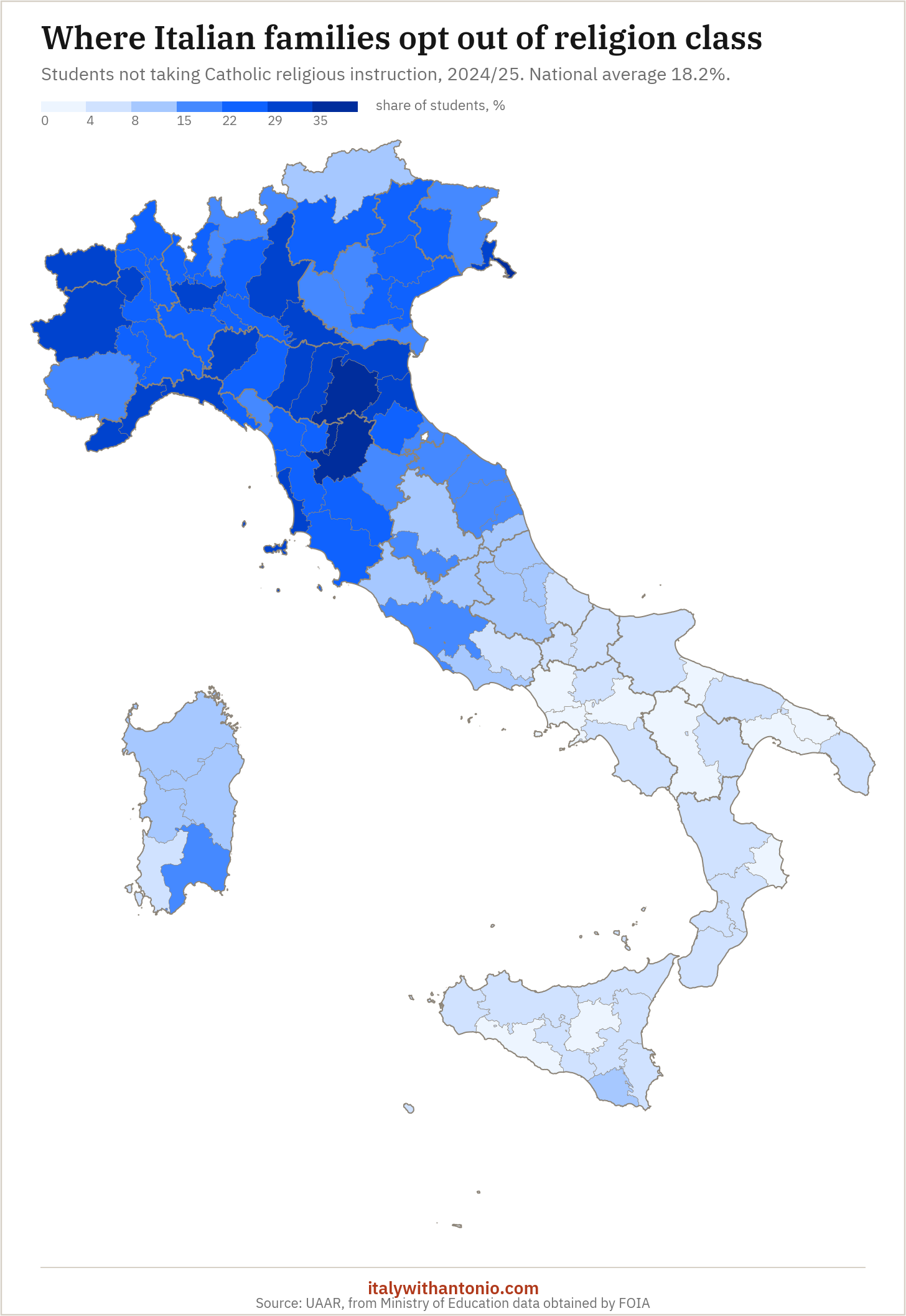
The gap between the north and south is wide. In Florence, 40.3% of students opt out. Bologna, Prato, and Trieste are all above 35%. Yet Potenza sits at 2.7%, Enna 2.8%, Barletta-Andria-Trani 2.9%, and Naples 3.3%.
It shouldn’t come as a surprise to anyone that the south is generally more religious than the north of Italy. Sardinia è l’eccezione che conferma la regola (the exception that proves the rule): Cagliari opts out at 16.7%, closer to the north than to Calabria.
One thing to keep in mind is that the class on offer is specifically Catholic. A Moroccan or Romanian family opting their child out isn’t secularizing; they simply aren’t Catholic. So the opt-out rate measures secularization plus the size of the non-Catholic population, and both of those things are higher in the north. Hold on to that, because it comes back later.
South Tyrol is a strange anomaly. Take Bolzano. We said that only 11.9% of its residents attend service weekly, one of the lowest rates in the country. And still, it has a very low opt-out rate from religion class.
My hunch is that there are other cultural factors at play; for example, religious education being part of the school curriculum in Austria despite the relatively secular nature of the population. But it’s a hunch, and the data has no answers for this outlier.
Do religious people have more children?
This section answers the question I received from the subscriber, more or less directly. Do religious families have more kids in Italy?
Demographically speaking, Italy is an old country that is getting older. The fertility rate at the national level is a mere 1.18.
The following map shows the fertility rate at the provincial level.
