


Italy with Antonio. Honest guides for moving to, traveling in, and understanding Italy from a native Italian. Three articles a week, with deeper resources for paid members (including the print-ready PDF and ePub downloads of this article). Join 1,500+ subscribers.

Facebook groups about migration to and from Italy offer a mezzanine view of cultural differences between countries.
I’m a silent observer, watching people with different faces and different names tell the same stories, which feel like restless ghosts. Familiar ones, as I’ve been through their experiences myself.
A common story is the sociable Italian colliding with Canadian politeness.
You just arrived and start seeing strange social dynamics. Your mastery of the language, or lack thereof, takes the blame for a while, but years pass and that excuse fades. People are courteous, but courtesy does not build friendships.
It’s a bit like the hollow “how are you doing?” It doesn’t mean “come stai?” It means “hello.” The person asking might care about you, but the social script doesn’t know what to do with a real answer.
Extend that idea to other aspects of your social life, and Italians abroad are often caught off guard.
Last night, an Italian couple who moved to Canada complained about it in one of those Facebook groups. They couldn’t understand why people suggested getting together for dinner or grabbing coffee and then never did, or even cancelled on the day of. Multiple people in different social circles. Enough to form a visible pattern for them. The comments largely validated that experience.
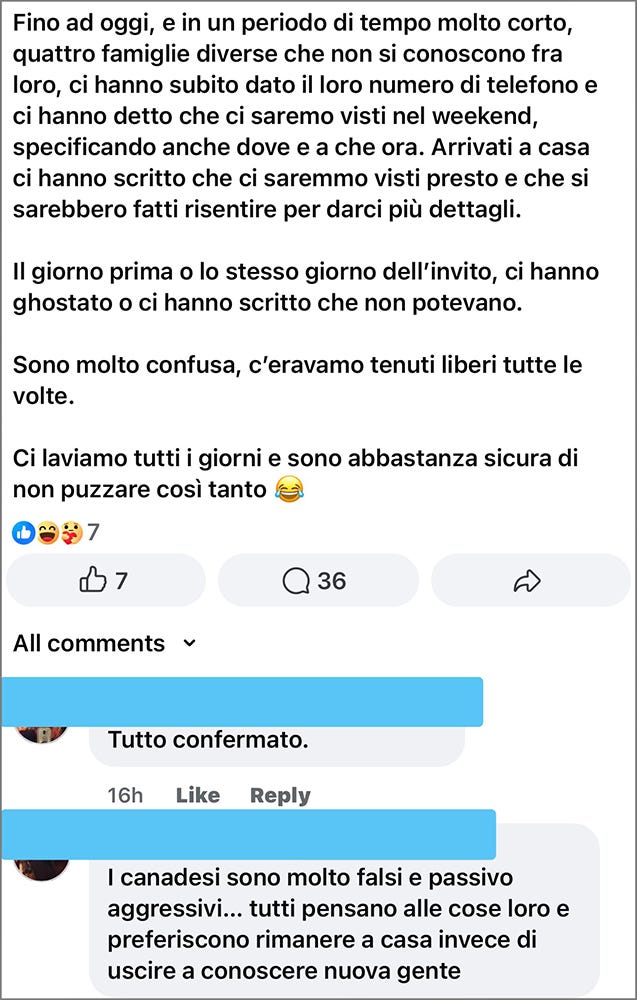
To be fair to Canadians, the cancellations are not indifference. Distance is real, winter is real, and most people here build their lives around work in a way that leaves the weekend as the only unclaimed time of the week.
However, much like “how are you doing?”, “we should grab coffee” is not a social contract. It’s an “I like you,” and if you pry deep enough, it’s an “I like you, but Saturdays are essentially the only free time I have in my week, and I must protect my schedule at all costs.”
It’s not a promise, even if a date and time are set, so most locals shrug when things don’t happen, because everyone raised here reads that social grammar correctly.
The most memorable episode related to this happened a while back.
For context, my fiancée Alicia is so used to fellow Canadians cancelling plans that special preparations, if we are hosting, are left for the last minute, because the risk of cancellation feels remarkably high. The two of us have been left with lasagna and tiramisù for six people after hours of preparation, more than once. (Hey, I’m not complaining; my cardiologist is.)
The downside of this approach becomes evident when people actually follow through. It turns into a stressful scramble. But it is a habit we developed because, in our experience, plans here often remain possibilities rather than commitments.
Back to the story, I met a local Italian and invited him and his family over for dinner.
Alicia approached this like we always do, ready for the last-minute cramming in the remote chance they showed up. I told her, “Baby, Italians actually show up.”
“Are you sure?”
“Trust me, they might be late, but they’ll show up.”
And sure enough, they did show up, and on time. (In fairness, the guy is from the north-east of Italy. If he were from Naples like my relatives, dinner might have been at 9:30 pm.)
Yes, I had to explain to Alicia that Italians actually show up at get-togethers because the experience is not the norm locally.
As I was working on this very article, I received two messages relevant to the conversation.
The first was a Canadian friend cancelling our plans for coffee on Saturday morning. I genuinely laughed.
Thirty minutes later, a second message arrived from someone else confirming dinner for 6:30 pm, also on Saturday. The lovely couple who sent that message are Polish and Venezuelan. I’m highly confident the dinner will happen.
After decades abroad, I’ve noticed that many of the people who became my closest friends were not necessarily from the country where I was living. They were often people who, like me, came from somewhere else and brought different assumptions about what friendship requires.
My theory is that, regardless of nationality, immigrants don’t have the built-in social network the locals assembled in their formative years. So they largely embrace the idea that relationships require showing up and are willing to make the extra effort with new prospective friends.
Still, showing up is the default assumption in Italy. In my experience, Poland and Venezuela fall in the same bucket of countries where a social invitation binds you. Canada sits outside of it.
For people thinking about moving to Italy, this is easy to underestimate. Bureaucracy and wages are the headliners, but nobody warns you about how much of your calendar belongs to other people in a society like that.
If dinner is a promise, then your presence is a promise too. Your cancellation requires a legitimate reason. Feeling a bit tired won’t cut it; you’ll burn your social reputation quickly.
The other side of the coin in a society that values personal interactions is intrusion into your life and your time. For some, it’s social bliss; for others, it’s Kramer barging into Jerry’s apartment unannounced. It’s a trade-off (a fair one, even), but you should be aware of it before you move.
I know expats who relocated to Italy expecting to make lots of friends, then declined invitations or cancelled the ones they accepted, a little too often. Until invitations simply stopped coming.
In Italy, dinner is not just something that happens before an event. Dinner is the event. A three-hour meal with friends is not considered a waste of time. Conversation at the table is one of life’s great pleasures. So it is savored, and nobody asks for il conto (the bill) just because the plates have been cleared.
A friend who watched Perfetti sconosciuti told me he liked it, but felt it wasn’t realistic. “Who sits around the table for a whole two hours?” I told him, in Italy, that’s the most realistic part of the movie.
I don’t think one culture is just better than another. It’s a matter of what each society prioritizes and whether that priority jibes with what you want in life.
I grew up in Italy. To me, “come over for dinner” will always mean showing up and sitting at that table until nobody has anything left to say.
Cancelling on the day of a planned dinner for any reason other than a medical emergency is just rude. Plain and simple.
I'm an American, and I DEFINITELY like one culture better than the other. I think American casualness is rude (and a change from 40 years ago), and a big part of the reason why Americans are so lonely and anxious.