


Italy with Antonio. Honest guides for moving to, traveling in, and understanding Italy from a native Italian. Three articles a week, with deeper resources for paid members (including the print-ready PDF and ePub downloads of this article). Join 1,500+ subscribers.
For those who don’t follow Canadian news, Summerland, the town next to mine, is burning and its 12,000 residents were evacuated overnight.
Where I live, just 20 minutes south, we’ve had PM2.5 readings (fine-particle pollution) over 300 µg/m³ today. For reference, the World Health Organization (WHO) recommends an annual mean PM2.5 of no more than 5 µg/m³.
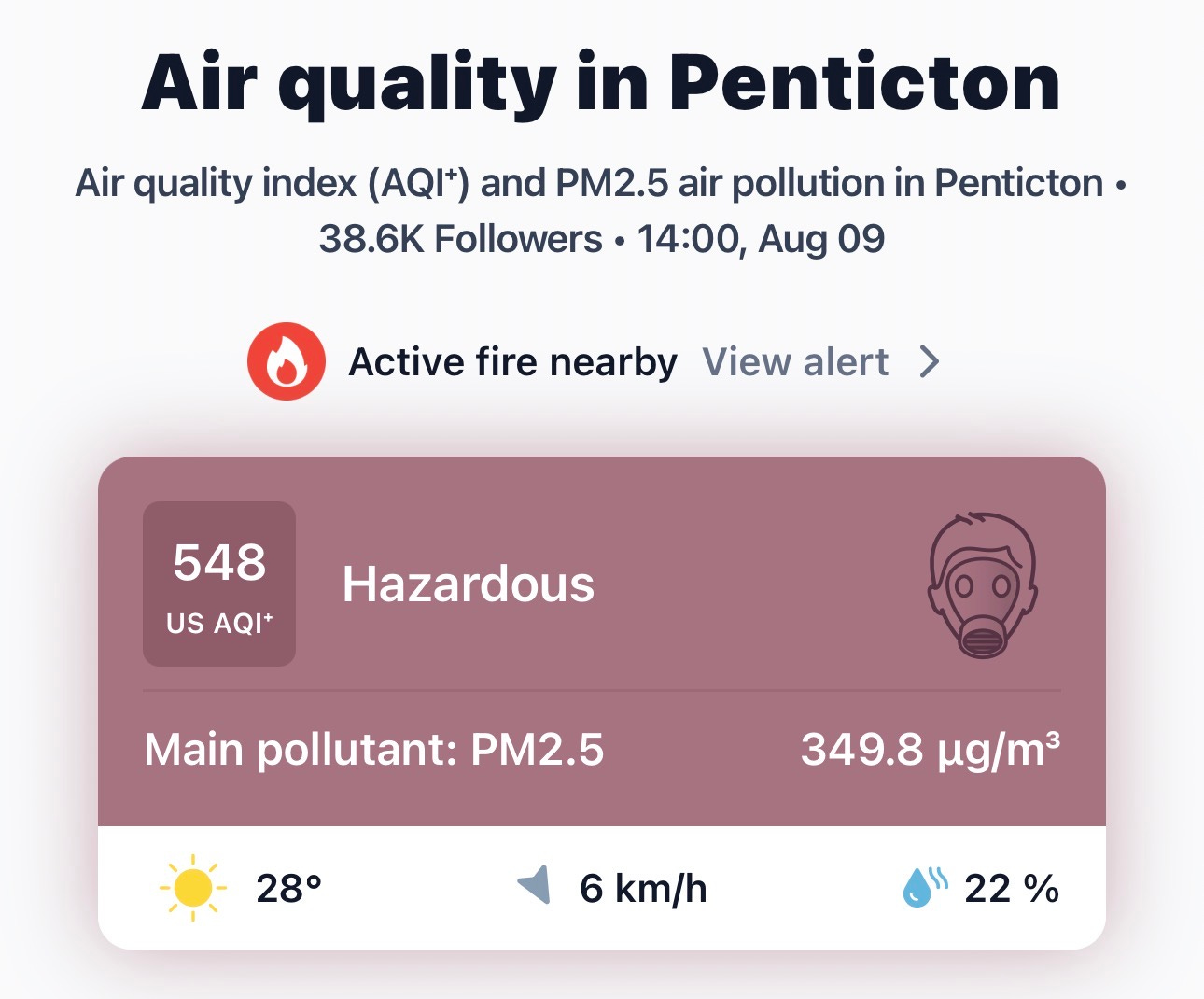
My eyes are burning, my throat stings, and I have headaches. With two air purifiers running 24/7, the house still only manages to keep PM2.5 to a miserable 50 to 70 µg/m³.
This is a case of acute, absurdly high levels of PM2.5, in a place that has low levels when wildfires aren’t around.
Sporadic surges might not give you lung cancer, but they still greatly increase the chance of cardiovascular events, especially for cardiac patients like me.
By the time you read this, I’ll be in a hotel room by the ocean in Nanaimo, breathing fresh air for the first time in 5 days. Acute exposure can at least be escaped.
Italy has a few places where wildfires are a concern (inland Sardinia in particular), but the air quality problem takes a different shape. It’s chronic.
That’s the kind of air quality problem that shaves off years even if you’re healthy. Berkeley Earth equates roughly 22 µg/m³ of PM2.5 over a day to smoking a cigarette. In Milano, non-smokers essentially smoke a cigarette a day.
You can’t temporarily escape it if the baseline is constantly unhealthy.
Like the climate piece before it, this one is essentially a careful collection of region-by-region data. This time, I’ll show you the air quality of the regions’ capitals.
What changed
The European Environment Agency changed its approach in July 2026. It now includes 761 cities and evaluates mortality risk via three pollutants, instead of one: PM2.5 (of course), but also Nitrogen Dioxide and Ozone.
The table
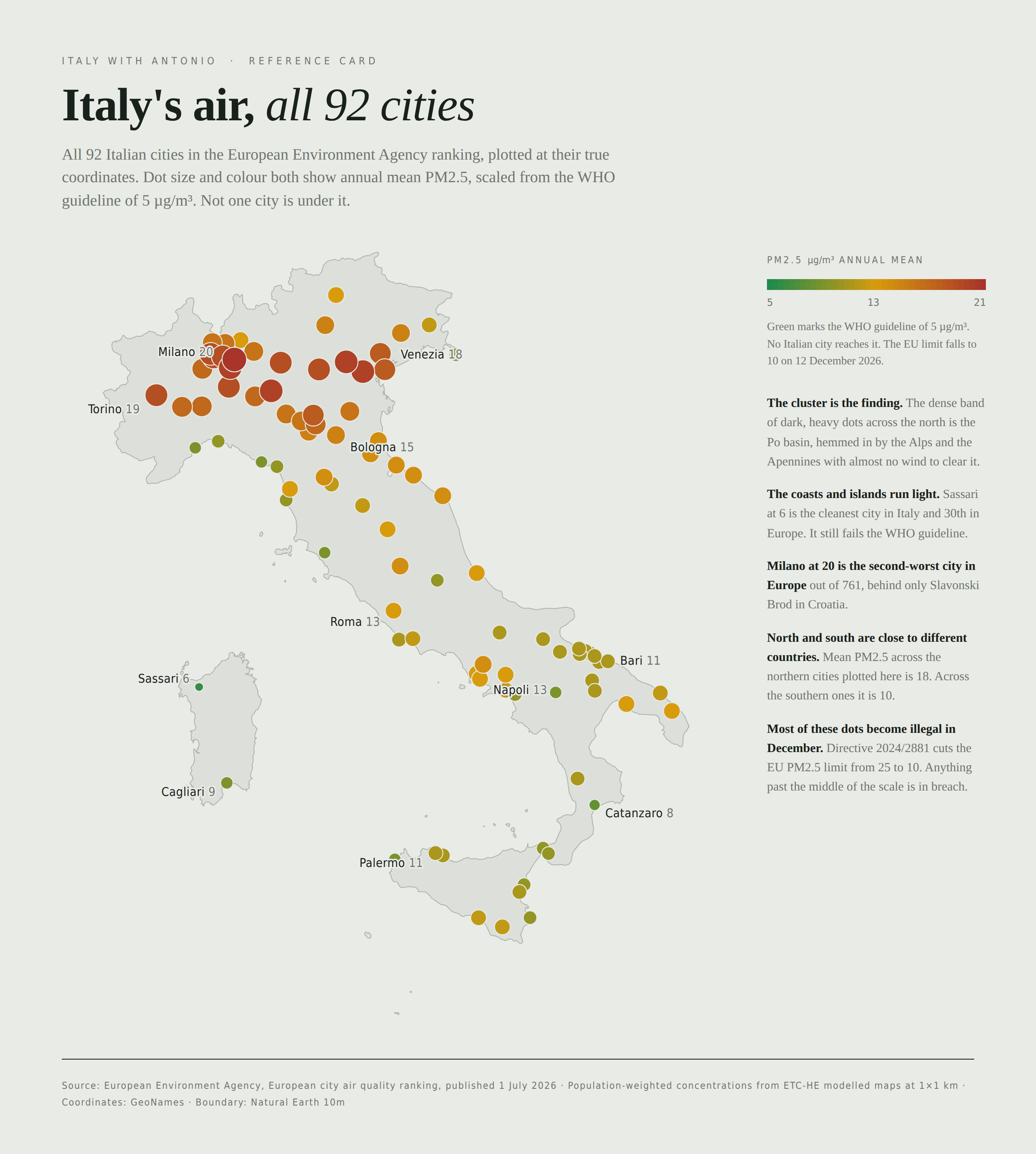
92 Italian cities are on the EEA list. The map below immediately paints a clear picture.
What follows are specific details for the regional capitals, ranked cleanest to worst. Rank 1 of 761 is the best air in Europe (Finland and Sweden dominate the top positions).
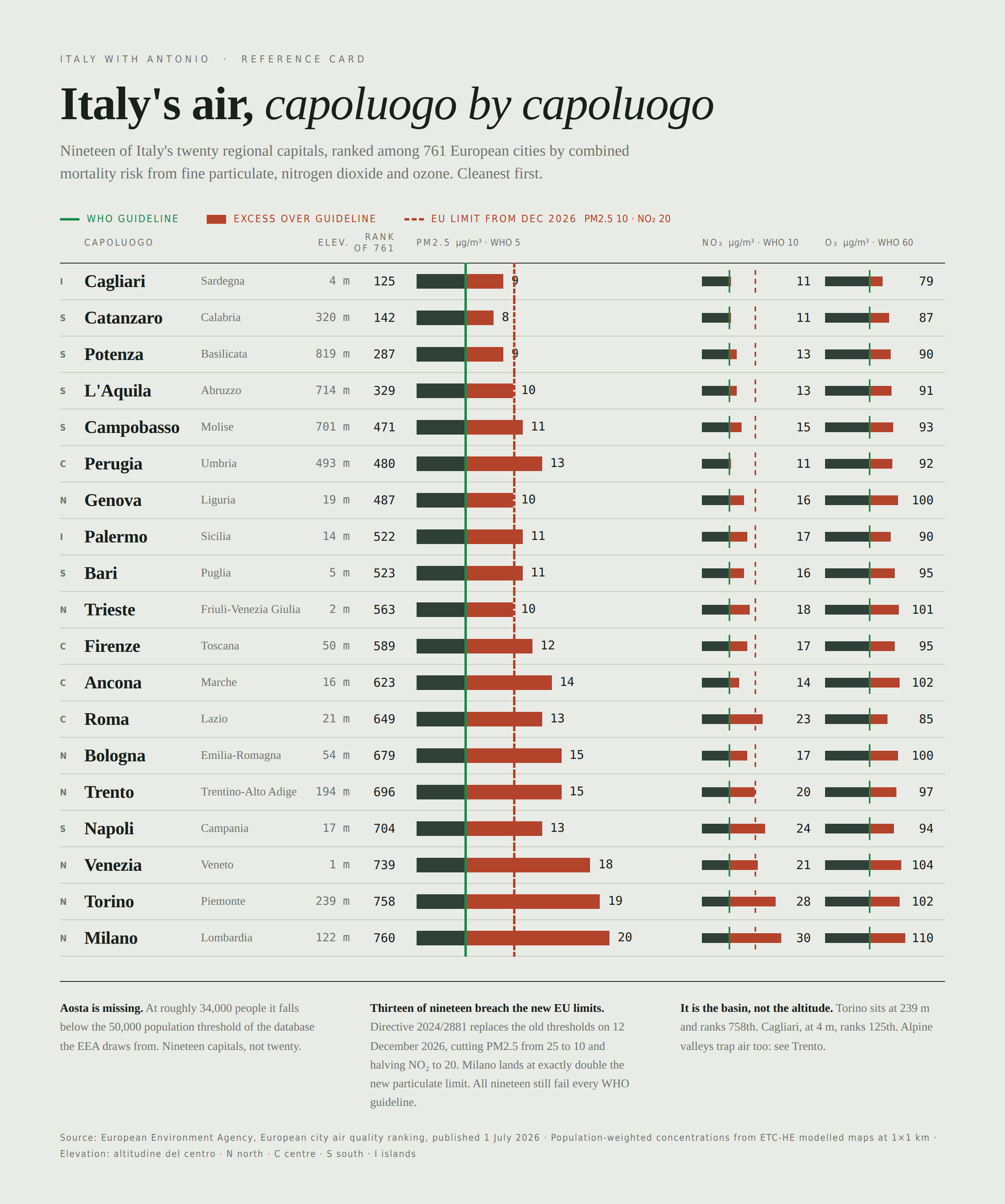
Aosta is missing from the list because, at roughly 34,000 people, it is too small to be part of the EEA database, which targets cities of 50,000+ residents.
A few thoughts
I’ll let you draw your own conclusions from this, but I’d like to point out a few of my thoughts about it.
Every regional capital in the table sits above the WHO health guideline of 5. The same is true of the other two pollutants: 10 µg/m³ for nitrogen dioxide and 60 µg/m³ for peak-season ozone. The cleanest capitals in Italy manage 11 and 79, respectively. All 19 fail all three targets.
The current EU limit for PM2.5, 25 µg/m³, five times the health guideline, is not breached by any Italian city on the list. That changes in December 2026, when the PM2.5 limit drops from 25 to 10, and the nitrogen dioxide one goes from 40 to 20.
13 of the 19 capitals don’t clear both bars. Only Cagliari, Catanzaro, Potenza, L’Aquila, Genova, and Trieste do.
Many journalists treat the EU limit as a health standard, but it was never one. But at least, in December, it becomes a serious one.
Nine out of 12 cities at the bottom of the list are Italian. Every one of them is in the north, specifically the Po basin.
In fact, Milano is the second-worst of all 761 cities in Europe tracked by EEA. The only city with worse air is Slavonski Brod in Croatia.
The highest ozone readings in Italy are Saronno at 114, Bergamo at 111, and Milano at 110, all in the north, all in Lombardia. The north-south gap is striking.
Cagliari, at 4 meters above sea level, ranks 125th. Potenza, at 819 meters, ranks 287th. So altitude is no guarantee either.
What really matters is whether a city sits inside a basin that traps air. Trento is on the floor of an Alpine valley and still manages to have bad air, placing 696th out of 761 (worse than Roma and even Bologna).
Mountain air is clean. The towns where most people live are in the valley at the bottom of it, which doesn’t help them.
Finally, treat these capoluoghi (region capitals) as a ceiling. They generally have the worst air in the area. Comuni (municipalities) nearby will go down from this ceiling the higher up you go in altitude, and the farther you go from the plain, the motorways, and industry.
The short version
If you are moving to Italy, you should consider air quality as a relatively important factor. The data votes for the south, the islands, and the coasts. It argues against the entire Po basin, and even the Alpine valley floors.
Even Sassari, at 6 µg/m³ (30th in Europe, with the cleanest air of any Italian city), is slightly above the WHO guideline.
No Italian city big enough to be on the list is under it.
This post is available for download as a print-ready PDF or as an ePub, which you can read on e-ink devices. Upgrade to gain access.
You live in *Penticton*???
I'm so sorry.
Stay safe!