

Italy’s Liberation Day: Why April 25 Still Divides Italians
A native Italian on what Festa della Liberazione actually means today, why the holiday is still politically contested, and why Bella Ciao is not a pop song.

Italy with Antonio. Honest guides for moving to, traveling in, and understanding Italy from a native Italian. Three articles a week, with deeper resources for paid subscribers. Join 1,000+ subscribers.
Across the road from the bus stop where I used to get dropped off in Montegiorgio, there is a monument to Salvo D’Acquisto. It was placed there in 1993, when I was in middle school.
At the time, I had no idea who he was. You will be forgiven for still not knowing. Stick around, we are going to change that today.
Italy is full of Via Salvo D’Acquisto, Piazza Salvo D’Acquisto, monuments, plaques, and so on. It sounds like a big deal, and it is.
Who Salvo D'Acquisto was
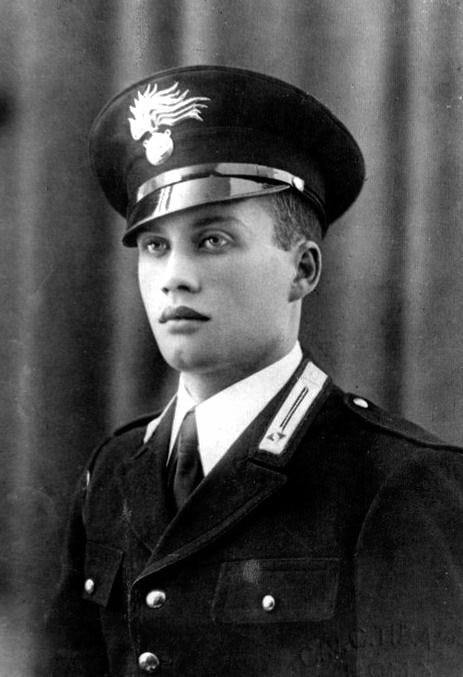
Salvo D’Acquisto was a twenty-two-year-old carabiniere, an officer of Italy’s military police, posted to a station north of Rome, in what is now the comune of Fiumicino.
On September 23, 1943, about two weeks after Italy had signed its armistice with the Allies and the Germans had moved in to occupy the country, a German unit near Palidoro arrested twenty-two local civilians.
The day before, two German soldiers had died when some old abandoned munitions exploded. The commander assumed sabotage. When nobody among the local civilians confessed, he forced them to dig a common grave and line up along it.
D’Acquisto stepped forward and said he had committed the sabotage. He had not. The civilians were released. He was executed by a firing squad. According to the one witness who survived, his last words were “Viva l’Italia.”
He was from Naples. He was also a devout Catholic. Pope John Paul II gave him the title of Servant of God. Pope Francis recognized his offering of life in the canonization process, an important step toward sainthood. Italy gave him the Gold Medal of Military Valour posthumously.
Yet he is not what April 25th commemorates. What it commemorates is part of why the holiday remains controversial eighty-one years later.
What the day is actually for
April 25 is Festa della Liberazione, Italy’s Liberation Day. It marks the date in 1945 when the National Liberation Committee called the insurrection in Milan that would put an end to the German occupation of northern Italy and what was left of the Republic of Salò (Mussolini’s puppet state).
Around 200,000 Italians had joined the Resistenza (the armed resistance). Roughly 35,000 to 45,000 of them died in the process. They were called partigiani, partisans, and unlike D’Acquisto, their contribution came from actively fighting.
That’s what the holiday was built to honor. Freedom from fascism and Nazi occupying forces, but also honoring those who valiantly fought for it. Not every brave Italian of the war years. The armed, organized ones who picked up rifles and attacked.
Martyrdom feels universal in a way armed resistance does not.
Everybody can agree that D’Acquisto was a brave and selfless young man. He sacrificed himself. He saved twenty-two civilians. He died saying “Viva l’Italia.” There is nothing to argue about. You can put him on a postage stamp, eventually a Catholic feast day, name a hundred streets after him, and nobody rightfully flinches regardless of their political inclinations.
The partisans are different. They shot people. They blew up trains. They executed collaborators. They were frequently Communists, Socialists, or members of the Action Party. (Though, there were also many Catholics, monarchists, and liberals in the resistance.) They won a war that left Italy on the losing side of its own alliance choices.
That is a more complicated thing to memorialize, and Italy has spent eighty years wrestling with its mixed feelings about it.
The contested part
Italy has never fully made peace with its own twentieth century. The partisans won the war. They also wrote, in large part, the 1948 Constitution that still governs this country. But the postwar amnesty of 1946 left most of the fascist apparatus intact. The prefects stayed. The magistrates stayed. A neo-fascist party, the Italian Social Movement, was founded in 1946 and sat in parliament for the next half century.
That party dissolved into National Alliance in 1995, and a few of its members ended up eventually founding Fratelli d’Italia, Brothers of Italy. It currently runs the country.
The prime minister, Giorgia Meloni, does not use the word “antifascist” to describe herself and has been careful to mark April 25 in generic terms about freedom and democracy rather than in the specific terms the day was built to honor.
Small examples matter here. In 2024, the president of the Italian Senate, Ignazio La Russa, spent April 25 laying a wreath in Prague for Jan Palach. A perfectly defensible gesture on any of the other 364 days of the year.
The same week, the state broadcaster pulled a Liberation Day monologue by the novelist Antonio Scurati. The official reason, eventually, was a contract dispute over 1,800 euros. Scurati read the monologue anyway, from Piazza del Duomo in Milan, holding a red carnation.
The Italian right has been working, patiently and with considerable skill, to reframe April 25 as a broad celebration of freedom that does not require anyone to condemn fascism by name or honor the partisans by name. That is not a neutral position. No matter how you see it, it is a presa di posizione (taking a stand) that has consequences for the way Italian kids learn history in school.
About Bella ciao
You probably know the song.
If you are under forty and not Italian, you most likely know it from La Casa de Papel, Money Heist, the Netflix series where it plays as a kind of heist anthem for charismatic thieves in red jumpsuits.
Or from TikTok where it spread without any knowledge of its heavily politicized past.
Bella ciao is complicated even inside Italy. Historians argue about how much it was actually sung during the resistenza itself. The honest answer is: less than you would think. It became canonical mostly in the 1950s and after, partly through folk revivals and partly through a famous Spoleto Festival concert in 1964. The lyrics are a partisan’s goodbye. “If I die a partisan, you must bury me, up in the mountain, under the shade of a beautiful flower.”
Italians sing this at the funerals of partisan veterans, at Liberazione ceremonies, at protests against governments, and yes, occasionally at soccer-adjacent events for no defensible reason. It is not a pop song.
A few Italian artists have, at different times, publicly declined or pushed back on performing Bella ciao, usually to avoid its political history. For example, Laura Pausini has at times said she prefers not to associate her work with explicitly political songs. Apriti cielo (All hell broke loose).
The globalization of Bella ciao through Netflix and TikTok has been good for the song’s reach while dulling a little its meaning for international audiences.
Why this matters if you are moving to Italy
You cannot understand modern Italian politics without understanding why April 25 is still contested eighty-one years later. If you arrive picturing a settled postcard country, you will be confused by the first real political argument you witness while eating an incredible dessert at dinner.
This country is not settled. It is still arguing with itself about whether the men who lined civilians up beside ditches deserve to be condemned by name, or whether it is kinder to fold that whole period into a comfortable “excesses of both sides.”
That fight is alive. It shows up in school curricula, in court cases, in which streets get renamed and which ones do not, in who gets invited to speak on April 25 and who flies to Prague.
To live in Italy is to live inside that argument, whether you brought opinions with you or not. Most long-term foreigners I know arrive neutral. They have an opinion within a year.
One last thing
Every Italian town has a Via Salvo D’Acquisto. Many of them also have a Via dei Partigiani, or a square named for a specific local partigiano who was tortured, or shot, or never came back from the hills. One of those signs gets nods from everybody. The other one, not always.
April 25 is the day the second sign gets its red carnations.
If you’re new here: I write about Italian culture and what it’s actually like to visit or move to Italy, from a native Italian’s perspective. If you want a place to start, Which Region of Italy Should You Move To? is probably a good introduction to how I think about this country.
When I arrived here a few years ago, in Bologna of all places, I began learning the nuance of the politics here. I was only in Italy for a few months at that time and Bologna exploded in April! I was born in the US and know the broad strokes of history of course but didn’t understand / comprehend the still open wound that the war brought. And another layer is that as I nomad around Italy looking for home, I’m fascinated that the impact is so different in different cities. I guess it should be obvious that political views vary widely but the political distance between one city and another around the war is astonishing.
Great piece. Such a complicated history, very well-explained. I've been trying to educate myself on some of this, but it seems there's always another layer. And at the core, the stark class distinctions rooted in the padrone/peasant relationship. It's not a very old country--but its problems are.