


Italy with Antonio. Honest guides for moving to, traveling in, and understanding Italy from a native Italian. Three articles a week, with deeper resources for paid members (including a downloadable PDF and ePub of this article for offline reading). Join 1,500+ subscribers.
Pop quiz: who built the first programmable desktop computer?
It wasn’t a company in America. It was one in a humble Piedmontese town of 22,000 people.
The machine was the Programma 101 (shown below), widely credited as the first. It entered the market in 1965, years before Xerox PARC built the Alto and more than a decade ahead of the Apple I. Before Silicon Valley even had a name.
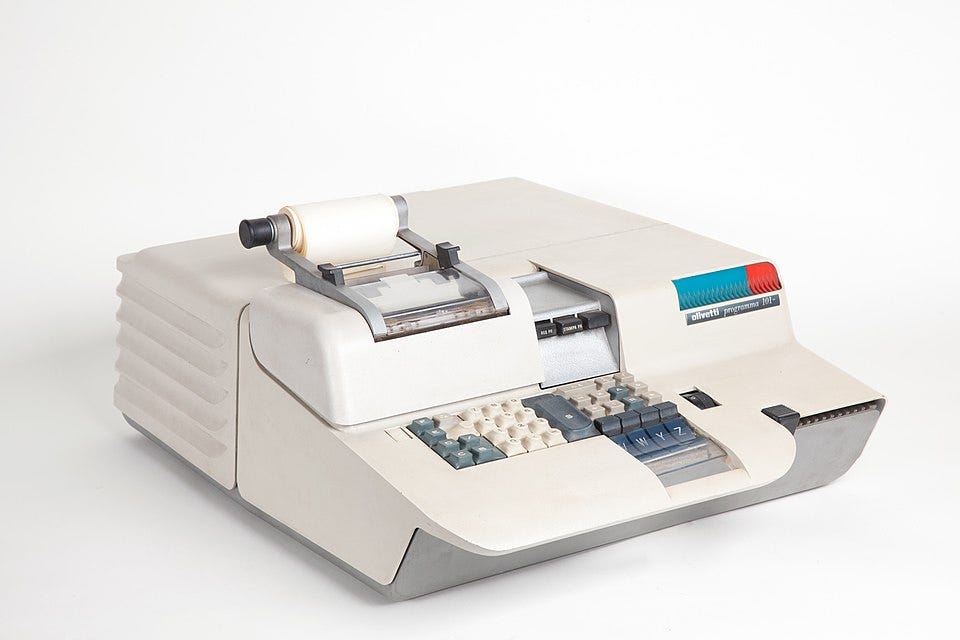
It weighed a hefty 35.5 kg (78 lb) and cost $3,200 (roughly $32,000 today), yet it sold a respectable 44,000 units. The majority of sales were to the United States, and even NASA bought ten. Programma 101 was used by engineers working on Apollo 11 calculations.
The real story of Olivetti is how a factory in Ivrea produced it. For sixty years the place was run as if it were a city, and by an industrialist who was elected mayor to test his own theories. The technology fell out of the philosophy, not the other way around.
Who founded Olivetti, and why in Ivrea
The Olivetti company was registered in Ivrea, a town in the Turin metropolitan area, on 29 October 1908. Camillo Olivetti, the founder, was a Jewish electrical engineer born and raised in Ivrea.
Camillo’s creativity and entrepreneurial tendencies ran in the family. His father, Salvador, was a textile trader, while his maternal grandfather was a banker.
His father died when Camillo was only 12 months old. Despite the challenges, his mother Elvira provided him with a good education, sending him to boarding school and eventually technical school, where he excelled.
His aptitudes and education led him toward industrial engineering, fluency in English, and extensive travel abroad. On his trips, he even met Thomas Edison.
His final stretch of time in the US was spent at Stanford in the 1890s as an assistant electrotechnical engineer before returning home to Italy and starting his company.
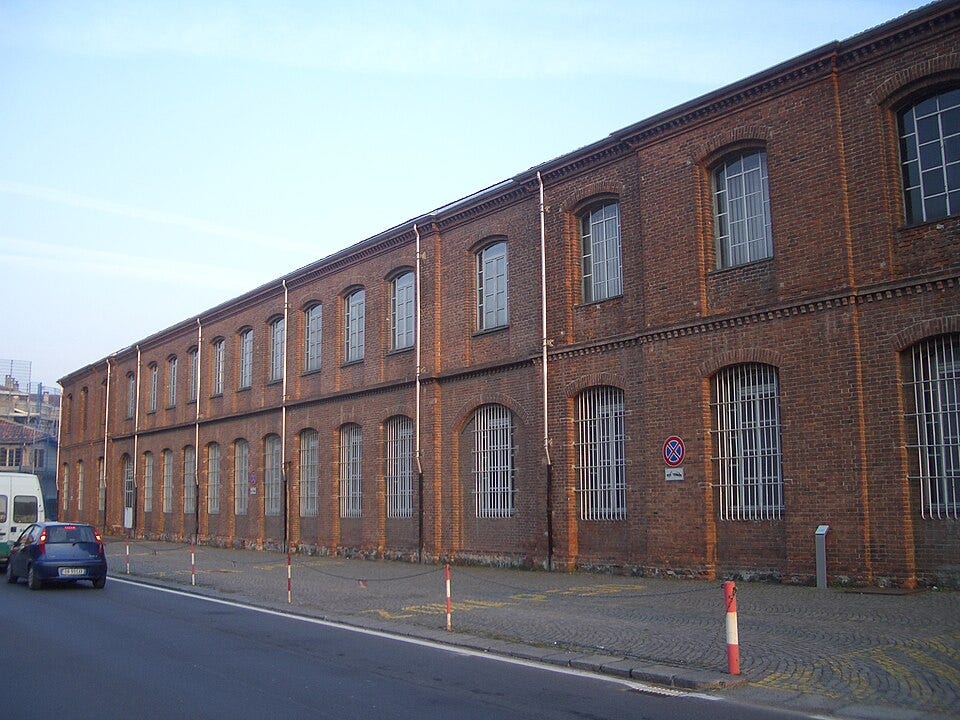
He built typewriters in a red brick workshop that he designed himself. The first model, the M1, was shown at the 1911 Turin Exposition and is now a coveted rare find among collectors.
Ivrea sits in the Canavese, a landscape of rivers and Alpine foothills below the Aosta Valley. A strange place to build an industrial future, but Camillo chose it because it was home.
Two values he held dear stand out. He raised his six children, with wife Luisa, on the idea that manual and intellectual labor were equal.
He demonstrated his respect for workers when the company nearly failed in 1914. He gathered them and explained there was no money. Instead of mass layoffs, he cut work hours in half while retaining the entire workforce. Many refused pay until the firm recovered.
Despite the travel, education, and influential people he met, everything Olivetti became started in that simple red brick factory.
Adriano Olivetti, the boss who became mayor
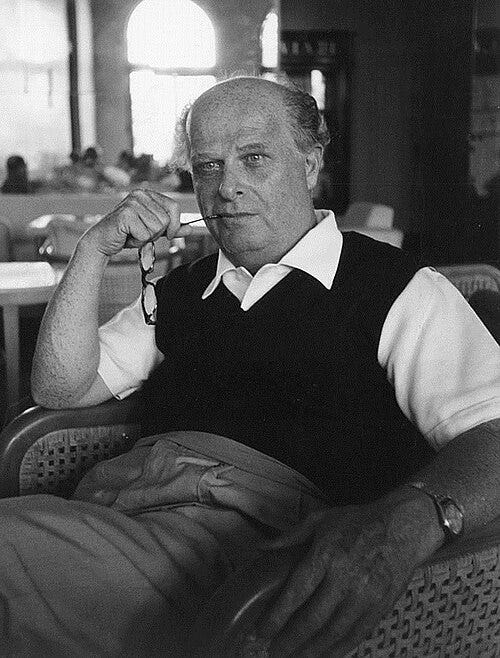
Camillo’s eldest son Adriano took over as director in 1932. He had extensively toured American factories in 1925, learning how to scale manufacturing, and returned home with a strange idea.
He wanted the factory not only to produce products, but to demonstrate a political argument.
In 1947 he founded Movimento Comunità (Community Movement). In 1956 he was elected mayor of Ivrea, and in 1958 he entered the Italian Parliament.
He wasn’t merely a benevolent boss who dabbled in politics. He was running an experiment about how people should live and work, and the company was the embodiment of that idea.
This innovative model didn’t lack critics. Some saw his approach as a form of enlightened paternalism: pro-worker, humane, even generous, but still built on the idea that a powerful employer and its management get to decide what’s best for the community.
By the early 1960s, from its humble red brick beginnings, Olivetti had grown substantially, employing around 36,000 people, more than half of them abroad.
Olivetti’s productivity secret
Olivetti offered many perks to its employees, including a nursery, library, evening classes, five-day weeks, wages above union standards, and free healthcare decades before it became universal. In 1930s Italy, these benefits were essentially unheard of.
As the company grew in size, they moved from the workshop to a glass factory (known as “la fabbrica di vetro”). Floor-to-ceiling windows allowed workers to see the Alps and passers-by to see the workers. The light and transparency were the goal.
Adriano made it a condition of taking over, one which many CEOs would struggle to sign their names to, that he would never fire an employee for financial reasons. He put the reasoning in print: “We must go beyond separations between capital and work, industry and agriculture, production and culture.”
It might seem a threat to the bottom line, but it’s a philosophy that yielded concrete results. By the late 1950s, Olivetti workers were among the highest-paid in Italian industry... but also the most productive.
The model wasn’t doing charity. It was a strategic approach.
From Lettera 22 to Programma 101

The Lettera 22 (designed by Marcello Nizzoli) is one of the most recognizable symbols of Italian design. It won the Compasso d’Oro in 1954. Five years later, the Illinois Institute of Technology named it the best-designed product of the previous 100 years. Light, stylish, and effective.
Joan Didion drafted Run, River on one. Cormac McCarthy wrote much of his work on the Lettera 32, the successor of the 22. Amusingly, he auctioned it at Christie’s in 2009 for $254,500, only to buy a replacement for $11.
But the typewriters undersell the rest of the company’s catalog. In 1959 Olivetti shipped the Elea 9003, one of the first fully transistorized commercial mainframes anywhere and the first built entirely in Italy. The lead engineer was Mario Tchou and the designer behind the console was Ettore Sottsass, who also designed the Olivetti Valentine typewriter displayed at MoMA.
Olivetti also entered the semiconductor industry, and helped found SGS in 1957, which later became STMicroelectronics, today one of Europe’s largest chipmakers.
In 1965, the Programma 101 was built by Pier Giorgio Perotto with a team of five. Affectionately known as the “Perottina”, it is widely considered the first desktop computer. At its New York debut, visitors assumed it was a terminal wired to a hidden mainframe and had to be told that the small box was the whole computer. It is also in the permanent collection of MoMA.
Between 1954 and 2001, Olivetti won 16 Compasso d’Oro awards, more than any company in the history of the prize. In 1986, it became the third-largest PC maker in the world. The 1990s then saw Olivetti become the largest in Europe.
Yet today, nobody owns an Olivetti computer or mobile phone. This story has no happy ending.
How Olivetti collapsed
Tragedy struck two key figures in the Olivetti empire less than two years apart. Adriano died of a heart attack on a train to Switzerland in February 1960, at age 58. No autopsy was performed despite the attending doctor asking for one.
Then Mario Tchou, the engineer running the Elea program, died in a head-on crash on the A4 near Santhià (Vercelli) in November 1961, at age 37.
Italian journalists called it “il giallo Olivetti” (the Olivetti mystery). Speculation is rampant, though most historians reject the conspiracy theory. Even the declassified CIA files on Adriano never produced a definitive answer.
What is not a mystery is what the state did as the company faced pressure: nothing.
In 1964, with the founders deceased, Olivetti’s bankers forced a sale of the electronics division to General Electric as a key condition to issue new operating loans.
Other European nations fiercely protected important companies on the verge of collapse. France protected Bull. Britain did it for ICL. West Germany, with Siemens. Yet, Italy did nothing to protect Olivetti.
Olivetti didn’t lack technology or talent. It had both in spades. The collapse was a combination of factors exacerbated by the passing of Adriano and Tchou. Sure, there were financial pressure and strategic mistakes, but the real death blow came from the absence of a national industrial policy to defend such a strategic Italian company.
Italy failed Olivetti far more than Olivetti has ever failed Italy.
The Programma 101 itself only hit the market because Perotto’s team, in typical Italian fashion, pulled a fast one. They cleverly reclassified the computer as a “calculator,” keeping it out of the GE deal. “Una furbizia” (a clever trick), a bureaucratic loophole really, allowed the first programmable desktop computer to survive.
The rest of its demise was slow death. Compounding bad decisions and failure to adapt. A late return to scale in the PC years, thinning margins, and then a pivot into telecoms. Finally, the loss of identity with the absorption into Telecom Italia in 2003. Olivetti ceased to exist as an independent company. By then, the part worth saving had been gone for forty years.
Ivrea today, and what tourists miss
In July 2018, UNESCO inscribed eighteen Olivetti buildings across Ivrea as World Heritage Site #1538, Italy’s first site recognized specifically as 20th-century industrial heritage.
You can walk it in an afternoon and visit the glass factory, workers’ housing, canteen, original red brick workshop, and open-air architecture museum. It still stands like a memorial to its accomplishments. Many older Italians share memories of the products they recollect, or wonder what could have been if they had held on longer.
However, those who remember are fewer every year. Almost nobody comes for this heritage site. Most visitors show up in February for the Battle of the Oranges, the carnival where the town splits into teams and pelts each other with three hundred tons of citrus. If you prefer a contemplative moment to step into another era of technology, rather than being pelted with oranges, this is the more interesting visit.
Why Olivetti still matters
The easy reading of all this is nostalgic, and at times tragic. A beautiful European moment ended; we mourn it, we move on.
Despite the demise of Olivetti, it has a form of immortality beyond its historical contributions to technology, as a concept. It is a case study for one specific claim: humane working conditions and frontier technology are not in tension.
A company built on the premise that they reinforce each other outproduced companies built on the opposite premise. It worked commercially right up until Italian bankers and Italian government inaction took it apart, while everyone else in Europe was doing the opposite.
Italians would call this “un’occasione mancata,” a lost opportunity. The phrase is far too small, however, for a loss so great. What was lost wasn’t an opportunity. It was a working argument in motion, already proven, that a factory could be a city and still build the best machines in the world.
Adriano saw the objections coming. He had a line for it:
“Often the term utopia is the most convenient way to liquidate what you do not have the ability, or the courage, to do.”
Olivetti wasn’t a tech company that happened to care about people. It was a project about people that happened to build some of the most important technology of the century.
Italy used to know the difference.
My father was an Olivetti typewriter repairman when I was a child, on Vancouver Island.
I think I first came across the typewriter Olivetti in Agatha Christie books. So sad how it was allowed to collapse. Very interesting article