


Italy with Antonio. Honest guides for moving to, traveling in, and understanding Italy from a native Italian. Three articles a week, with deeper resources for paid members (including the print-ready PDF and ePub downloads of this article). Join 1,500+ subscribers.
This is a guest post by my fiancée Alicia, who saw a PACE flag in Italy and went down a rabbit hole researching the topic. These are her findings.

“Pace” (pronounced pah-chay) is the ever-so-simple Italian word for one of the hardest things to get: peace. Many non-Italians find the flag depicted above intriguing, as it is not very well known outside of Italy, despite its international intentions and being in existence since 1961.
Firstly, one clarification. The colours vary slightly from the better-known rainbow pride flag by featuring seven colours, rather than six, and colours that often slightly differ in terms of shade. The colours are (from top to bottom) purple, blue, azure, green, yellow, orange, and red.
“With nonviolence, we recognize the right of everyone to exist; with non-mendacity, the right of everyone to truth.”
— Aldo Capitini (Poet, Activist, Philosopher, and Educator)
On December 23rd 1899, in Perugia, Aldo Capitini was born into a modest family, the son of the custodian of the town hall’s bell tower and a seamstress. Money was tight, and he was steered into practical accounting studies rather than the literature he loved. So he taught himself. As a young man he took up Latin and Greek as an autodidact, reportedly studying up to twelve hours a day, and the strain left him physically exhausted and frail. It was in those years, by his own account, that he first felt the fragility of a human life caught between birth and death. This physical struggle, and the solitude of a self-made scholar, led him to become a deep thinker.
Capitini was intrigued by philosophy, literature, and religion from a very early age in an attempt to find answers. Those proficient in war history may have noted the era of his birth as one which experienced the seemingly endless horrors of World War I. Capitini, despite being the perfect age for the draft, was not enlisted due to his poor health. However, that did not mean he was immune from the tragedies of the war. No one was, even if they were ill and on the sidelines. One notable quote that captures this:
“Forgetting the deeper unity beyond the war? I remain here, isolated from everybody, working for deeper togetherness.”
The neighbors who did not come home, the stories of friends and families meeting a horrible end, and the economic hardships were apparent to all who were living. There is little doubt that this left a profound impression on the young Capitini. The war was the catalyst that led him to pursue deeper meaning through philosophy, and eventually motivated him to find ways to share his vast knowledge for the hope of a better and more peaceful world. With the war ending, he worked toward a master’s degree in philosophy, and like many young people, worked on finding his identity both politically and socially.
In the late 1920s, Capitini found himself captivated by the teachings of Gandhi. These readings and the political changes surrounding him led to a great change in his philosophy and lifestyle. In an effort to become even more pacifistic, he became vegetarian. In a country that loves its traditional meats, in an era where conformity was praised, that was an incredibly radical and rare form of activism in itself. He had found deep comfort in faith, but soon that faith was shaken, and personal change followed.
Life in the shadow of fascism
A charismatic dictator named Mussolini arrived on the political scene, quite uninvited, bringing violence with his army of Blackshirts and the deaths of many who opposed him. After gaining power, and under much pressure, Mussolini signed the Lateran Treaty in 1929. It resolved a rift that had lasted since 1870: the Vatican secured recognition as a distinct sovereign nation and was compensated for the Papal States that Italy had absorbed decades earlier. The irreligious Mussolini now had everything in place to keep Catholicism from interfering with his larger goals. To Capitini, this was a betrayal, and he saw the church as complicit in the rise of fascist power.
Aside: In his later writings after WW2 (such as his 1955 book Religione Aperta, or Open Religion), he shared his views on what the focus of the church should be, and soon found himself on the forbidden book list of the Vatican.
By 1930, he secured employment at the Scuola Normale Superiore di Pisa as its secretary. He found himself surrounded by like-minded, or sympathetic, students who also shared a desire for political change and pacifism. Soon, he made two bold moves that would cost him his employment. Capitini became a conscientious objector, and also declined an invitation to join the Fascist Party that was extended to him by the director of the school. This was the end of his formal employment, but in a sense provided him with greater freedom.
He returned home to Perugia and began to teach private lessons. He was no longer under the thumb of an institution and could continue his research, writing, and activism more readily until the end of the war. Amazingly, he even managed to publish three books during the fascist era that passed censorship and were widely praised.
Post WW2 activism
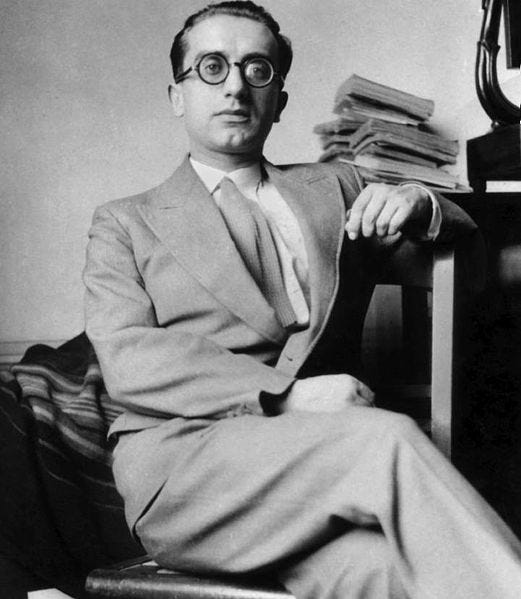
While settling into the life of a citizen in the new Italian Republic, Capitini formed the Centro di Orientamento Sociale (Centre for Social Orientation). Despite its initial success and spread across Italy, this movement soon faded into history due to opposition from the Christian Democratic Party and lack of political support in general. He had hoped left-leaning political groups would take interest, but he was left disappointed.
Soon he found himself touring Europe as a public speaker, meeting with like-minded people at conferences in Rome, London, and beyond. He spoke of non-violence and vegetarianism, and enjoyed discussions around the teachings of his mentor Gandhi. The fame that followed him soon landed him in Sardinia as a professor at the University of Cagliari, and eventually things went full circle and he was approved for a transfer to the University of Perugia.
The 60s were the perfect era for Capitini, as you can well imagine. He now found himself in an era where the public desire for peace was greater, questions were being asked of superiors, and the public felt safer to demonstrate. He now had a captive youthful audience and realized this was the time for on-the-ground activism.
Upon reflection, he realized every movement needs a symbol to unite under, and to convey a clear message. The fascists had a bundle of wooden rods with an axe, the communists had their hammer and sickle, and yet he was without one to represent the contrary. He soon found himself looking to other movements for one to adopt, or even modify.
The flag is raised
In 1912, a U.S. Methodist pastor named James Van Kirk created a “World Peace Flag.” It featured a blue background with yellow stars, and in the foreground the Earth with a rectangle of rainbows beside it connected by lines. He felt this idea came to him from God himself. Van Kirk wanted to express the many colours of the human family in the rainbow (with a nod to the biblical rainbow after the Great Flood), represent international cooperation through the connected lines, and add stars to represent nations. This flag was used in various forms at demonstrations and became the inspiration for Capitini and others.
Despite Capitini’s aversion to organized religion, many close to him speculated that he was inspired by seeing this flag from the campaign for nuclear disarmament in England. The rainbow was seen as a symbol of peace and hope after the great storm that was WW2.
Capitini urged the 12-year-old daughter of his friends on the committee, Francesca Siciliani, to gather fabric. With the help of two older girls, they sewed the first flag. The colours differ from those of today, perhaps due to a sense of urgency, fading over time, and limited materials. But the moment of its creation was symbolic in itself: a group of people collaborating, using what they had, and creating something in the name of nonviolence for the world. Something bright and uplifting contrasted with the starkness of black, brown, and red used in violent movements.
The flag debuted in Perugia in 1961 at the 24 Km “March for Peace and the Brotherhood of Peoples” with the intent of encouraging people to ease international tensions. Along the way, Capitini saw, much to his frustration, many marchers holding the blood-red flag of communist movements that had swept much of Italy after the fall of Mussolini. According to Francesca, he was frustrated as he felt “peace in the world should not take political sides.” After the march ended in Assisi, Capitini gave the flag to Francesca.
One may wonder: what became of the flag over the years? This would not be an Italian article without the usual dose of controversy. There are two rival claims to the original. The Imago Mundi Foundation, in Treviso, has exhibited what it calls the only surviving example of the flags made for the 1961 march, the one it says Capitini gave to Francesca. But a second flag, kept in Perugia, makes the same claim; it came down through Lanfranco Mencaroni, a friend and collaborator of Capitini, who handed it to the city in 2011. Both carry their own stories of previous owners and of how they arrived where they are.
Pace da tutti i balconi
After the death of Capitini in 1968 (a mere seven years after the famous 1961 march), the flag lived on and carried out its purpose. It even received a makeover. Somewhere along the way, it began to appear with the white lettering of PACE. It is unknown when exactly this started, but these versions began to appear in the 1990s. Some say it was added to differentiate itself from the Pride flag, but this is not confirmed.
In 2002, the pace flag received its biggest moment, one that made it visible again to younger generations and cemented it into Italian history.
As the Iraq war loomed, with the war in Afghanistan already underway, a campaign called “Pace da tutti i balconi” was launched. It translated as “peace from every balcony,” and asked everyone to hang the flag from their balconies as a call for peace.
Many say the founder of this movement was the missionary Father Alex Zanotelli, but it has been clarified that he was the face of a larger collective movement organized by the Catholic movement “Pax Christi.”
It was a success. Italians who felt weary of war, even if it was beyond their shores, felt the same frustration and helplessness that was at the core of Capitini’s early experience. In a moment of unity, they began to hang the flags from every balcony, and soon every piazza was cloaked in a patchwork of peaceful solidarity for all to see. This moment solidified the flag’s place at future protests and events, and as an everyday reminder that peace starts with us.
In closing, a boy from a poor house beneath the town hall’s bell tower taught himself in near-monastic solitude, then rose from his desk and stepped outside. He started to walk. His walk became a purposeful march, others joined him in this journey, and he marked his place in history with a flag for everyone.
It would never even have occurred to me to ask myself the origins of the flag, as I had sort of merged it in my mind with the pride flag - so thank you for sharing this!
An incredibly interesting read; most definitely a rabbit hole worth going down!