


A Substack bestseller, Italy with Antonio offers honest guides for moving to, traveling in, and understanding Italy from a native Italian. Three articles a week, with deeper resources for paid members (including the print-ready PDF and ePub downloads of this article). Join over 2,000 subscribers!
A British subscriber wrote me that he’s sick of the rain. In retirement, he and his wife want to enjoy as much sunshine as possible. So he asked me where to move to Italy for that.
Here is the catch: the obvious answer, “the south”, doesn’t work for them. They need and want the services and access to world-class healthcare provided by the north (or, at bare minimum, the center). And it’s a sound decision, not one I’m going to argue against.
So, I went on to investigate, with raw data, the sunniest places in Italy. I included in the analysis the 20 regional capitals, plus 16 towns that keep getting mentioned in private conversations with paid subscribers.
How I measured sunshine
Sunshine is slippery to quantify. The usual metric used by most is “hours of sunshine.” Il Sole 24 Ore publishes it at the provincial level every year in its Indice del Clima (Climate Index).
It’s a reasonable metric, but it has a flaw for what we are trying to determine here: an hour of weak January light at 14°C (57.2°F) is counted the same as a full hour in July at noon. And yes, some light in January is better than none, but what people generally care about when seeking sunny places is a degree of intensity that you can actually perceive even in winter.
Instead, I opted for a different metric: the global horizontal irradiation. In other words, how much solar energy per square meter hits the ground. It’s expressed in kilowatt-hours per square meter.
It captures duration and strength together; it’s the number solar installers count on when showing you that it’s worth upgrading your roof. Using this metric also has the additional benefit of being satellite-based, covering any set of coordinates, including small places like Sanremo, Olbia and Lampedusa.
The ranking
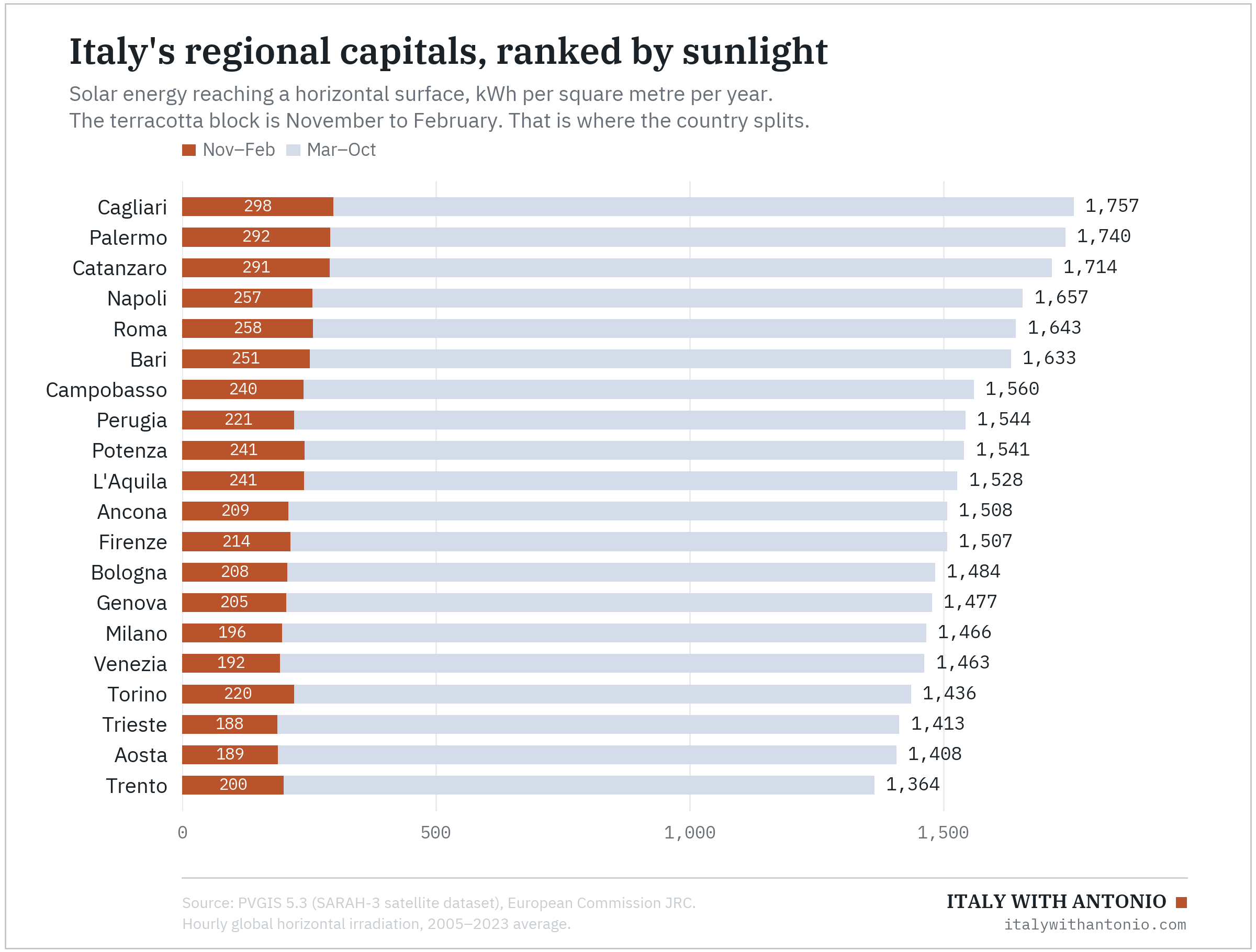
Unsurprisingly, Cagliari is ranked number one among the regional capitals. It gets 1,757 kWh per square meter per year. Palermo, Catanzaro, and Napoli follow. Trento comes last at 1,364, which is 22.4% less light than Cagliari over the course of a year.
The only way we are going to beat Cagliari is by including places that are not regional capitals. In fact, Lampedusa (an island closer to Tunisia than Italy) takes the crown at 1,880 kWh/m2. 38% more sunlight than Trento.
That number gives us the spread for the whole country, from 1,364 kWh/m2 of Trento to 1,880 kWh/m2 of Lampedusa. The gap is actually huge, but somehow, intuitively it doesn’t feel so.
The reason the gap feels narrower than it is comes down to seasonality. Specifically, how these cities perform in the winter, which we’ll look at next.
Italy is one country in July and two in January
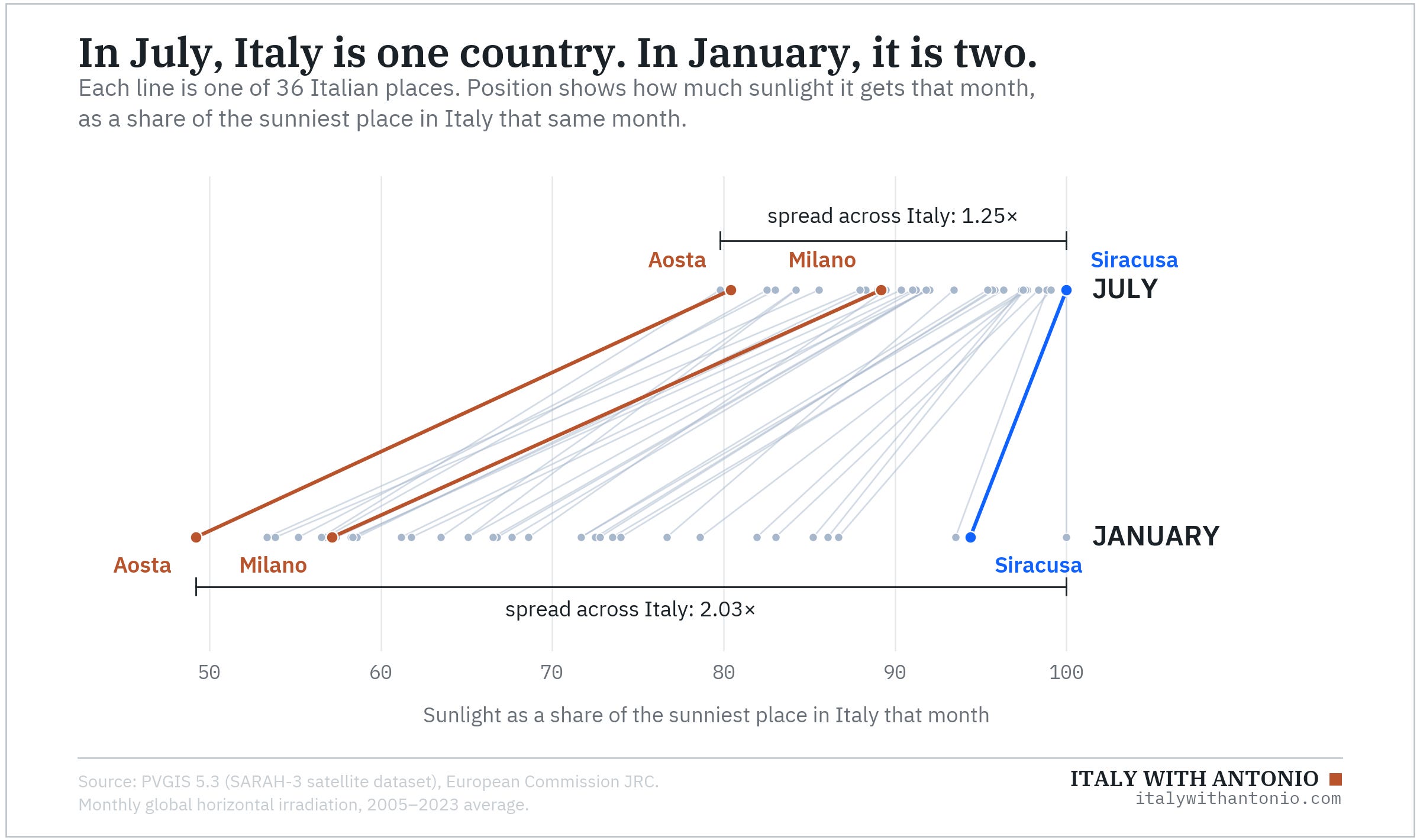
The chart above shows the spread of the 36 locations we are considering in January and July. As you can see, in July the spread across Italy is only 1.25x. During that summer month, Siracusa and Lampedusa match as the sunniest places in Italy.
What happened to Cagliari?
Cagliari is the sunniest regional capital. Lampedusa and Siracusa are both sunnier, but they are not regional capitals.
Milano is in the middle of the July range. And even Aosta receives 80% of the sunshine that Lampedusa and Siracusa get. You only lose about 10% of sunlight by being in Milano instead of Palermo in summer.
In other words, in July, it’s sunny everywhere in Italy.
Where the gap becomes serious is in winter. In January, the gap is 103%. So Lampedusa gets more than twice the sunlight of Aosta (and Siracusa is close, at nearly twice).
Put differently: Siracusa beats Milano by 12% in July and by 65% in January. The north-south gap for these two cities is more than five times larger in winter than in summer.
Broadly speaking, in the summer, we have the unified Italy of sunshine. In the winter, the south is sunny and warm; the north is cold and gray.
The places that punch above their weight
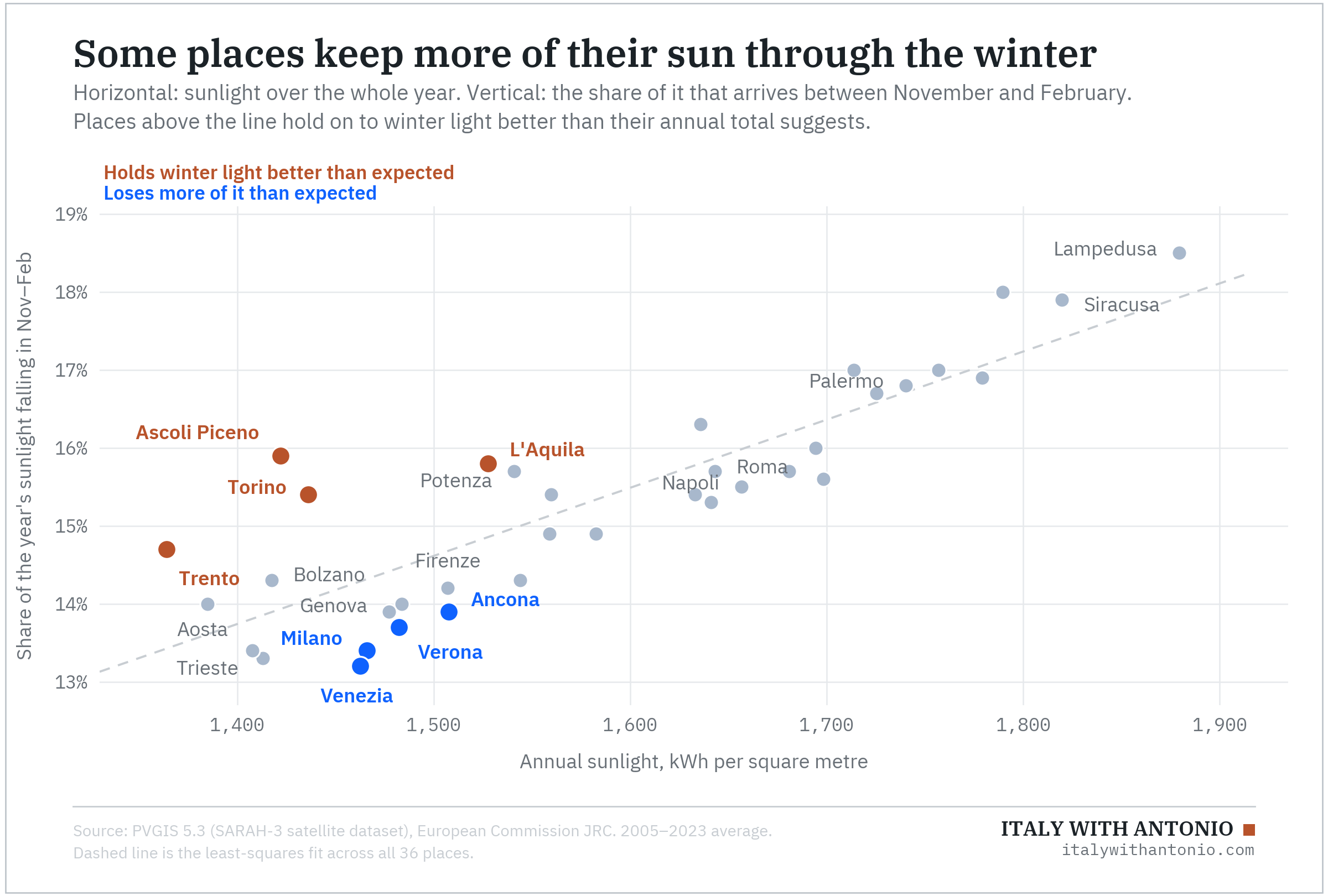
Generally speaking, sunnier places also keep more of their sunlight through winter. So we can look at outliers that somehow manage to keep more sunlight in winter than their annual numbers would suggest.
Take Torino, for example. A genuinely strange case. Of the 20 regional capitals, it ranks 17th for annual sunlight. Yet, from November to February, it gets more sun than Firenze, Ancona, Bologna, Genova, Milano, and Venezia.
Torino is relatively dim in summer but comparatively bright in winter, which is not what you’d expect from a northern industrial city. The answer might be that the föhn wind coming down off the Alps clears the valley in a way that simply does not happen in Milano, 90 minutes northeast.
Generally, the mountain towns hold winter light better than the coast does. L’Aquila, Potenza, and Ascoli Piceno all do well with a higher share of sunlight in winter. Venezia and Ancona do not.
The Apennine towns likely rise above the low haze, enabling the sun to hit them more consistently in winter. Just don’t assume that this applies to the Alps as well. Bolzano is very much in the middle of the pack in the summer-winter sunlight gap.
Venezia has the lowest winter share of sunlight in Italy, at 13.2%. Trieste is second lowest at 13.3%. I have called Trieste highly underrated, and I stand by it, but the full sentence might have to be that it is highly underrated, provided you do not mind the Bora wind and the gray winters.
The Riviera Ligure's sunny reputation belongs to the western end of the region. Genova sits at only 1,477 kWh/m2 annually, essentially tied with Bologna and below Firenze. Sanremo, much farther west in the region, is more than 100 kWh/m2 higher. So if you are shortlisting Ligurian candidates for the sun and the sea, look at the Riviera dei Fiori, not Genova.
So, where should the British couple go?
In the appendix below, I’ve included for paid subscribers the entire table of 36 entries sorted by sunshine exposure, as well as the full data for the entire year and not just January and July.
To directly address the British couple’s conundrum, that data gives us clear answers.
With the south ruled out, in central Italy, Roma wins a mani basse (hands down). Pescara and Perugia also do relatively well. In the north, Sanremo does best. After that, it flattens fast, and Bologna, Verona, Genova, Milano, and Venezia are all essentially a wash.
Torino doesn’t do too well annually, but as we mentioned, it genuinely shines relatively speaking in winter if that’s the couple’s main concern. In the center, L’Aquila and Ascoli Piceno follow a similar pattern.
Center or south?
L’Aquila and Pescara are often considered part of the south, even though they are geographically central. I included them, but it’s up to the British couple to decide whether they qualify.
For the record, our subscriber and his wife are from Manchester, which gets 942.5 kWh/m2. In winter, even gray Milano gets more than twice their sunshine. Heck, Trento would be a massive improvement.
If you are curious, here are other cities in that neck of the woods, plus Paris for fun: London (1070.1), Birmingham (1015.8), Dublin (1007.2), Edinburgh (922.9), and Paris (1218.9).
At any rate, if it were me, I’d shortlist: Roma, Pescara, Perugia, Sanremo, and L’Aquila. Maybe even Torino. Then evaluate everything else about these places, as sunshine is only one factor for someone moving to Italy.
What to do with this?
Now that we have a better idea of how sunny Italy gets and where, let’s briefly make the information actionable. Or simply put, this is cool, but what do we do with this information?
If sunshine matters in your relocation to Italy decision, do two things.
First, do not shortlist on the basis of annual totals. Look at the winter column. It’s what determines whether you’ll face months of gray skies out your window or a thriving lifestyle year-round.
Second, visit your candidate places in winter. Visiting Italy in the summer and then deciding where to move is a terrible way to pick a place. It doesn’t teach you anything about the weather (it’s sunny and warm everywhere in summer), and of course many places come alive for the summer and go quiet in the winter months. Even the terrible air quality in the Po Valley gets some respite in summer.
Visit in February. If you still love the place in the winter, you’ll love it year-round.
Data source: PVGIS 5.3 (SARAH-3), European Commission Joint Research Centre. Hourly global horizontal irradiation, 2005–2023, thirty-six locations.
On the "center or south?" question, the healthcare constraint might deserve the treatment you gave sunshine hours: a better metric than the obvious one. "North" and "south" are blunt proxies, because Italian healthcare is organised region by region, and patients moving between regions for treatment is common enough to be officially measured under its own name, mobilità sanitaria. So the relocation map is really two maps laid on top of each other: winter irradiation and access to the care you're likely to need. I suspect they line up less tidily than the January chart.
Super interesting piece! Particularly the Torino anomaly.