


A Substack bestseller, Italy with Antonio offers honest guides for moving to, traveling in, and understanding Italy from a native Italian. Three articles a week, with deeper resources for paid members (including the print-ready PDF and ePub downloads of this article). Join over 2,000 subscribers!
For such a small country, Italy has had a disproportionate positive impact on the world. So when approaching an article about Italian things, it’d be tempting to include the greatest hits: Pasta, Pizza, Parmigiano Reggiano, Nutella and, for a bit of provenance controversy, bidet. Or take the angle of its great artistic and cultural contributions.
This isn’t that article. Much like pretentious breweries that charge you $25 for a burger and parmesan fries, “we do things a little differently around here.”
Non ce la faccio, troppi ricordi
So this list will be about things that are immediately recognizable to Italians, but are virtually unheard of if you haven’t lived there.
If you’re Italian, we’re about to enter the land of nostalgia, since many of these items defined our childhoods and had a lot of meaning for us. Even Italian-Americans might fondly recall some of these products that might have made it across the diaspora.
The heading “Non ce la faccio, troppi ricordi” means “I can’t. Too many memories.” and it’s a meme from an Aldo, Giovanni e Giacomo movie.
Food, sweets, and snacks

I Pocket Coffee: there are two versions: a winter and a summer edition. The winter one is a hard chocolate shell filled with delicious liquid espresso inside. It’s the one I grew up with. Amazing treat. The summer version is essentially a mix of espresso and chocolate that you drink through a paper straw. A necessary travesty, because the winter one melts in 35°C (95°F).
Le Goleador: two flat strips of liquorice candy sold in a thin see-through wrapper that somehow was branded with soccer players on it. Eventually they added other flavors as well. It was the number one purchase for kids with pocket change, and it was available in every edicola (newsstand) and tabaccheria (tobacconist, do-it-all shop).
I Big Babol: yes, “big bubble” spelt the Italian way. A delicious pink bubblegum that enabled us kids to blow up, well, big bubbles.
Le Tabù: liquorice candies sold in little metal tins. They have a very strong taste that becomes addictive. Their 80s commercials were, by modern standards... interesting.
Le Zigulì: tiny fruit pastilles. Essentially candy but somehow sold to parents as almost-vitamins that were good for us kids. Every pharmacy in Italy carries them.
Il Cucciolone: literally “the big puppy”, a rectangular ice cream sandwich with a corny cartoon strip printed right on the biscuit. It was a crime to eat it without reading the cartoon first.
Il Calippo: an ice lolly (typically lemon- or cola-flavored) in a cardboard tube. As you ate it, you kept pushing it up by squeezing the bottom. The leftover juice at the end was the real treat.
I Sofficini Findus: breaded half-moons filled with mozzarella and tomato, fried or microwaved straight from frozen. Not a healthy food by any means, but it was Italy’s idea of a quick microwaved dinner. By the same brand (Findus), also iconic are the bastoncini (fish sticks).
Le fette biscottate: the English word for this is rusks (twice-baked dry toast slices). Few people I’ve ever spoken to even know what rusks are. These slices are ready to eat and are great with Nutella or jam. Except that they inevitably break if you’re not careful when spreading them. Still, a staple of Italian breakfasts and essentially unheard of in North America.
Drinks
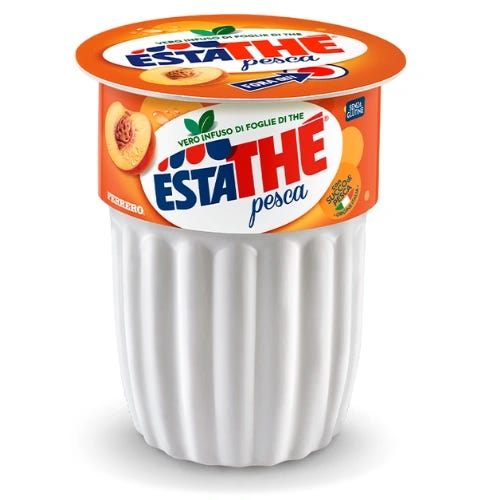
L’Estathé: iced tea in lemon or peach flavor, drunk from a small cup with a straw. To date, to me, still the best-tasting iced tea in the world.
L’orzata: a white almond syrup you dilute with cold water. Amazing with acqua frizzante (fizzy water). Growing up, it was a staple in summer alongside latte e menta (milk and mint syrup). Many bars (cafes), but not all, still make them.
Il Chinotto: a dark bitter citrus soda. This is 100% an acquired taste. I grew up drinking it so I absolutely love it, but most North American friends who tried it don’t like it.
Il caffè d’orzo: roasted barley served in a tiny cup. Sort of an oatmeal-tasting coffee that is caffeine-free, and therefore appreciated by both children and adults.
L’Effervescente Brioschi: lemon-flavored fizzing granules that get dissolved in a glass of water. Kinda tasty in its own way. It’s sodium bicarbonate, which helps with GERD and indigestion. Not a problem as kids, but adults swore by it.
School and stationery
Il Pongo: sticks of plasticine modeling clay used by school children. It never dries and doesn’t require baking, so it’s perfect for small kids. The smell instantly reminds me of my childhood. My fiancée Alicia uses FIMO, the grown-up version of modeling clay that you bake. I bet she would have loved Pongo as a child.
Lo zaino Invicta: in Italy there is one brand of school backpacks you had to have as a status symbol: Invicta. It’s not so much that you were cool for having it. Most had one. It’s that you were uncool if you couldn’t afford one. These days, it still exists but is no longer dominant. Back in the day, it was around 100,000 lire (50 euros or so). When I finally got a black one in high school, I felt like a king.
La Smemoranda: “la smemo” was a diario scolastico (a school planner) that doubled as a scrapbook. Chock full of illustrations, quotes, writing from famous authors, and pages for your friends to fill in. Each year would have a specific theme. It became a cult for decades among both boys and girls. It technically still exists, but it’s a post-liquidation version that looks nothing like the original, where you could find writings from Fellini or Benigni.
Il quaderno a quadretti da 4mm: young children do math on square paper notebooks that have squares similar to those you can find in North America (5 mm in size). However, from fourth grade onwards, in Italy we switch to smaller quadretti (4 mm). Having spent my entire life doing math and engineering with 4 mm squares, using ruled paper or larger grids feels just wrong.
Il vocabolario Zingarelli: yes, even Italians need an Italian dictionary. The better high schools (licei) often adopted “lo Zingarelli,” a massive Italian dictionary originally authored by Nicola Zingarelli. By the way, I highly recommend it to those with a B2 level of Italian or higher.
I Bignami: thin condensed summaries of everything you were supposed to have read as homework.
Hobbies and publications

La Settimana Enigmistica: the weekly puzzle magazine. Essentially unchanged for decades, it’s available in every waiting room in the country. Piero Bartezzaghi (the legendary crossword author) challenged you no matter how cultured you thought you were. There is still a Bartezzaghi crossword on page 41, courtesy of his son Alessandro.
L’album Panini: the soccer sticker album, where the real skill was trading with your classmates to complete the album each year. I can still hear “Ce l’ho già” (I already have it) and “Mi manca” (I’m missing it).
Topolino: the weekly Disney digest, pocket-sized and thick as a paperback, with stories written and drawn in Italy. Interestingly, despite the Mickey Mouse title, virtually everyone favors the Donald Duck and Scrooge stories within it.
Le carte da Scopa e Briscola: a deck of 40 cards, instead of 52, with coppe, denari, bastoni, and spade instead of the traditional suits. Used for the very popular games Scopa and Briscola. At home we used both the standard Italian version and the Neapolitan one (which is also used in Spain). As a child, at Christmas time, I would make a lot of money gambling against my relatives.
La tombola: a Christmas bingo on a ninety-number board, played with dried beans or pieces of mandarin peels as markers. Popular across Italy, though originating in Naples.
La Gazzetta dello Sport: the sports daily newspaper, printed on pink paper. Bars ordered several copies as it was always the most desired newspaper by the patrons.
On the streets
Il Supersantos: a very popular orange PVC soccer ball that was very prone to being swayed by the wind. But it was relatively cheap, and so many families could afford one. Many of us had to play with something even cheaper: the Super Tele, an even lighter version by the same company (i.e., Mondo). These were completely unpredictable in the wind and often ended up under parked cars or on someone’s property. The stereotypical expression of frustrated adults would be “mo’ ve lo buco questo pallone” (now, I’m going to puncture this ball). Few of us had a proper leather ball like the ones used in actual matches. But Supersantos and Super Tele got us playing.
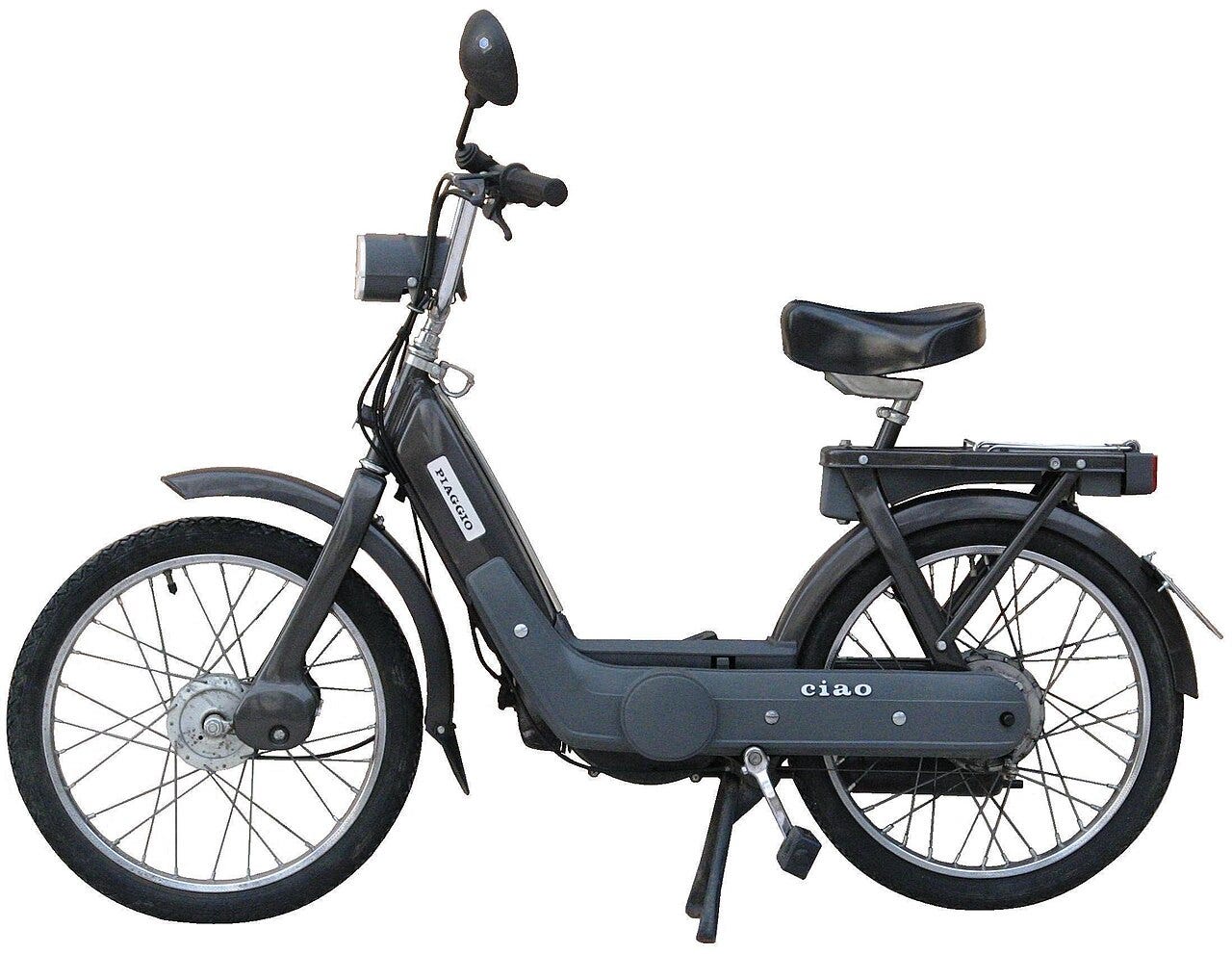
Il Ciao: everyone is familiar with the Vespa, and we certainly liked it. But three other iconic mopeds really appealed to 14-year-old kids in the 80s and 90s: Il Ciao, the Sì, and the one we all really actually wanted, the Malaguti Fifty. Often modified with a bigger carburetor and exhaust. All three were discontinued many years ago.
L’Autogrill: it’s expensive, but Italy has amazing motorway service stations where you’ll find all sorts of cool products and great food options. Sometimes they are located in a glass building suspended on a bridge over the lanes. Canada has nothing even remotely comparable.
L’arrotino: not a product, nor a place, but the arrotino was an iconic figure for decades. He would come with a small truck to sharpen knives and scissors, and fix umbrellas. He would announce himself over a loudspeaker, often using a recording from the 1950s that specifically addressed women to come out with their knives.
I don’t care who your parents are or where you were born. If you experienced even half of these, you’re Italian in my books.
Che flashback Antonio, grazie per i ricordi.
Alcune cose come lo sciroppo Fabbri per l’orzata e il latte&menta, o il bicarbonato Brioschi, le trovo ancora qui negli us grazie ( o purtroppo) an Amazon.
La maggior parte dei miei amici a Monza negli anni 70/80 avevano il Ciao o la Vespa. Io per essere diverso🤪 avevo un “guzzino” il moto Guzzi magnum 5 “ cinquantino”. Anch’esso oramai defunto, come la Laverda 125 che ho avuto a 16 anni.
Bei ricordi.
Bu yaz Roma da bulabildiğim her marketten Estathe satın aldım. Neredeyse evde hazırlanan buzlu çaylar ile aynı lezzette mükemmel bir serinletici.