

10 Tuscan Cities to Visit Instead of Florence
You've seen Florence. Here are 10 Tuscan towns and cities worth your next trip, from Lucca to Pitigliano, plus how to actually get to each one.

Italy with Antonio. Honest guides for moving to, traveling in, and understanding Italy from a native Italian. Three articles a week, with deeper resources for paid subscribers. Join 1,000+ subscribers.
Florence is stunning. One of the most beautiful cities in the world.
If you are visiting Italy for the first time or you’ve never been to Florence, you must go and spend a couple of days there.
What you’ll find is an overwhelming amount of beauty and Renaissance art. You’ll also find everybody else.
In fact, millions of people visit Florence each year and it recently ranked as one of Europe’s most overcrowded tourist cities.
Going to Tuscany and limiting yourself to Florence is choosing to fly to Italy to stand in line in a sea of selfie sticks.
I’m not going to lie, the Uffizi gallery makes your whole trip to Italy worthwhile. My fiancée, Alicia, thinks that even the Officina Profumo-Farmaceutica di Santa Maria Novella alone warrants the trip.
Florence is worth two days. The mistake is making it your base or your only stop in Tuscany.
Tuscany is much more than just Florence.
There is a lifetime of Tuscan cities and towns to fall for, most of them with a fraction of the crowds and the cost.
Here are ten I would send anyone to. Some are easy day trips by train. Some need a rental car and a willingness to drive scenic, winding roads. All of them give you something Florence no longer can: room to breathe.
What about Pisa?
Before we start, Pisa is an afternoon. Drive to it, take a photo of you virtually high-fiving the tower, eat a sandwich, and leave. Do not book three days to “experience Pisa.” There aren’t three days of Pisa. The airport is genuinely useful for landing in Tuscany, but the city as a base is a planning error.
The Tuscan provinces on the map
Before we review my recommendation list, I prepared a map to show you Tuscany’s 10 provinces to give you better context.
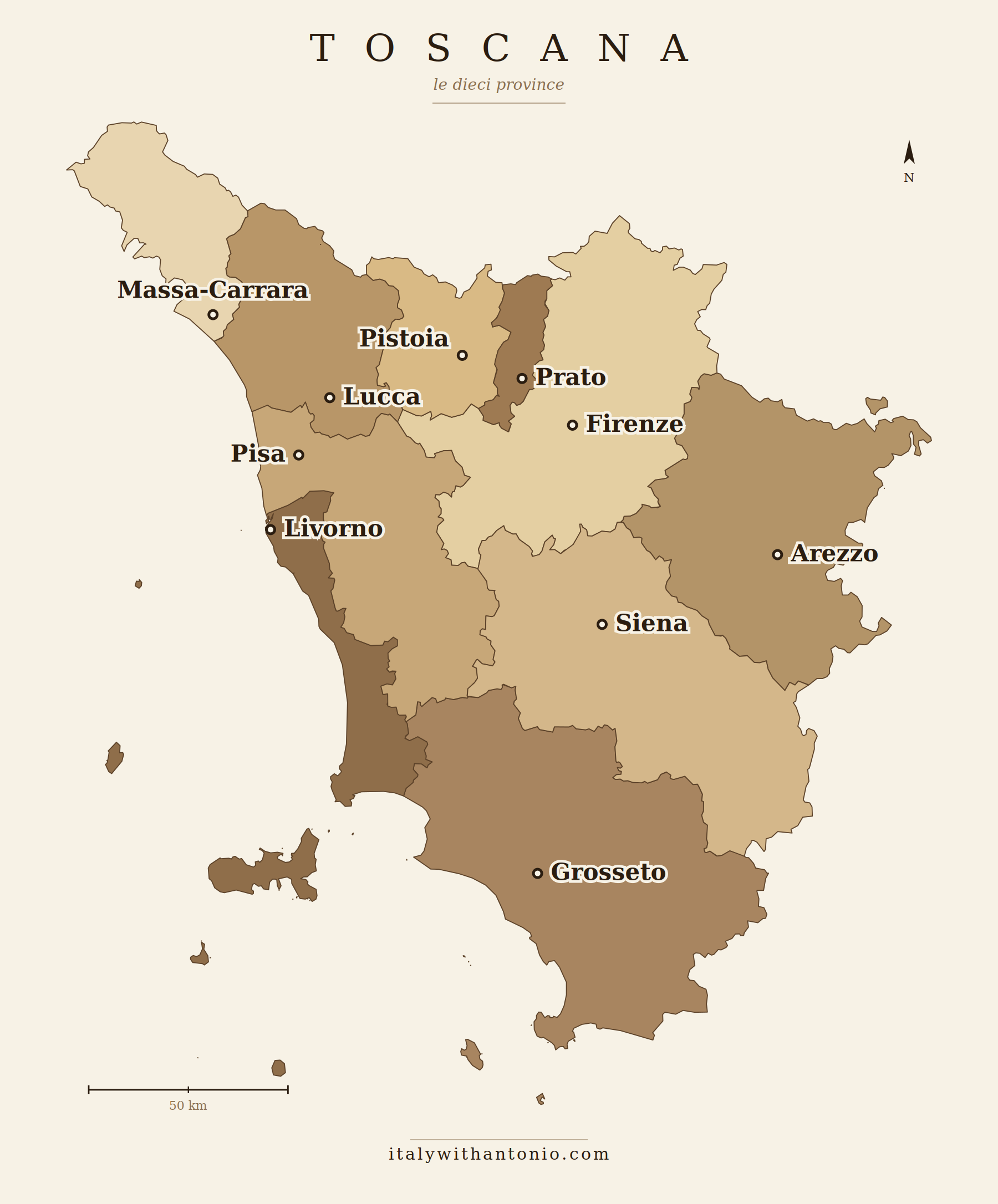
Alright, let’s dive in.
1. Lucca: A walled city

Lucca is one of the most overlooked cities in Tuscany. It is a walled, flat Renaissance city that favors people on foot and cyclists over car drivers.
The historic center of the city is surrounded by 16th-century walls. This gives you a four-kilometer (roughly 2.5 miles) tree-lined loop that you can walk or cycle. Renting a bike while visiting is a great idea here.
The population (of the city, as opposed to the province) is around 89,000, though the beautiful historic center accommodates way fewer people and feels relatively small.
It’s a city of culture. Puccini was born here. The Lucca Summer Festival brings major international acts to town every July. The Piazza dell’Anfiteatro, built on the footprint of a Roman amphitheater, is a beautiful square that is actively used by locals even though it looks stuck in time.
Two or three days is plenty for a visit. Climb Torre Guinigi, the medieval tower with oak trees growing out of the top (depicted in the photo above). Eat tordelli lucchesi, the local meat-stuffed pasta in beef ragù. Walk the walls at sunset.
If the hills of many Tuscan towns wear you out, Lucca is flat, which makes exploring the center easy on the legs.
If you are thinking about actually moving to Tuscany, Lucca is a serious option if you have some budget. It is not cheap. But unlike many Tuscan towns it has a working non-tourism economy. It is essentially the Paper Valley of Europe (plus mechanical and pharmaceutical employers in the surrounding comuni).
Its streets are genuinely livable inside the walls, and it has an established expat community (mostly retirees and remote workers from English speaking countries).
Getting there: Direct train from Florence Santa Maria Novella, about 1 hour 20 minutes, around €9 for a regional ticket. Pisa airport is 30 minutes by train. Don’t drive into the historic center, it's a ZTL (Zona a Traffico Limitato, the restricted traffic zone that'll get you an expensive ticket if you drive in).
2. Siena: One of the best cities in Italy

When we visited, Alicia fell in love with Siena. Chances are, you will as well.
Piazza del Campo is a shell-shaped square that slopes toward the Palazzo Pubblico. It’s the place where, twice a year, in July and August, the local contrade (neighborhoods) race horses in the Palio di Siena.
Siena takes its contrade seriously. The Palio is not an event put up for the tourists. It is a local event with tourists watching.
It is a working city of roughly 53,000 people, highly ranked for quality of life, with one of Italy’s oldest universities and a banking history that includes Monte dei Paschi, the world’s oldest continuously operating bank.
The food is phenomenal even by Tuscan standards, with its own twists. Pici, the thick hand-rolled pasta, is the local specialty. Order it cacio e pepe or all’aglione if you like garlic. Their sweets are also remarkable, including Panforte, the dense spiced fruitcake Siena has been exporting since the 13th century. And while you’re there, order gelato from Il Masgalano.
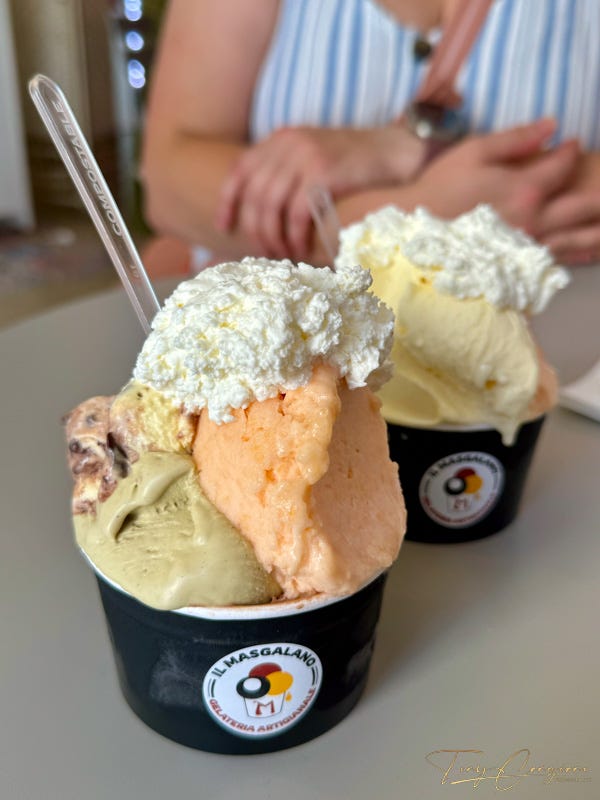
Stay at least two nights. Wake up early to see Piazza del Campo empty. Then see it again at sunset. Day-trippers from Florence arrive at noon and leave at five. The city changes once they go.
Getting there: The bus is faster than the train. Autolinee Toscane runs frequent direct services from Florence’s Villa Costanza station in about 1 hour and 15 minutes. Flixbus is also an option. The train involves a change and might not be worth it. An endless network of escalators will take you from the bus station to the upper level of the city.
3. Arezzo: The smart move most tourists skip

Arezzo is where Roberto Benigni filmed Oscar-winning Life is Beautiful. An overlooked city by most visitors, well-loved by us Italians.
You’ll find great art (particularly by Piero della Francesca) and an amazing antique market on the first Sunday of every month and the Saturday that precedes it. Fiera Antiquaria turns the entire centro storico into one of Italy's most celebrated antique markets.
Arezzo is also the cheapest province in Tuscany for property, at around €1,403 per square meter. If you have been priced out of Lucca but still want a real Tuscan city with services, art, and good train connections, this is the one to look at. Whether you’re reading Italian property listings for a rental or a buy, Arezzo offers a lot for the money.
A day covers the visitor highlights. Two, if you want to settle into the rhythm of the locals.
Getting there: Direct train from Florence in 30 to 90 minutes, depending on whether you catch a Frecciarossa or a Regionale. Fast trains cost €15, regional ones around €9.
4. Pistoia: 35 minutes from Florence, half the price

Italy’s Capital of Culture in 2017, a title that came and went without most foreign visitors noticing. Pistoia sits 35 minutes by train from Florence, has one of the most beautiful main squares in Tuscany (Piazza del Duomo, with a striped cathedral, an octagonal baptistery, and a Romanesque bell tower), and you can usually have the churches mostly to yourself.
Pistoia is also Europe’s biggest plant nursery hub. The countryside around the city is chock full of vivai (nurseries) producing trees and ornamental plants for half the continent.
Half-day or a full day for a visit, easily combined with Lucca or Florence. As a place to live, Pistoia province has the lowest rents in the region at about €9.1 per square meter, a serious gap compared to Florence. Cheap, well-connected, and quietly cultured.
Getting there: Regional train from Florence Santa Maria Novella, 32 to 50 minutes, departing a few times per hour, for literally €5.
5. Cortona (Arezzo): Under the Tuscan sun

Yes, this is where Frances Mayes set her book and the film. Yes, that has made Cortona the most visited small town in the Val di Chiana. But Cortona was a hill town with serious Etruscan history a long time before any of that.
The MAEC archaeological museum has an Etruscan collection that would be the centerpiece even in large cities. The view from Piazza Garibaldi at sunset is the kind of view that has been earning love letters for centuries.
The town sits at around 600 meters above the Val di Chiana plain. The old centro is small and walkable. The light is, even by Tuscan standards, quite remarkable.
One or two nights as a visitor. Use it as a base for Pienza, Montepulciano, and Lake Trasimeno (technically Umbria, but twenty minutes away). For movers, the expat presence is real, and so is the seasonality. In February, Cortona is quiet to the point of melancholy. Decide if that sounds restful or boring before you commit.
Getting there: Train to Camucia-Cortona station, then a bus or taxi up the hill (the historic center is a steep two-kilometer climb). About 1 hour and 20 minutes from Florence.
6. Pienza (Siena): A Renaissance Pope’s idea of the perfect town

A 15th-century pope decided his hometown should be the architectural ideal of a Renaissance city, and he had the money to make it happen.
Pope Pius II hired Bernardo Rossellino, redesigned the village from scratch, and renamed it after himself. The result is the most coherent piece of Renaissance urban planning you can walk through. UNESCO listed the entire town in 1996.
Pienza is also where pecorino di Pienza is made. Sheep’s milk cheese, aged in caves, sometimes wrapped in walnut leaves or rolled in ash. Buy a wedge from any of the cheese shops on Corso il Rossellino and eat it with a glass of Vino Nobile from nearby Montepulciano.
This is a stop, not a base. A few hours, half a day at most. Fewer than 2,000 people live in the historic center, and it gets seriously crowded with day-trippers between 11 am and 4 pm. Come early or come late.
Getting there: Rental car, basically. There is a bus from Siena that takes about 75 minutes, but if you want to actually visit the wider Val d’Orcia, you need a car.
7. Montepulciano (Siena): Vino Nobile and a ridge in the sky

Vino Nobile di Montepulciano is one of Italy’s oldest documented wines, with records of winemaking in the area going back to the 8th century. The town that produces it sits on a long ridge at 600 meters, with cellars carved into the tufa rock beneath noble palazzi. Many of those cellars are open for tasting.
Unlike the Brunello tastings up the road in Montalcino, they often don’t require an appointment booked weeks in advance.
The Piazza Grande at the top of the town is the kind of place you want to sit and let the afternoon happen to you. The 16th-century church of San Biagio, just outside the walls, is one of the great Renaissance buildings nobody talks about.
One night is fine. Two if you want to drink properly without driving.
Getting there: Rental car. A train to Chiusi-Chianciano Terme followed by a regional bus exists, but it’s a three-hour ordeal from Florence, and the bus connections are unforgiving. Drive.
8. Volterra (Pisa): Older and moodier

A walled hill town, but a darker one. Volterra was a major Etruscan center (the Museo Etrusco Guarnacci has one of the great collections of funerary urns anywhere), then a Roman city with a well-preserved theater, then a medieval town built around the alabaster trade that still operates today.
Local artisans carve alabaster by hand in workshops you can wander into. Twilight fans know it as the home of the Volturi vampires, which has produced a small subgenre of disappointed teenagers wandering the streets.
Volterra feels older than other Tuscan hill towns. It is grayer, windier, harder. That is a feature, not a bug, for some.
One night for visitors, two if you want time at the alabaster workshops and the Etruscan museum. As a place to live, Volterra is on the affordable end of Tuscany and has a small but committed expat community. It is also fairly isolated. A pro or a con, depending on how you see it.
Getting there: Driving is easiest. By bus from Pisa or Florence with a change at Colle Val d’Elsa, expect 2 to 2.5 hours. Volterra has no train station.
9. Pitigliano (Grosseto): Carved into the cliff

Pitigliano is built directly into a cliff of volcanic tufa rock, in the wild southern Maremma near the Lazio border.
From a distance, Pitigliano looks like the village grew out of the cliff itself. Architecturally, it kind of did. The Jewish community here was substantial enough from the 1500s onward that the town was nicknamed “La Piccola Gerusalemme,” Little Jerusalem.
You can still visit the synagogue (built in 1598), the kosher bakery, and the ritual bath cut into the rock. The synagogue is preserved largely thanks to the Associazione La Piccola Gerusalemme, a mixed Jewish and non-Jewish cultural association founded in 1996 by Elena Servi, one of the last Jewish residents of Pitigliano, together with her son Enrico Spizzichino.
This is the part of Tuscany most travelers never see. The food is Maremman: cinghiale (wild boar), pici, sfratto (a Jewish-origin pastry filled with honey, walnuts, orange peel, and pepper). The local white wine, Bianco di Pitigliano, was one of the first Italian whites to receive DOC status.
One or two nights, with day trips to Sovana and Sorano (the other two villages in the Città del Tufo trio) and the Etruscan vie cave, sunken paths cut up to twenty meters deep into the rock.
Getting there: Rental car. Public transport to Pitigliano is theoretical at best. The nearest useful train hub is Orvieto in Umbria, then a bus or car.
10. Viareggio (Lucca): The beach, the Carnival, the Liberty promenade

Viareggio is the largest beach town in Tuscany. Three kilometers of sandy beach, a Liberty-style promenade lined with elegant cafés where Puccini used to sit, and Italy’s most famous Carnevale.
The Viareggio Carnival has been running since 1873 and features enormous papier-mâché floats, often satirizing politicians, paraded along the Passeggiata for four Sundays leading up to Lent.
Outside Carnevale, Viareggio in summer is what most Italians mean when they say “andare al mare.” Beach clubs (bagni or stabilimenti balneari) where you rent a sun lounger and umbrella for the day, lunches of fritto misto, and evenings on the seafront. You will not find many famous monuments. That is not why you come here.
A day or two combined with Lucca for a visit. If you are coming for Carnevale itself, book your lodging six months in advance. The town fills quickly.
For movers, Viareggio and Marina di Pietrasanta, to the north, have some of the highest residential property values in the province of Lucca. Here, beachfront stays beachfront even in winter.
Getting there: Direct train from Florence in about 1 hour 30 minutes, hourly, around €10. From Lucca, 20 minutes. From Pisa airport, 25 minutes.
So here is the question. If you have seven days in Tuscany, how many of them are you really going to spend with 44,000 other tourists in five square kilometers of Florence?
Pick your three from the list above. Build a route between them. Rent a car for the southern stretch. You’ll come home with stories that don’t start with “we waited two hours for the Uffizi.”
Which of these have you been to? And which one are you considering for your next trip?
Frequently Asked Questions
What is the best Tuscan city to base yourself in besides Florence?
Lucca and Siena are the two strongest bases for travelers without a car. Lucca works well for the western side of the region, including Pisa, Viareggio, and the Garfagnana. Siena is the natural base for the south, including the Val d’Orcia, Chianti, and Montepulciano. For the eastern flank toward Umbria and the Marche, Arezzo is the answer.
Can you visit Tuscany without renting a car?
Yes, but with limits. Florence, Lucca, Siena, Pisa, Arezzo, Pistoia, and Viareggio are all on the train network. The hill towns of the Val d’Orcia and most of the Maremma, including Pitigliano, are not. If your itinerary is all city-based, skip the rental. If you want Pienza, Montepulciano, or Pitigliano, rent.
Which Tuscan town is the cheapest to live in?
The Arezzo and Pistoia provinces are the most affordable. Arezzo province sits at around €1,403 per square meter for property, the lowest in the region. Pistoia province has the lowest rents at about €9.1 per square meter. Within those provinces, look at Sansepolcro, Anghiari, and the smaller towns of the Casentino valley for real value.
Is San Gimignano worth visiting?
It is worth a few hours. The medieval towers are striking, and the Vernaccia di San Gimignano is a fine white wine. But the town is overrun by day-trippers from Florence and Siena, and it doesn’t reward an overnight stay. Stop for lunch on a route between Florence and Siena. Don’t book three nights.
How many days do you actually need in Florence?
Two full days cover the must-sees: Uffizi, Accademia, Duomo, Ponte Vecchio, and a long walk through Oltrarno. Add a third day if you want to slow down. After that, the city becomes a place to eat in but not really inhabit, because the historic center is mostly tourists, restaurants for tourists, and shops for tourists. Better to use those extra days on one of the ten cities above.
Understand Italy before you arrive.
New posts every Monday, Wednesday, and Friday: cultural pieces and step-by-step guides for people planning a move.
Paid subscribers get every post; free subscribers get a large selection.
I love Florence. In addition to a number of shorter visits, I lived there twice - once for only 3 months, the other for a year. But yes, there are so many other amazing Tuscan cities. I'm a little biased - I also lived in Lucca for a year. In fact, the photo in your post of the Guiniji Tower was the view from my toilet - I'm not kidding.
Anyone saying Pisa is just worth a photo of the Leaning Tower either has never been there or is an envious Tuscan from another city