
Weekly Dose of Italian Culture #4
Welcome to the fourth episode of the Weekly Dose of Italian Culture! As usual, we’ll explore a famous Italian movie, song, and personality. We’ll then continue with some facts about Italy’s geography, history, and customs.
Italian Movie of the Week
My pick for this week is Quo Vado? (broken Latin for “where do I go?”) a hilarious comedy from 2016.
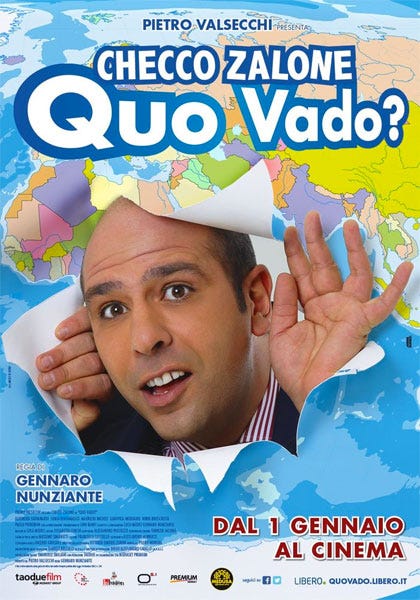
This movie perfectly captures many Italian stereotypes and exaggerates them for comedic effect. For example, the protagonist refuses to give up his posto fisso (a secure job from which it's hard to be fired) and accepts increasingly ridiculous assignments across Europe in order to keep it. He even ends up at the North Pole, where he meets his romantic interest; a relationship that, of course, changes his perspective on many things.
Checco Zalone is a controversial figure in Italy. As an actor and comedian, he embodies the stereotype of a crass, ignorant southerner but uses irony to criticize the subjects he addresses. He often portrays talentless characters in his movies, but in reality, he is highly intelligent, educated, and talented (he’s also a great musician).
Some people dislike him for these coarse portrayals, while others, including myself, absolutely love his comedy.
Italian Song of the Week
The song of the week is il filo rosso (the red thread) by Alfa.
This song was actually just released this Friday, but it went viral online well before its release, as the artist involved the community in creating part of its lyrics.
Aside from being a catchy tune, this song talks about the invisible but powerful bond that connects people, symbolized by a "red thread." In il filo rosso, Alfa touches upon topics such as love, separation, and the power of human connection, even when life circumstances create a (literal) distance between us.
Famous Italian of the Week
This week’s famous Italian is Marcello Mastroianni.
Marcello Mastroianni was an iconic Italian actor who embodied the charm of Italian cinema. With a career that spanned decades, he became a sex symbol and an international representative of Italian film.
He’s best known for his roles in La Dolce Vita and 8½, classic Italian films that cemented his status as one of cinema’s greatest actors. His collaboration with Fellini in particular showcased his range, as he effortlessly moved between charismatic roles and characters who struggled with angst and life itself.
He always brought a subtle sense of humor and lightness to his performances, making his characters very relatable.
For me, he represents the essence of classic Italian cinema. If you’re not familiar with his work, I highly recommend you check out some of his movies, including those in which he acts alongside Sophia Loren.
Geography Fact of the Week
The Appennini (Apennine Mountains) stretch over 1,200 km (750 miles) from the north of Italy down to the southern tip, forming a natural backbone along the peninsula.
The Apennine Mountains, running down the spine of Italy, have a practical impact on how we travel in the country.
Trains are a fast and extremely convenient mode of transportation, but because of the natural barrier created by the Apennines, they are best suited for traveling north to south (and vice versa).
When crossing the country horizontally (from west to east or vice versa), you’re generally better off using buses if relying on public transportation. It won’t be fast, but it will be faster and cheaper than trying to combine multiple train rides to make the journey by rail.
History Fact of the Week
Spain ruled over the Kingdom of Naples from 1504 to 1713. It had a profound impact on the city and even the local language (i.e., Neapolitan). However, the Spanish Empire also induced poverty and rebellion due to excessive taxation in their attempts to extract as much wealth as possible from their territories.
Masaniello (Tommaso Aniello) was a fisherman and merchant from Naples who became an unlikely leader of a major revolt in 1647. Frustrated by the oppressive taxation policies imposed by the Spanish, Masaniello rallied the lower classes of Naples to rise against their harsh fiscal demands.
For a few days, he was hailed as a revolutionary hero, gaining control of the city and forcing the Spanish to negotiate. However, just ten days after the beginning of the revolt, his behavior became erratic and he was assassinated.
Despite his tragic end, Masaniello remains one of the most popular figures in the Neapolitan tradition.
Italian Custom of the Week
When it comes to prices in Italy, what you see is what you get. Unlike in North America, displayed prices include sales tax (generally 22% VAT).
Furthermore, when dining at restaurants, it’s customary not to leave a tip. The prices you see on the menu are exactly what you will pay. One small exception is the coperto, a small fee of just a few euros, which you can think of as a "cover charge." It’s meant to cover things like the “free” bread, cleaning of utensils, and your time at the table.
While tipping technically exists, it’s absolutely not required. If you're paying in cash, you might round up a €38 bill to €40, or if paying by card, you could leave a euro or two on the table. However, there is no expectation to tip, although it’s obviously appreciated by the waiters, who receive a normal wage by local standards.
If you find yourself in a place where they demand a tip or harass you for one, you’ve likely fallen prey to a tourist trap. Italians are not expected to tip, and most don’t.
I hope you enjoyed this edition of Weekly Dose of Italian Culture. A presto! (See you soon!)


