
Weekly Dose of Italian Culture #8
Welcome to the eighth episode of Weekly Dose of Italian Culture, your gateway to discovering Italian traditions and customs.
Italian Movie of the Week
My pick for this week is La vita è bella (Life is Beautiful), a touching film from 1997 directed by Roberto Benigni.
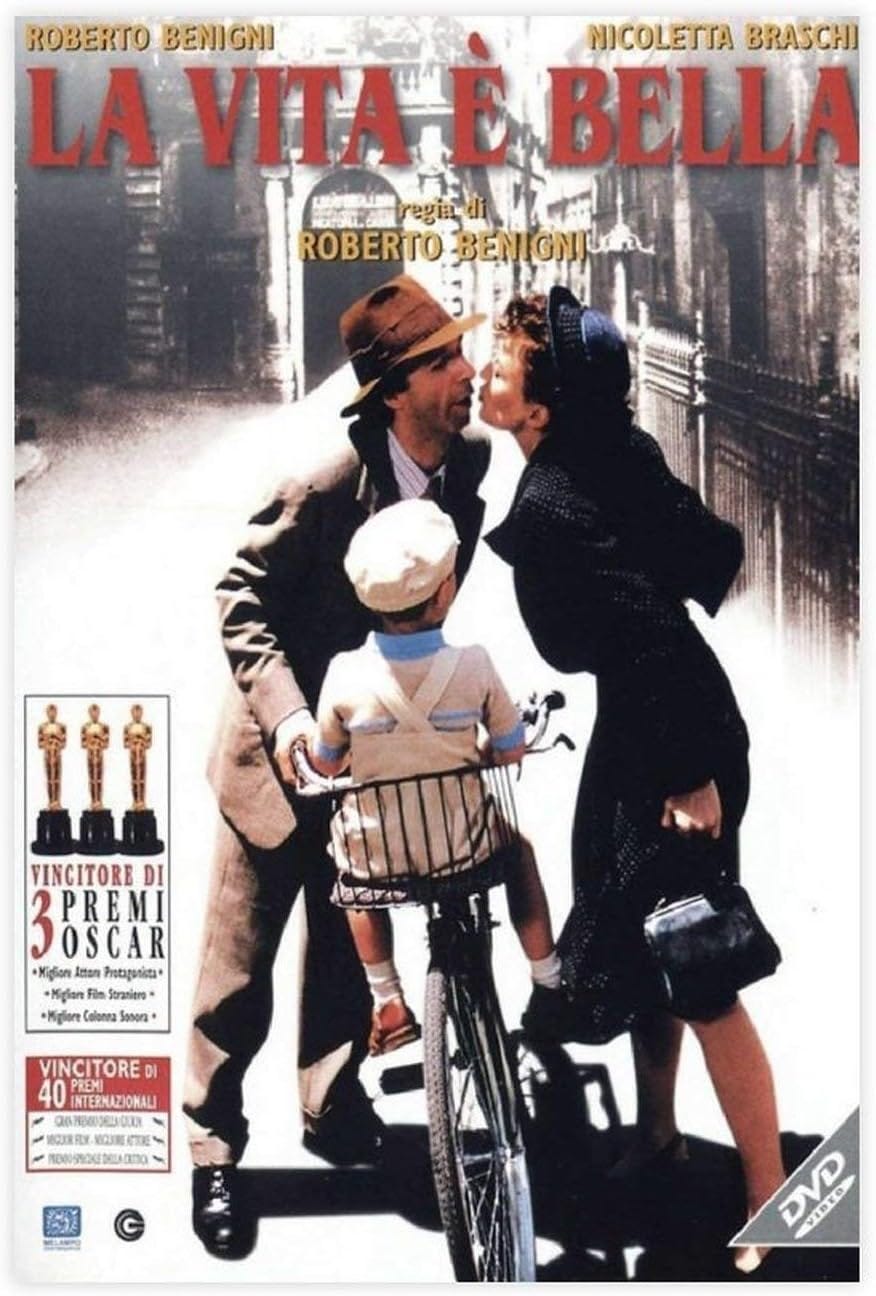
The plot centers around the deep love of a father for his young son. To shield him from the horrors of the Holocaust, he turns their experience in a concentration camp into a game, with the ultimate prize being a tank.
The film is widely celebrated internationally, having won three Oscars, but if you haven’t seen it yet, it’s definitely worth seeking out.
Italian Song of the Week
My song of the week is Napule è by Pino Daniele. Technically sung in Neapolitan, the title translates to “Naples is” in English. The song is a heartfelt ode to Pino’s beloved city.
A city of stark contrasts, with incredible highs and deep lows. It’s a stunning, yet controversial place that evokes strong feelings; it’s either loved or hated, even among native Italians.
As the lyrics say:
Napule è na cammenata Naples is a walk Dint'ê viche 'mmiez'a ll'ate Through alleys among people Napule è tutto 'nu suonno Naples is a dream E 'a sape tutto 'o munno And the whole world knows it Ma nun sanno 'a verità But they don’t know the truth
Famous Italian of the Week
This week’s famous Italian is Alberto Manzi, an influential Italian educator and writer.
In the 1960s, Manzi began hosting an educational TV program called Non è mai troppo tardi (It's Never Too Late) to combat adult illiteracy in Italy. The show featured live classroom lessons and significantly contributed to improving the literacy of millions of Italians.
Geography Fact of the Week
Matera is a city in Basilicata, renowned for its Sassi (stones) a network of ancient cave dwellings that have been around for 9,000 years. This makes Matera one of the oldest continuously inhabited cities in the world. What's particularly fascinating about this place is that people still live in these very same caves today (though they have been modernized and renovated.) It's a unique mix of history and modernity that few places can claim.
History Fact of the Week
The Anni di Piombo (Years of Lead) was a dark period in Italian history between the late 60s and the 80s. During this time, both far-left and far-right groups generated chaos through numerous acts of political terrorism.
Here is an incomplete list of major events during this tragic period:
Piazza Fontana Bombing (1969) - A bombing in a Milan bank that killed 17; attributed to neo-fascists.
Aldo Moro Kidnapping and Murder (1978) - The Italian Prime Minister was kidnapped by the Red Brigades (far-left terrorists) and killed after 55 days.
Italicus Express Bombing (1974) - A train bombing that killed 12; linked to neo-fascist groups.
Bologna Massacre (1980) - A bombing at Bologna train station that killed 85; attributed to neo-fascist terrorists.
Assassination of Luigi Calabresi (1972) - A police commissioner killed by the far-left terrorist group Lotta Continua.
Assassination of Guido Rossa (1979) - A trade unionist killed by the Red Brigades for exposing terrorism.
Giangiacomo Feltrinelli's Death (1972) - A left-wing publisher possibly killed while planting a bomb.
Roberto Peci Kidnapping and Murder (1981) - A retaliatory killing by the Red Brigades against a defector's brother.
Assassination of General Dalla Chiesa (1982) - An anti-terrorism general killed by the Mafia in Palermo.
These terroristic acts led to lasting changes in Italy's legal and political landscape, including the introduction of various anti-terrorism laws and countermeasures.
Today, Italy is significantly safer and faces less political turmoil as a result of this.
Italian Custom of the Week
In Italy, it’s not uncommon for young people to live with their parents well into their mid-thirties. While it’s easy to label this as Italian men being mammoni (mama’s boys), the reality is more nuanced.
The biggest factor is economic instability. Jobs, especially in the South, are hard to come by, and salaries tend to be low (often around 1,200 to 1,300 euros a month.) Italy is inexpensive with North American salaries, but with just 1,200 euros a month in income, staying at home simply makes financial sense, allowing young Italians to save money instead of struggling to make ends meet on their own. (In Italy, carrying credit card debt is only a recent phenomenon.)
Beyond that, there’s also a strong cultural element at play. Italian families are generally much closer than those in, say, North America. Privacy isn't as much of a priority; instead, there’s a focus on family closeness and support. For many, it’s not just an economic choice but also a way to stay connected with their loved ones.
I hope you enjoyed this edition of Weekly Dose of Italian Culture. Alla prossima! (Till next time!)


