


A Substack bestseller, Italy with Antonio offers honest guides for moving to, traveling in, and understanding Italy from a native Italian. A paid article every Monday and a free one every Thursday, with deeper resources for paid members, including print-ready PDF and ePub downloads. Join over 2,000 subscribers!
Friuli-Venezia Giulia has 215 comuni (municipalities). Run them through my framework, and you’ll end up with eight viable candidates.
The framework, as you probably know by now, screens towns based on population (between 15,000 and 100,000; not too big, not too small), availability of a hospital nearby, a high school and a supermarket in town, not in the worst seismic zone, not depopulating too fast, and so on.
Truth be told, in Friuli the population filter does most of the screening for us. Nine survive that filter. The biggest city, Trieste, is out because it’s too populated. The other 205 are too small.
The remaining filters eliminate one more town, leaving eight serious candidates for relocation to Friuli-Venezia Giulia.
What is living in Friuli-Venezia Giulia actually like?
Friuli-Venezia Giulia is Italy’s northeastern corner, and it’s the region that trips up schoolchildren in geography class. In fact, despite its name, it’s not Venezia’s (Venice’s) region. That would be Veneto just west of it.
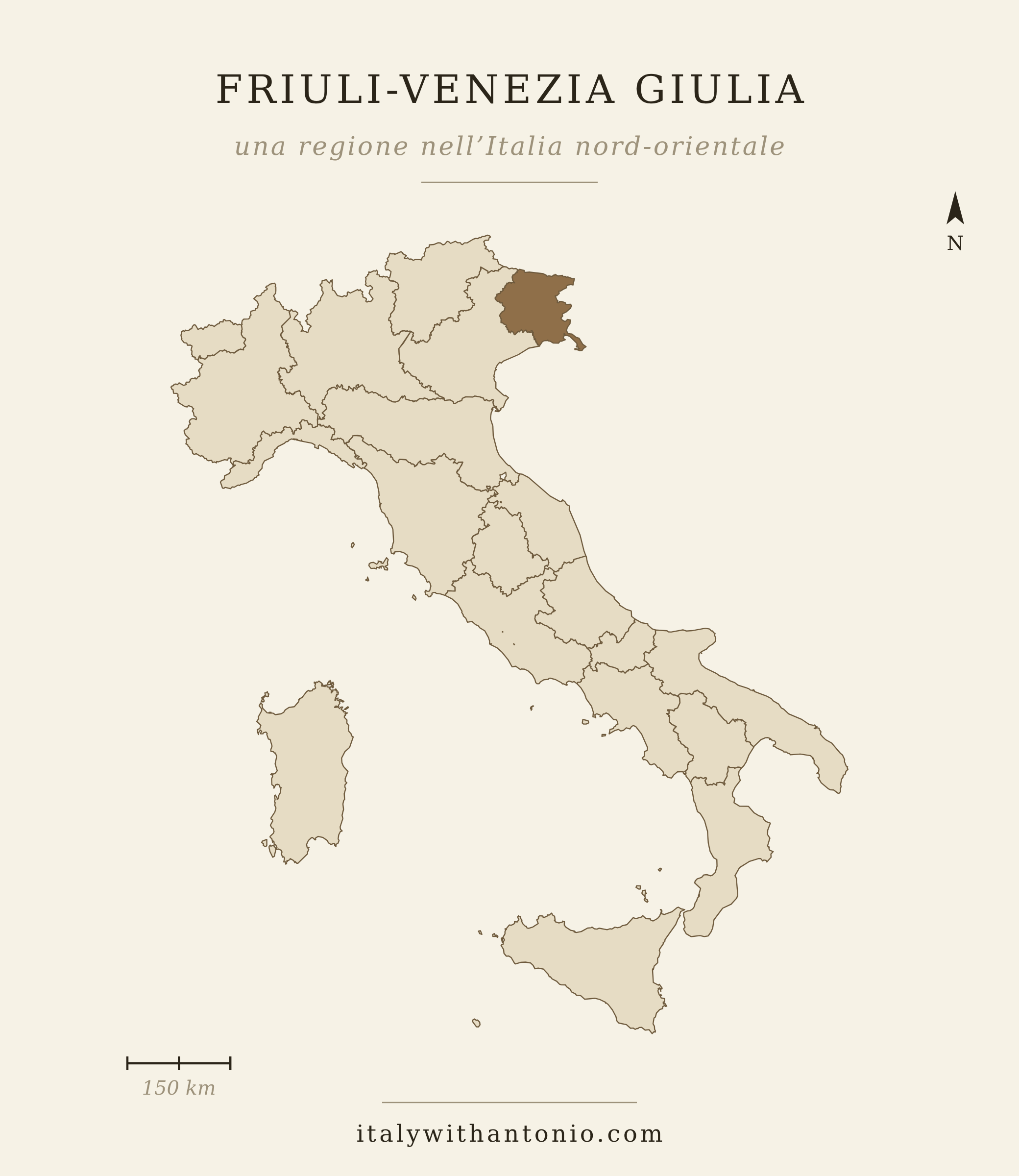
It borders both Austria and Slovenia and faces the Adriatic Sea, with interesting cultural and atmospheric consequences. As of the end of 2025, it had 1,193,496 residents, down 1.9% in ten years, which is actually good by Italian standards. One in six people in the region lives in the capoluogo di regione (capital), Trieste.
It’s a special-statute region, which means it has more autonomy and retains more tax euros compared to a standard region. Residents even get a regional discount on fuel for their private cars, and the discount grows the closer you get to the national borders.
Its provinces were abolished for roughly a decade, but the regional council voted to bring them back, effective January 1, 2027. They are Udine, Pordenone, Gorizia, and Trieste.
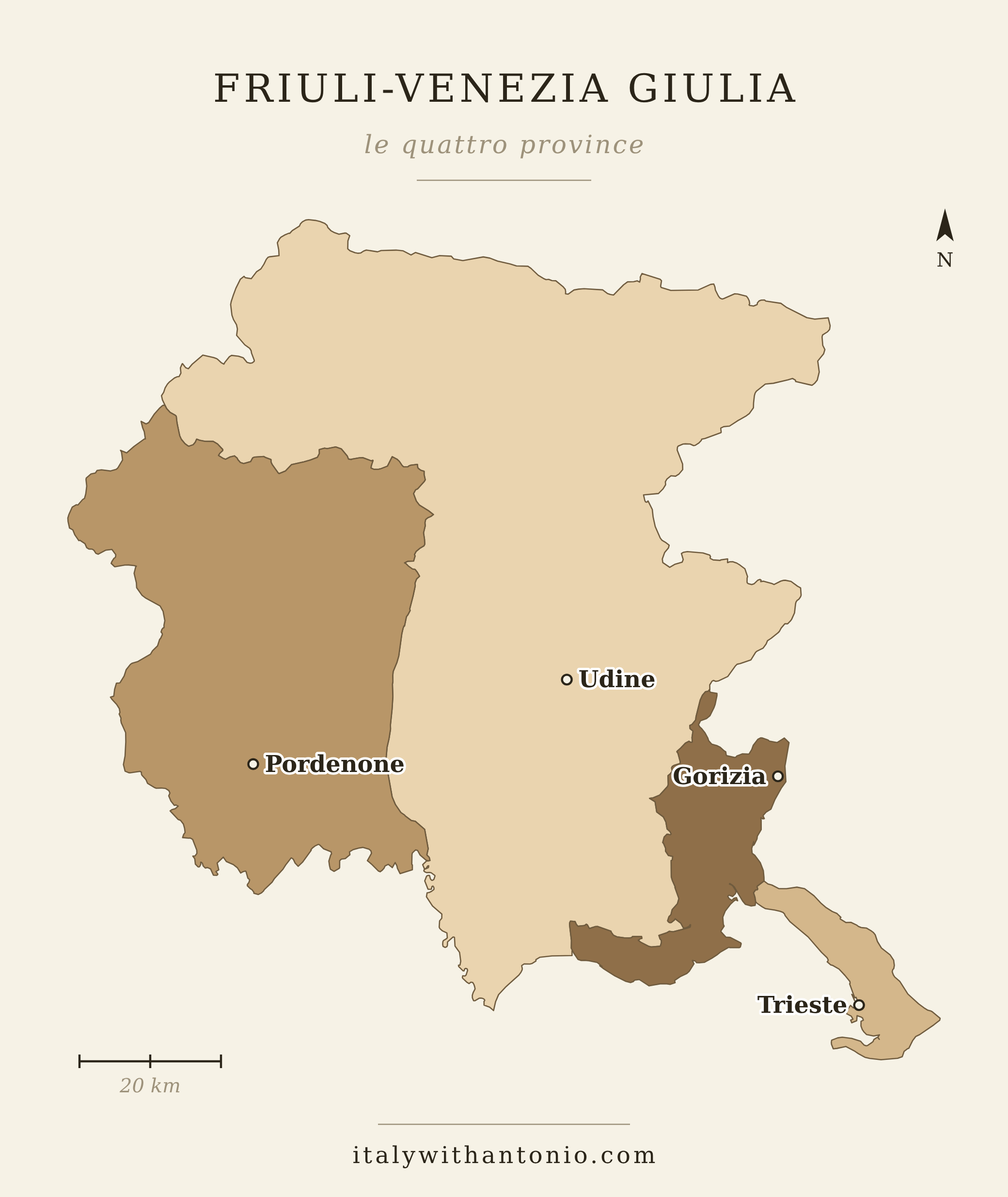
For you, a potential newcomer, nothing really changes in practice. The Questura (the police headquarters where you’d renew a residence permit) is still in each of those four cities.
Population-wise, it’s a small region. Yet its economy is oversized. Unemployment is low, sitting at 4.6% in 2025, against the national average of 6.1%. In fact, in the province of Pordenone, it’s as low as 3.0%.
Shipbuilding, appliances, steel, furniture, wine, and the port of Trieste all contribute heavily to Friuli’s remarkable economy.
It’s also well run. Il Sole 24 Ore’s 2025 Qualità della vita index ranks Udine 3rd out of Italy’s 107 provinces. Trieste is 17th, Pordenone 24th, and Gorizia 35th. All four provinces are in the top third of the table.
No place is perfect, but in the case of Friuli, the weaknesses are limited and specific. Trieste, for example, ranks poorly on safety almost single-handedly due to cybercrime. Gorizia ranks poorly on justice on account of too many disputes ending up in court.
But this is the safe north, where rules tend to be respected. Organized crime barely registers, and no Friuli-Venezia Giulia municipalities have ever been dissolved for mafia infiltration.
In terms of language, Italian will do. If you have even a basic mastery of the language, you’ll be able to communicate with everyone in the region. However, it’s worth noting that due to its geographic location, Friuli is fairly multilingual. In the countryside, you’ll see the local dialect/language (Friulian) widely spoken. Near the eastern border, Slovenian becomes more common, with six comuni officially bilingual. Finally, in a few Alpine valleys of the north, you’ll encounter German.
But Italian knowledge is sufficient to thrive across the region. Just don’t expect English outside of Trieste’s academic circles and around the US Air Force base at Aviano in the province of Pordenone.
My site, Linguetto, can help you learn Italian.
The north of the country is generally more expensive than the south, real-estate wise. However, by northern standards, Friuli is relatively cheap, provided you don’t shoot for beach or ski resort properties.
Immobiliare.it’s September 2026 regional average is €1,847/m², and it’s skewed by Trieste (€2,708) and the resorts: Lignano Sabbiadoro (€3,803), Grado (€3,714), and the ski town of Sappada (€3,577).
The rest of the region is quite reasonable and, in some extreme cases, incredibly cheap. For example, Tramonti di Sopra, up in the Pordenone mountains, only asks €301/m². That means that a 100 m² apartment (1,076 ft²) would cost about €30,000. The eight towns that pass my filter run a more normal €1,200 to €2,000. For the north, genuinely not bad.
The catch might be the weather. It’s warm (budget for air conditioning), but it rains often and some areas, such as Trieste and the coast, have incredibly strong gusts of wind.
A cousin of mine did his military service in the area, and his recollection is pioveva (it rained).
To quantify this, as I like to do around here: Trieste averaged 854 mm of rain a year from 2011 to 2020. Pordenone got 1,357 mm. Udine got 1,534. Some hamlets in the pre-Alps hit over 3,000 mm.
The local wind really is no joke. Trieste and the coast are hit by the bora, a cold wind that has gusted to 157 km/h in the city. It’s wonderful for clearing the air but an absolute killer of umbrellas. Thanks to my weight, I don’t have to worry about being lifted off the ground, but if you weigh 110 lb, you might have to give it some consideration.
The good news is that air quality is decent by northern Italian standards. The fine-particle averages are under the legal limits everywhere. Pordenone, near the Veneto border, had the worst readings due to its proximity to the Po Valley and weaker northeasterly winds.
The two bigger worries are earthquakes and flooding in some areas. This isn’t theoretical. In 1976, an earthquake in the villages north of Udine killed 990 people and displaced over 100,000. The framework spares you most of the earthquake risk by only allowing towns in seismic zones 2 and 3. Zone 1, the most dangerous zone, is out, and Friuli has no Zone 4 towns.
For flooding and landslides, I recommend using ISPRA’s IdroGEO platform to look up the specific address of a property you are considering buying or renting. Particularly for properties right on the Tagliamento, the Livenza, or the Isonzo rivers.
Applying the filter to Friuli-Venezia Giulia
Here’s the funnel. As I mentioned, the population filter screens out 206 of the 215 comuni. Trieste (198,622) is too big, and 205 are too small (below 15,000 residents according to ISTAT).
The warning against moving to a tiny village is particularly relevant here, since 95% of Friuli’s comuni sit below the line.
The nine then face the rest of the filters, and they all survive except for one. That is Azzano Decimo, a growing town of 15,760 south of Pordenone. It has everything on our list except a high school. Teenagers living here would have to commute (homeschooling is rare in Italy).
Since it’s a region of the north, the 7% tax for retirees doesn’t apply here.
Without further ado, here is the list. We’ll start with the crown jewel of Friuli’s quality of life: Udine.
The best places to live in Friuli-Venezia Giulia
1. Udine

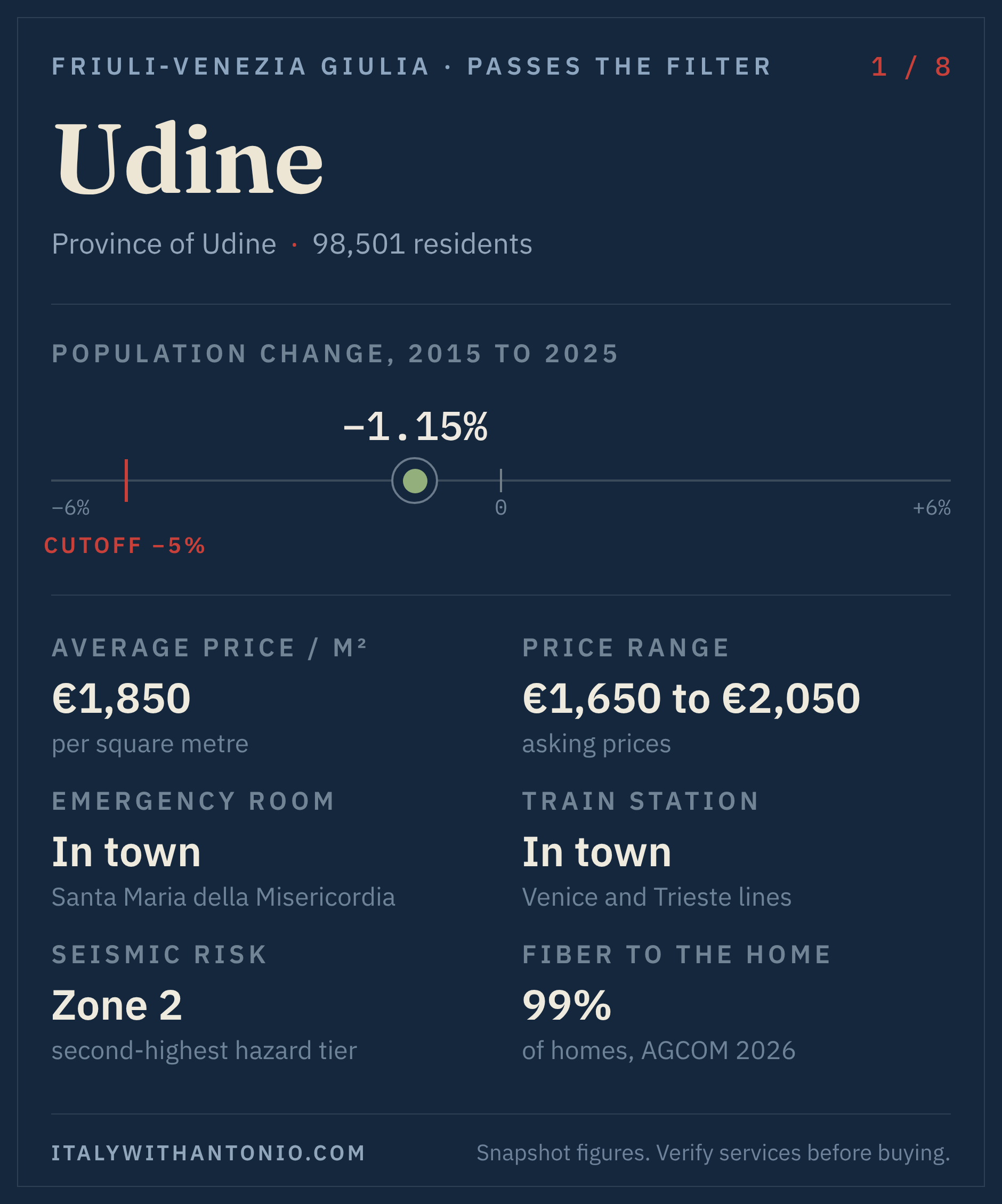
It could be argued that Udine is the region’s true capital, despite Trieste having the actual honor. It has the main hub hospital, the university, the best food in Friuli, and a Venetian-Gothic loggia in Piazza Libertà that will leave you awestruck.
Its province ranked 3rd in Italy for quality of life in 2025, and 1st in 2023. With 106 other provinces available, this is a serious achievement. At 98,501 residents, it’s also as much of a city as this framework allows you to have. All this for under €2,000/m², so you’re not even paying big-city money for it.
The downsides are the weather (1,500+ mm of rain a year) and a city that is a bit sleepy at night.
It’s for anyone who wants a proper city without a big-city price or temper. If you look at only one town in Friuli, Udine is the one.
