


A Substack bestseller, Italy with Antonio offers honest guides for moving to, traveling in, and understanding Italy from a native Italian. A paid article every Monday and a free one every Thursday, with deeper resources for paid members, including print-ready PDF and ePub downloads. Join over 2,000 subscribers!
I was born in Rome, and my filter throws it out on the first criterion: population. With 2,745,062 residents, my hometown is more than 27 times the population ceiling I set for this series, which aims to discover livable cities that aren’t too big or too small.
That’s fine. Asking where to live in Lazio is mostly asking where to live near Rome without living in it, and the region has plenty of answers: 37 of its 378 comuni pass.
The surprise is which ones don’t. Of Lazio’s five provincial capitals, only Viterbo survives.
Latina is too big. Frosinone and Rieti are emptying too fast.
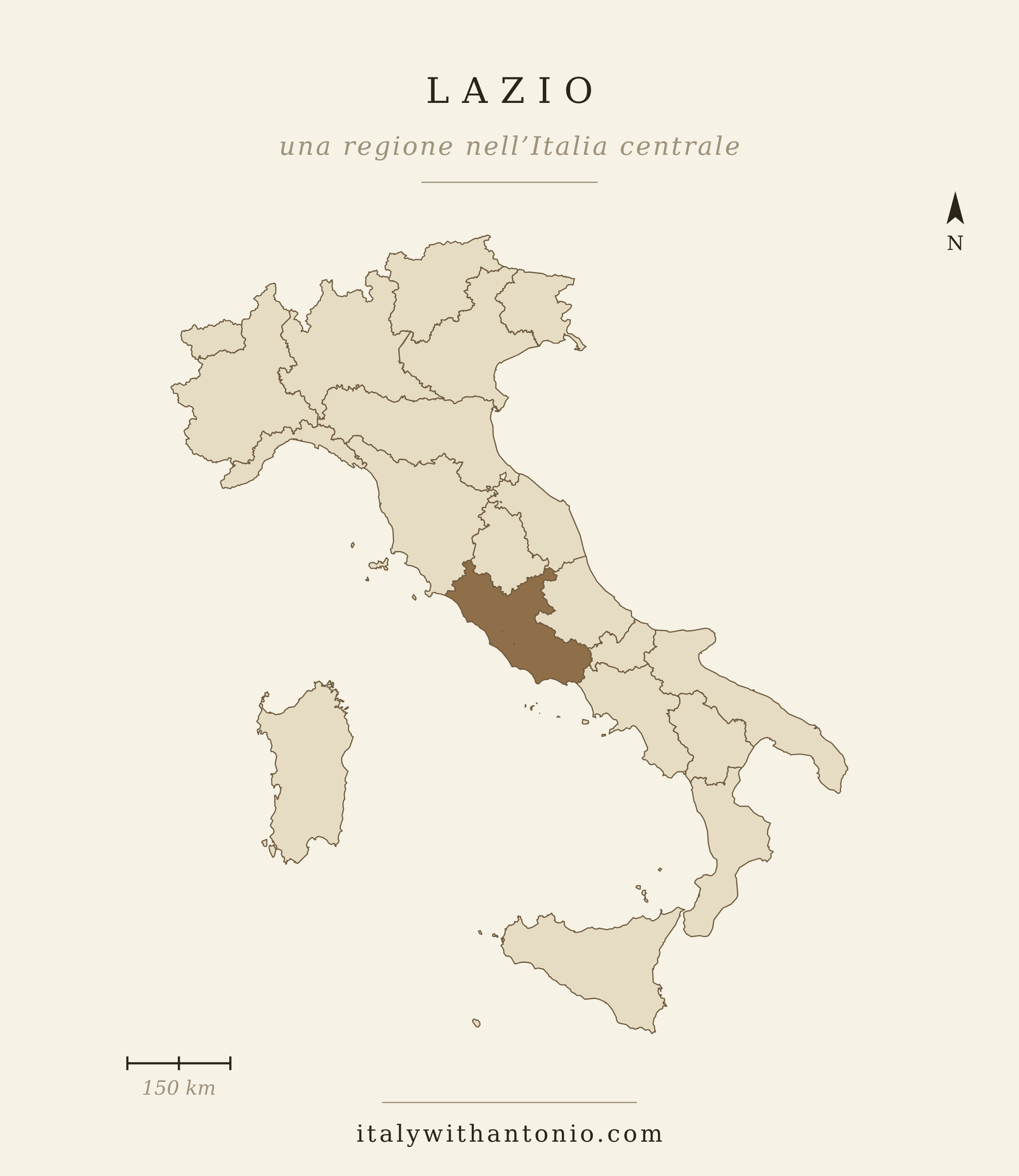
What is living in Lazio actually like?
Lazio has 378 comuni and 5,709,444 residents (ISTAT, start of 2026). There are four provinces (Viterbo, Rieti, Latina and Frosinone) plus the Metropolitan City of Rome, which replaced the province of Rome in 2015. For you, a province mostly means the capital whose Questura (police headquarters) renews your residence permit. So, really, province versus metropolitan city is just semantics for you.
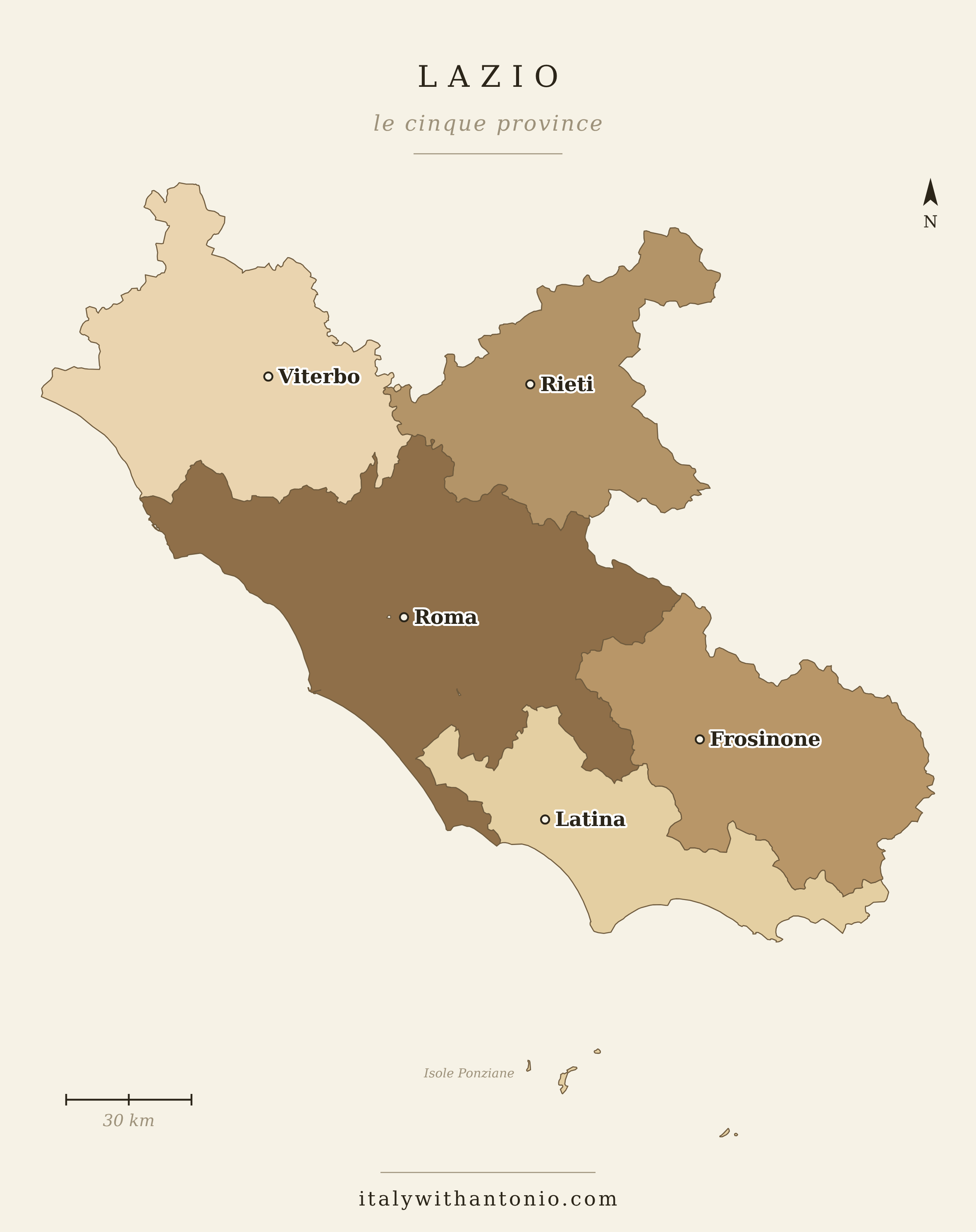
Rome isn’t so much Lazio’s capital as Lazio is Rome’s backyard. Almost half the region lives inside the city limits, and three-quarters in its metropolitan area (ISTAT). But it would be a mistake to think of Lazio as just the region that happens to have Rome in it.
Rome is also where the jobs are: ministries, hospitals, universities, two airports. Lazio’s employment rate was 64.2% in 2025, a little above Italy’s average.
Quality of life is middling. In Il Sole 24 Ore’s 2025 ranking, Rome’s province came 46th of 107, and that’s Lazio’s best. Viterbo was 71st, Rieti 75th, Latina 83rd, and Frosinone 85th.
English gets you around central Rome and not much further. The coast is mild in winter and sticky in August. Inland, Rieti sits under a ski mountain, Terminillo, and gets winters to match.
Prices show exactly where Rome’s pull ends. The regional average is €2,656/m² on immobiliare.it (October 2026). Rome asks €3,895 and the beach town of Sperlonga €5,888, while the province of Frosinone averages €803.
Terelle, a mountain village near Cassino, lists at just €218/m². There’s a reason for that.
Two Lazios: the one Rome feeds and the one it drains
The assumption is that cheap Lazio is a bargain. Mostly, it’s cheap because people are leaving.
Over ten years, the region lost 0.90% of its residents, but the average hides a split. Rome’s metropolitan area held steady (-0.27%), and Latina’s province grew (+0.62%), while Rieti’s lost 4.80% and Frosinone’s 5.85%.
The winners are the towns Rome spills into: Anzio grew 15.55%, Fiumicino 10.88%, Marino 9.61%. Meanwhile, 196 of the 378 comuni lost at least 5%. ISTAT rates half of Lazio’s comuni as highly fragile, yet only 9% of its people live in them: the population has already moved.
So the price gap is a commuting gap. Grottaferrata, minutes from Frascati and the Rome ring road, asks €2,953/m². Veroli, in the hills of the Ciociaria (the Frosinone hinterland), asks €729. One is for those who work in Rome. The other is not.
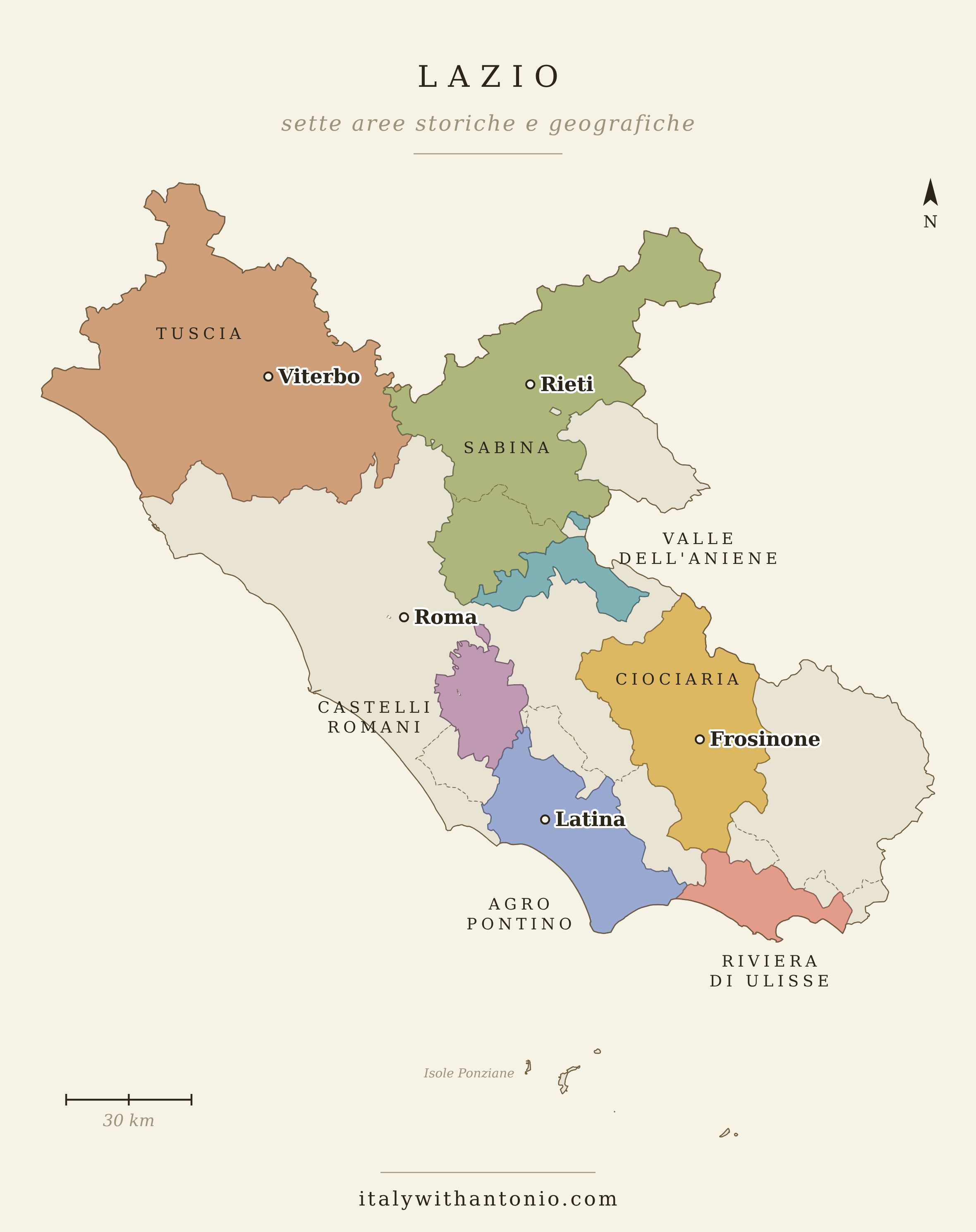
The catch south of Rome is the air, the soil, and the town hall
Earthquakes first, because everyone asks. Lazio has 43 comuni wholly or partly in Zone 1: thirty in the province of Frosinone, around Sora and the Valle di Comino, and thirteen in the mountains above Rieti, Amatrice among them. Only Sora is in my population band anyway.
The bigger problems are quieter. The Valle Latina, the corridor along the A1 motorway from Colleferro to Frosinone, traps smog. Frosinone logged 55 days over the EU daily limit for fine particulates (PM10) in 2025, fifth worst in Italy, after topping Legambiente’s list the two years before.
The same valley holds one of Italy’s largest contaminated areas. The Sacco river basin is a SIN (sito di interesse nazionale, a national cleanup site): 19 comuni and about 7,200 hectares, where an industrial pesticide residue, beta-HCH, turned up in cows’ milk in 2005 and then in the people living by the river.
Colleferro, Anagni and Ferentino pass my filter and sit inside the SIN. That doesn’t rule them out, but I hand them to you with a warning: you really should check whether the house, the garden, or the well falls inside the perimeter before you sign.
Then the coast. Anzio and Nettuno had their councils dissolved for mafia infiltration in 2022, Nettuno for the second time. Aprilia followed in 2025, the first in the province of Latina.
You’re unlikely to notice it at the bakery. You’ll notice a town run by state commissioners for 18 months and public contracts that went to the wrong people. But I don’t want to downplay the impact too much; ultimately, it does hurt you indirectly.
Applying the filter to Lazio
The framework is the usual one: 15,000 to 100,000 residents, no Zone 1 or devastated-tier cratere (the official earthquake zone), a full ER within 25 minutes, a high school and a full supermarket in the comune, fiber to the home, and a ten-year population decline under 5%.
Of the 378 comuni, 323 are under 15,000 residents, and two are over 100,000: Rome and Latina. That leaves 53.
Seismic risk removes Sora. Stability removes six, led by Gaeta, which lost 8.62% of its residents in ten years. Frosinone and Rieti go here too, with Civita Castellana, Ceccano and Genzano di Roma.
The ER filter removes three. Ladispoli’s nearest full ER is 29 minutes away. Sabaudia and Sezze barely miss, but they do miss.
Then high schools take six more, all suburbs whose teenagers commute. Ardea has 51,374 residents and no high school.
Every survivor has a supermarket and some fiber. No relaxation of the rules needed.
Of the 37 towns that pass, I’m profiling ten; the other 27 follow briefly, grouped by area.
The best places to live in Lazio
1. Viterbo
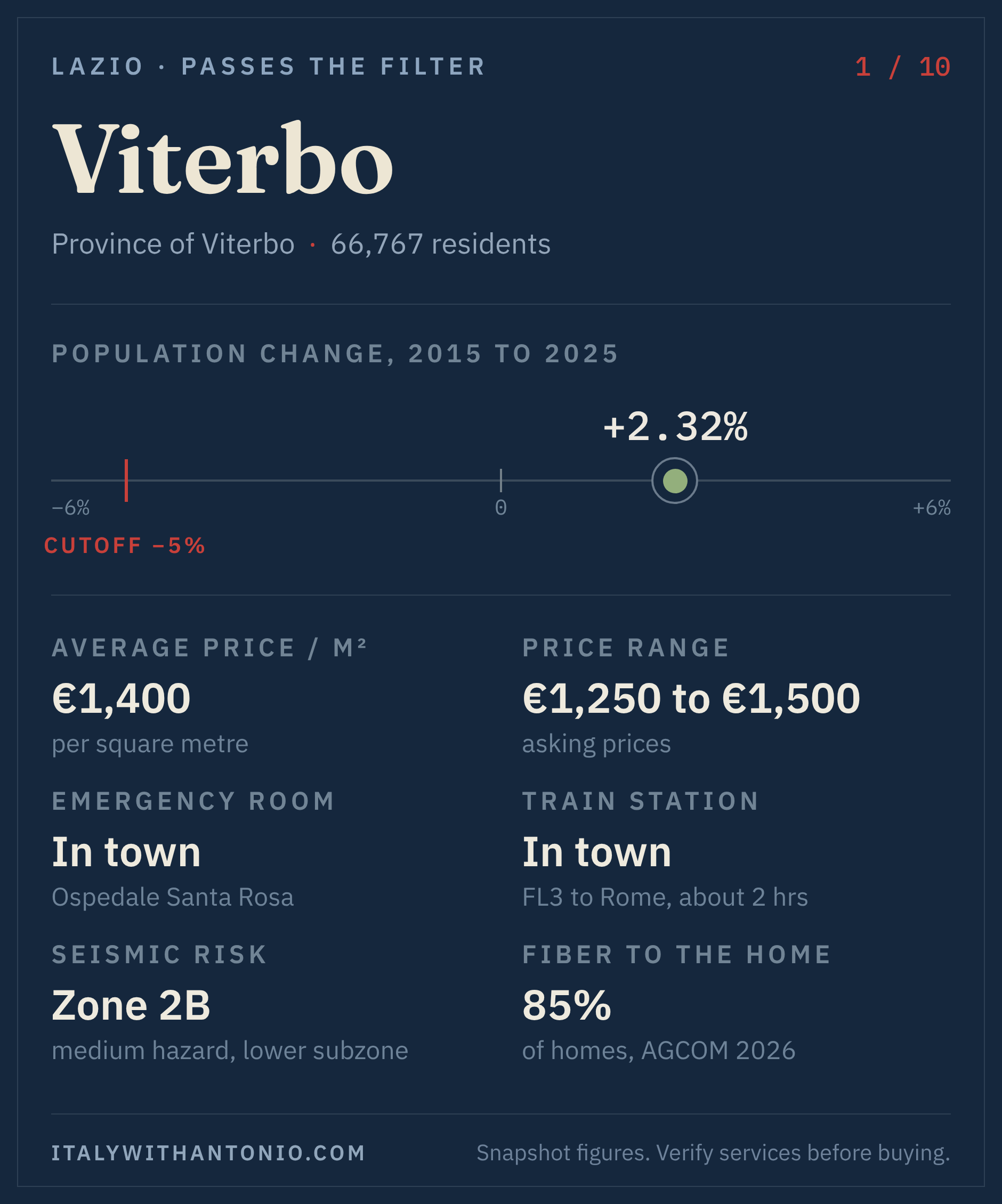
Viterbo is the only provincial capital in Lazio that passes. In the 1200s it was the seat of the popes, and the papal election of 1268-1271 dragged on here for almost three years, so long that the locals locked the cardinals in and tore the roof off.
The medieval San Pellegrino quarter is intact, hot springs bubble up just outside town, and homes cost around €1,400/m², about a third of Rome’s price. The hospital, Santa Rosa (formerly Belcolle), is a first-level DEA (the full ER tier).
The downside is access to Rome. The train takes about two hours, on a line that turns single-track beyond Cesano. You’ll go to Rome for a reason, not on a whim.
It’s for people who want a university town with a real hospital at provincial prices. The capital Lazio should be famous for (other than Rome, of course).
