


Italy with Antonio. Honest guides for moving to, traveling in, and understanding Italy from a native Italian. Three articles a week, with deeper resources for paid members. Join 1,000+ subscribers.
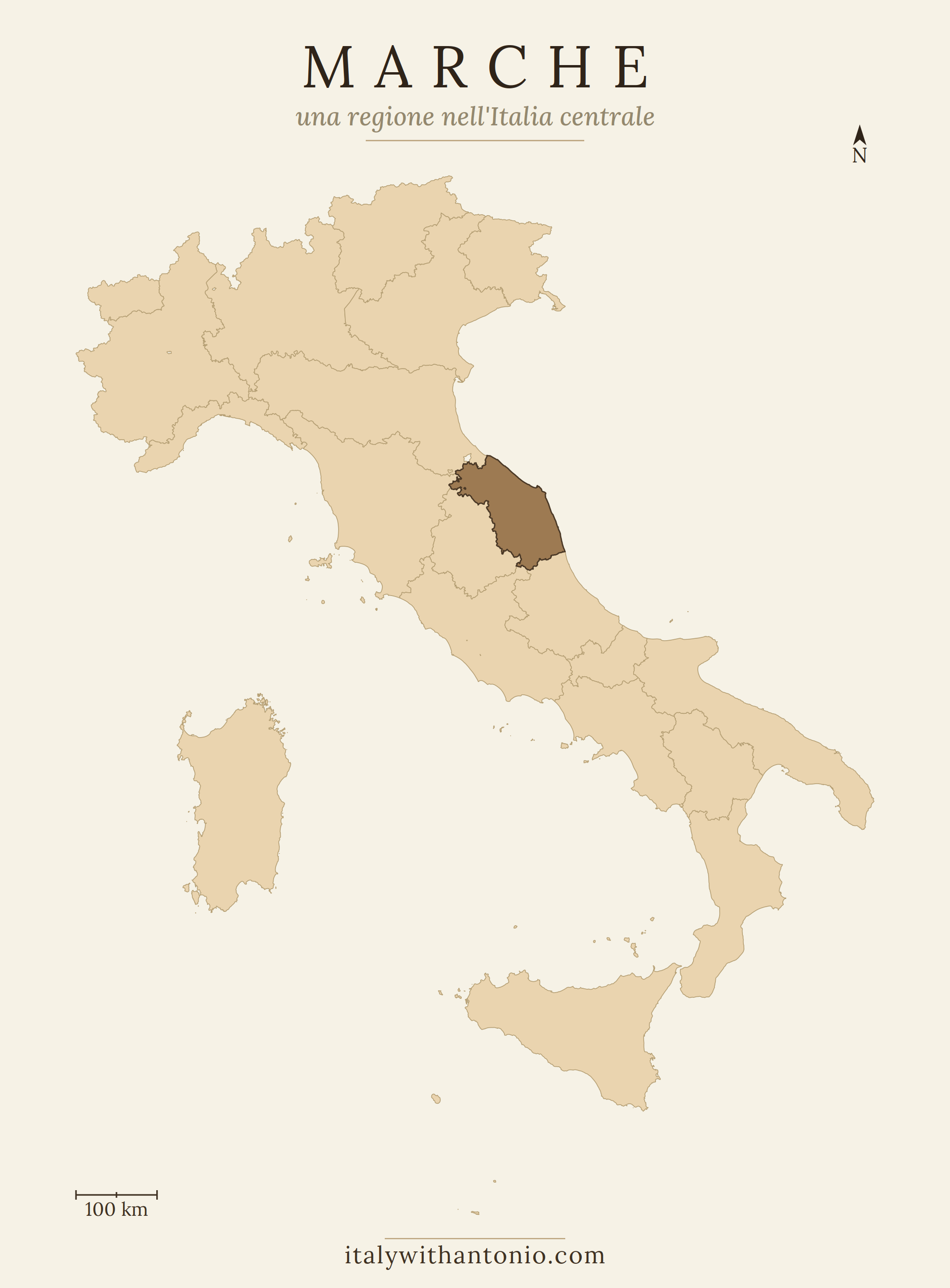
This is the first article in a series of region-specific articles on where to live in Italy. I grew up (from age 9 onwards) in the Marche, and I’m just back from a vacation there, so I feel motivated to cover it first. I’ll report on the other 19 regions at the rate of one per week.
As a reminder, the following are the criteria that we’ll use to screen for worthwhile candidates. Cities or towns worth considering for a move or for buying property.
The filters:
A population between 15,000 and 100,000
A full pronto soccorso (ER) within a 25-minute drive
A high school in town
A proper supermarket in town
Fiber internet
Not in seismic Zone 1, and not a wrecked earthquake-crater town
A depopulation rate of less than 5% over the past decade
Having a train station and being near a provincial capital are nice-to-haves, but they won’t be used to screen out candidates.
7% make the cut
Located on the Adriatic Sea, Marche has 5 provinces, and its comuni are split as follows:
Pesaro e Urbino: 50 comuni
Ancona: 47 comuni
Macerata: 55 comuni
Fermo: 40 comuni
Ascoli Piceno: 33 comuni
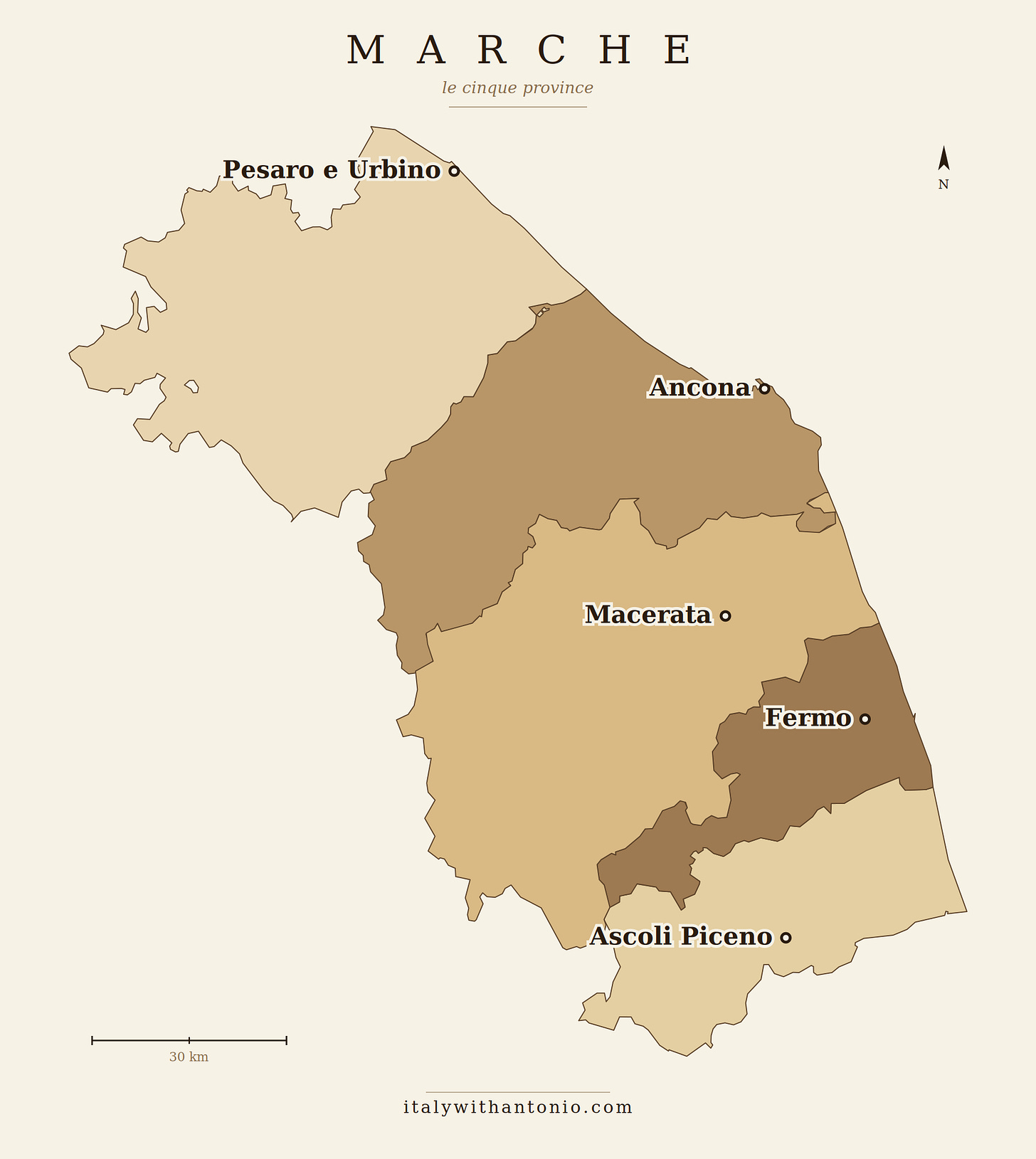
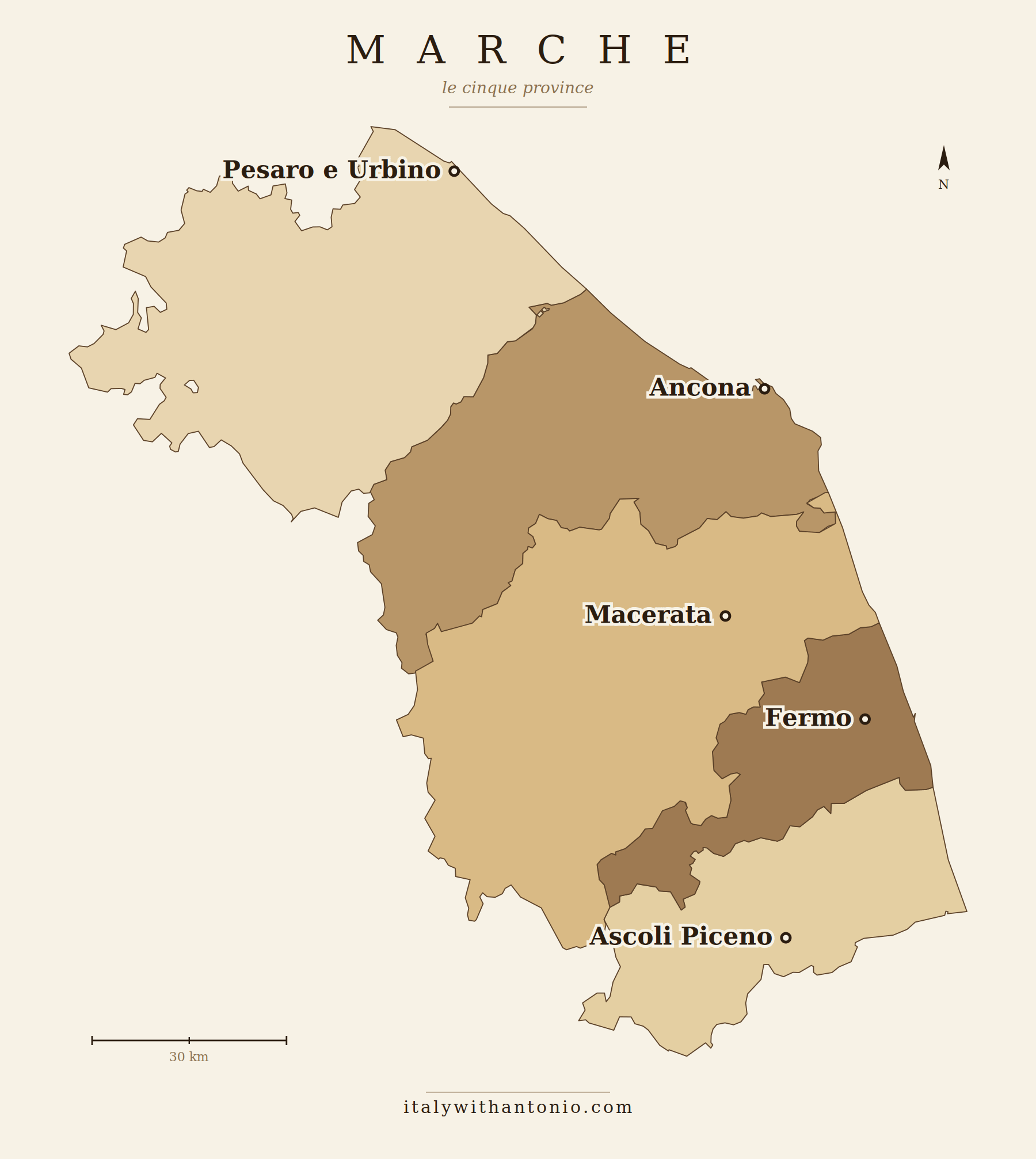
I applied our filters to every one of Marche’s 225 comuni (municipalities) and emerged with a list of 16 relocation candidates split as follows:
Pesaro e Urbino: 2 comuni
Ancona: 6 comuni
Macerata: 3 comuni
Fermo: 3 comuni
Ascoli Piceno: 2 comuni
That’s roughly 7%, which is a lot more manageable than choosing among 225 towns. There will be regions where only 1 or 2% of comuni get through our filters. So 7% is still relatively high, but that’s because the Marche region is a very livable choice full of hidden gems. The large number of survivors reflects that.
The other 209 are largely charming towns that you should visit, but not move to. Most fail at the very first filter because they are just too small. And moving to tiny Italian towns is usually a mistake.
A few words about Marche
Before we jump into the specific municipalities, let’s have a brief discussion about Marche as a whole. Only what matters.
Marche offers much of what attracts people to Tuscany: rolling hills, medieval towns, excellent food, and varied landscapes, but at lower prices and with a fraction of the tourism. You get sea, sandy beaches, hills, and bona fide mountains, all in one affordable package.
Marche doesn’t live on tourism alone. It’s also one of the most industrious regions in Italy, built on small and medium manufacturing and best known for shoes, hats, leather, and paper (the latter being an exception, since it has been an industrial-scale business here for over a century).
Now, in the original article introducing the framework, I mentioned a few systemic problems in Italy. Let’s briefly review key issues and life quality factors as they apply to Marche.
Air quality: Marche is far enough from the Po Valley that it doesn’t suffer from poor air quality, with one local exception we'll get to.
Crime: Crime levels in the Marche region are very low. Violent crime is almost non-existent compared to most North American cities. Several Marche provinces rank among the safest in Italy. Annoyances like parcheggiatori abusivi (unauthorized parking attendants intimidating you into paying for free spots) are essentially non-existent here. There is some petty crime and, for my taste, a little too much residential burglary, the organized kind often run by foreign crews that travel in to hit houses when the owners aren’t home. But on the whole, Marche is incredibly safe.
Seismic risk: This is where Marche loses significant points. Marche is almost entirely Zone 2; a handful of Apennine comuni were bumped to Zone 1 in a 2022 update, and none of them survive our population filter anyway. The coast and selected inland areas are fine, especially if you're buying or renting a home built or retrofitted to seismic code.
Climate: The weather in the Marche is relatively mild, but do not expect a Mediterranean climate like Sardinia’s. You can expect gray and relatively cold winters (by Italian standards, by Canadian standards, it’s practically warm). Think a minimum of 2°C / 36°F on a cold day. Plus the occasional snowfall. Sticking to the coast keeps the temperature mild. Go inland towards the Sibillini mountains, and you’ll get both proper snow and below-freezing temperatures at altitude. The one exception is the southern corner around San Benedetto del Tronto. Temperatures there stay mild even during the winter. It’s also much drier in summer compared to the north of the region, where afa (mugginess) is common.
English: Outside of some university towns, English is patchy at best. Marche expects you to speak Italian. Broken Italian is fine, but Italian nonetheless. The accent of Marchigiani speaking Italian (particularly in the center and north) is fairly easy to understand for expats, which is a plus for learners. Their own dialect is another story, of course.
On the whole, si vive bene nelle Marche (you live well in the Marche). On Il Sole 24 Ore’s quality-of-life ranking, the Marche provinces sit mid-table, with Ascoli going as high as 22nd out of 107 provinces. Very respectable, especially when you consider that the ranking tends to skew in favor of northern cities with more economic opportunities.
Applying the filter to Marche
If you’re seriously thinking about moving to Marche, this is where that checklist earns its keep. Run those requirements across the region, and the bulk of towns get screened out.
The population floor does the heavy lifting for us, eliminating 205 comuni out of 225. The seismic filter removes just one more: Tolentino, still actively rebuilding after the 2016 earthquakes.
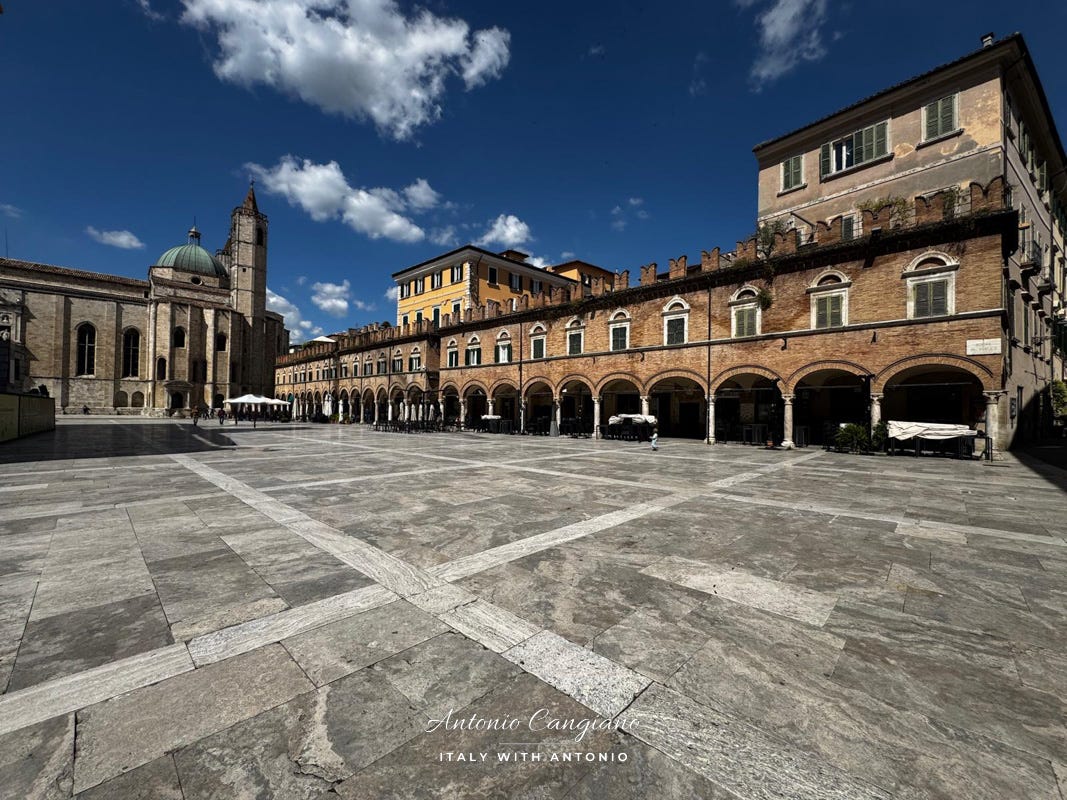
Finally, the depopulation filter erases three otherwise interesting choices: Ascoli Piceno (down 8% in the past 10 years), Fabriano (declining almost 10% due to factories closing), and Fermo (at 5.3%, just over the line).
I’ll stick to the rules and not include Fermo, the city (as opposed to the province), but I’ll leave it up to you whether to consider it as an edge case.
I’ll reveal the 16 comuni, one at a time, starting from the north.
Pesaro (PU) ~95,000
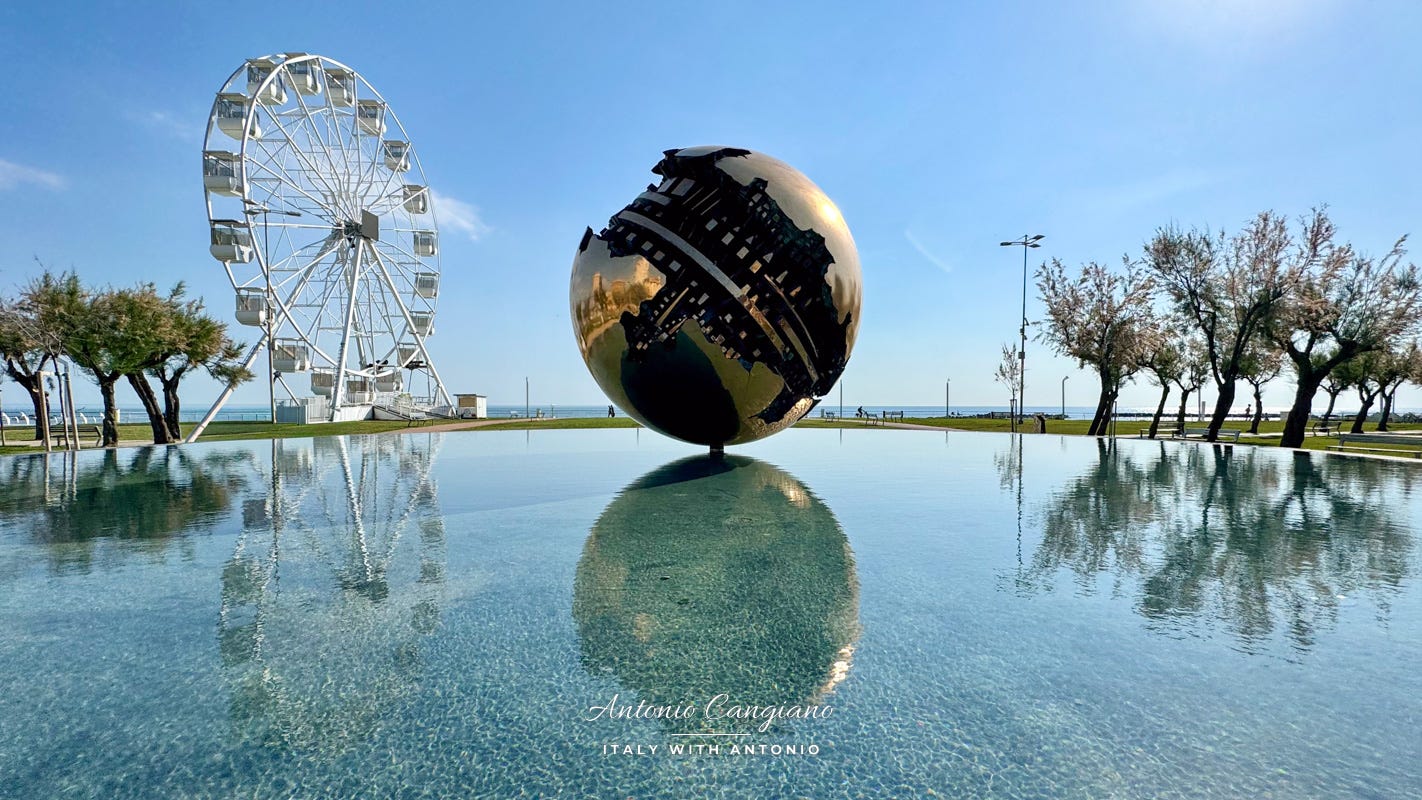
Pesaro is the capital city of the Pesaro e Urbino (PU) province. It’s located in the north of the region, not far from Rimini.
With 95,000 people, it’s on the larger side of our range and the second-largest city in the Marche region. It's still a city on a human scale that lacks nothing major.
My sister and her family live in Pesaro and are very happy there. During my recent visit, I asked cab drivers and other locals, and they all universally expressed pride for the city, as well as enjoyment for their vita tranquilla (peaceful life) in Pesaro.
Pesaro is often labelled the city of music, being the birthplace of Rossini. A lot of the cultural events are related to Rossini. And speaking of culture, it was the Italian Capital of Culture in 2024. It has a beautiful piazza with many shops nearby, as well as an impressive promenade by the seafront characterized by a giant Arnaldo Pomodoro sphere affectionately known as “la palla” (the ball).
The city also features an impressive bike-lane network known as the Bicipolitana (essentially, a “bike metro”), which is actively used by the locals and has won awards before.
In essence, you have a real city with a real beach, which doesn’t die when the summer is over. Something a lot rarer than you might think. The local hospital is very respectable, the tech infrastructure is solid, and the train station easily gets you to Bologna and from there, almost anywhere else you want.
Real estate is relatively expensive by Marche standards, but still affordable at around €2,350 per square meter.
If you want both urban and sea life in one place, this is a strong contender.
(I covered Pesaro before, if you want to dive in deep.)
