


A Substack bestseller, Italy with Antonio offers honest guides for moving to, traveling in, and understanding Italy from a native Italian. A paid article every Monday and a free one every Thursday, with deeper resources for paid members, including print-ready PDF and ePub downloads. Join over 2,000 subscribers!
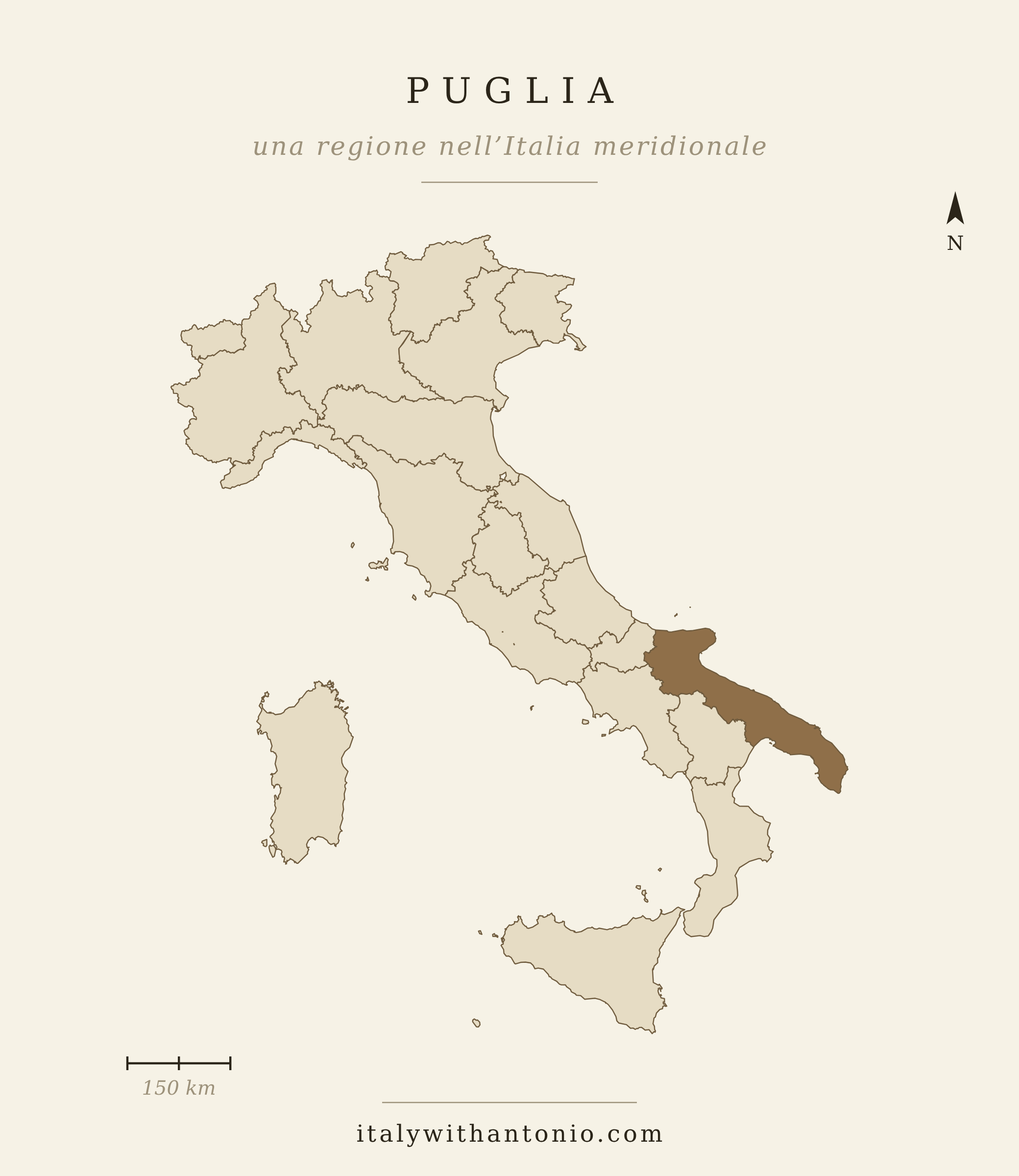
Puglia is one of the most popular destinations in Italy. It used to be a hidden gem for the most part, but the Internet happened, and the cat was out of the bag. Now, it’s not just Italians who visit Puglia every summer. It’s the whole world.
Many become so fascinated with the place that they decide they want to move there. And as far as the south of Italy goes, it’s actually a great choice.
Now, foreigners looking for a place in Puglia will often target the famous towns: Alberobello, Ostuni, Polignano a Mare. Two of them fail the filters I use in this series. The third passes, but it’s the most expensive town in the region.
I ran all 257 of Puglia’s comuni (municipalities) through the framework, and 35 make it. 20 of them in the province of Bari alone.
That’s the honest story about Puglia as a living destination as opposed to a vacation spot. The good life clusters where services are, and that generally means around Bari and other selected capitals.
If you’re new to the series, the short version is that we select towns of 15,000 to 100,000 people, outside the worst seismic zone, with a full ER within 25 minutes, a high school, a real supermarket, fiber, and a population that isn’t draining away. You end up with livable places which spare you some of the worst the rest of the region would subject you to.
What is living in Puglia actually like?
Puglia had 3,865,277 residents at the end of 2025. Ten years earlier, it had 178,458 more: more than twice the population of Brindisi, gone in a decade.
Only 18 of Puglia’s 257 comuni have grown in the same time period.
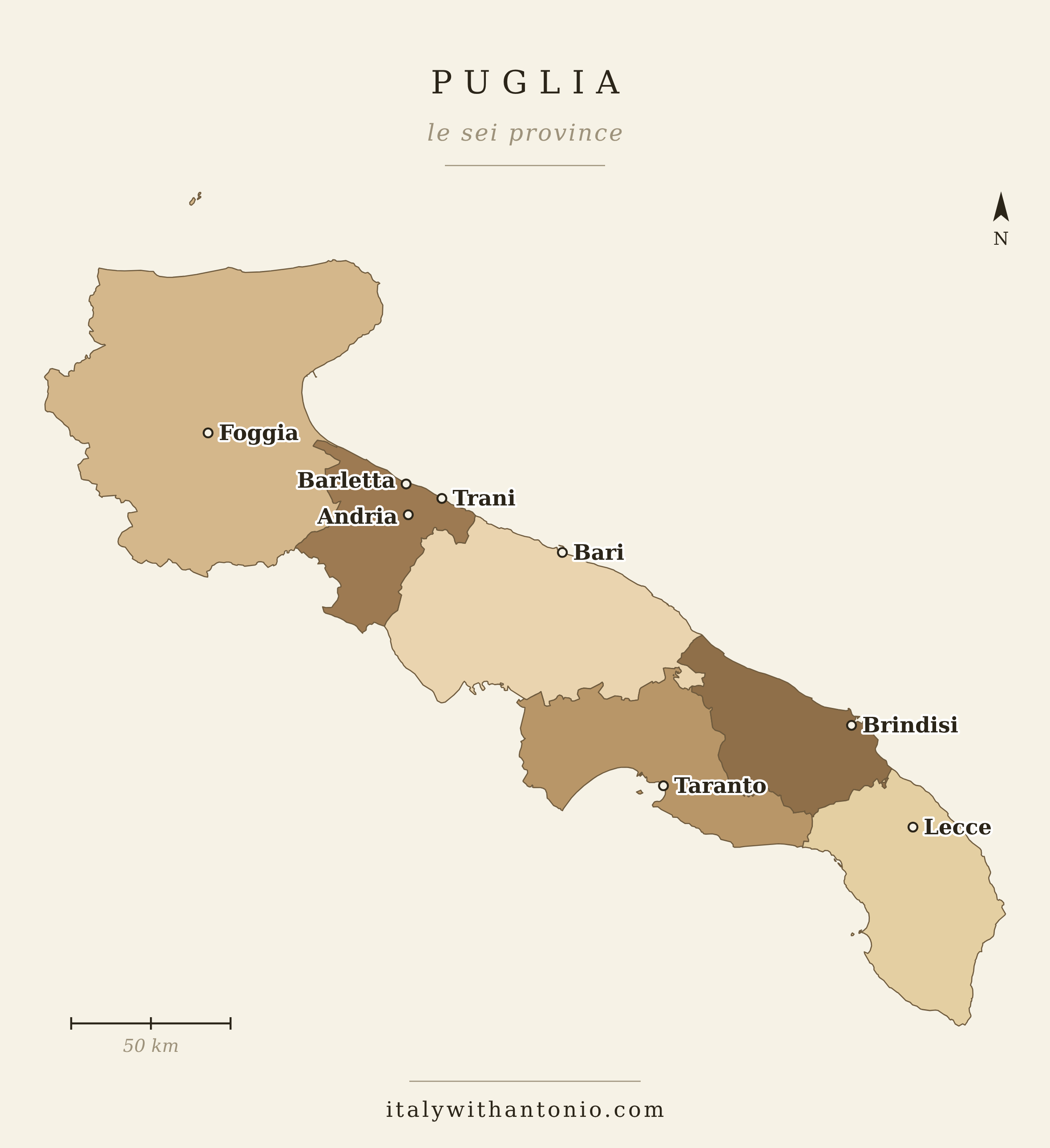
The region has six provinces. Bari is a metropolitan city, Barletta-Andria-Trani splits its capital three ways, and then come Foggia, Taranto, Brindisi and Lecce. Each has a Questura (the police headquarters where you renew a residence permit), so permit renewals stay in your own province.
Disclaimer: I have family in Taranto (uncle, aunt, and cousins). This doesn’t really bias my judgement.
This is proper south, so, as you can imagine, jobs are the weak point. Unemployment was 10.3% in 2025, against 6.3% nationally, and only 51% of working-age residents had a job. If you’re bringing a pension or a remote salary, that’s background noise. If you need a local job, it’s a major problem.
No Puglia province reaches the top half of Il Sole 24 Ore’s Qualità della vita ranking. Bari is the region’s best, at 67th of 107. Lecce is 81st, Barletta-Andria-Trani 86th, Brindisi 88th, Foggia 98th and Taranto 99th.
Organized crime is real here, and unevenly spread: three distinct mafias in Foggia’s province, the Sacra Corona Unita in the south, clans in Bari. Puglia has had 26 council dissolutions for mafia infiltration since 1991, but the good news is that there have been none since 2023.
As a resident buying an apartment or small house, you’re unlikely to notice (at most you’ll be extorted a few euros where parking is scarce). As someone opening a bar in the wrong town, you likely will.
Speaking Italian gets you everywhere. English works in Bari’s and Lecce’s tourist centers and the Valle d’Itria’s holiday rentals, and fades to almost nothing outside of that.
Property is cheap until the coast comes into the picture. Immobiliare.it’s September 2026 regional average is €1,456/m². Polignano a Mare asks €2,864, Ostuni €2,591, and Monopoli €2,581. Up in the Subappennino Dauno, Castelnuovo della Daunia asks €270, which tells you everything about that area.
Puglia is also one of the eight southern regions with the 7% flat tax for foreign pensioners, which since April 2026 covers comuni of up to 30,000 residents. It’s for pensioners who haven’t been Italian tax residents for five years and come from a country with a tax cooperation agreement, and it covers ten years. 19 of the 35 towns below qualify, so if you’re a retiree, the sweet spot is towns with 15,000 to 30,000 residents.
Puglia is sunny and dry, which is lovely, but drought is a real issue. Parts of the region get only 400 to 600 mm of rain a year, and the last water emergency only ended in July 2026. Buy a house with a storage tank and a pump (autoclave), or budget for one.
Hospitals have a Puglia-specific trap: since 2016, many small ones have become outpatient clinics without an emergency room. The building still says “ospedale”. The ambulance drives past it. Find out where the ambulance goes, not which building has a red cross on it.
Applying the filter to Puglia
Here’s the funnel. ISTAT counts 257 comuni in Puglia. 190 have fewer than 15,000 residents, and Bari, Taranto and Foggia have more than 100,000. That leaves 64.
The case against moving to a tiny village does the usual heavy lifting. But in Puglia, the second cut is the one that bites.
Seismic risk removes nobody: Puglia’s Zone 1 is ten small comuni in the Subappennino Dauno, none in the band. Depopulation removes 27, measured against ISTAT’s reconstructed 2015 baseline.
Brindisi has lost 7.45% of its residents in ten years, Gallipoli 9.21%, Lucera 9.75%, Canosa 9.80%. Manfredonia, San Severo, Grottaglie, Galatina and Ostuni go the same way.
The margins are thin. Giovinazzo passes at -4.98%, about three residents inside the line; Adelfia fails at -5.01%, about two outside it. Five people decided two towns, and I don’t round.
The service filters take two more. Ginosa fails on the ER. Capurso, a Bari suburb of 15,107, has no high school. Every survivor has a full-range supermarket and fiber.
35 towns clear the bar. So this piece is roughly 90% data and 10% apologizing for said data.
The best places to live in Puglia
1. Lecce

Lecce is the Baroque capital of the south, a university city built from soft local stone, with the best evening passeggiata (the slow stroll before dinner) in the region.
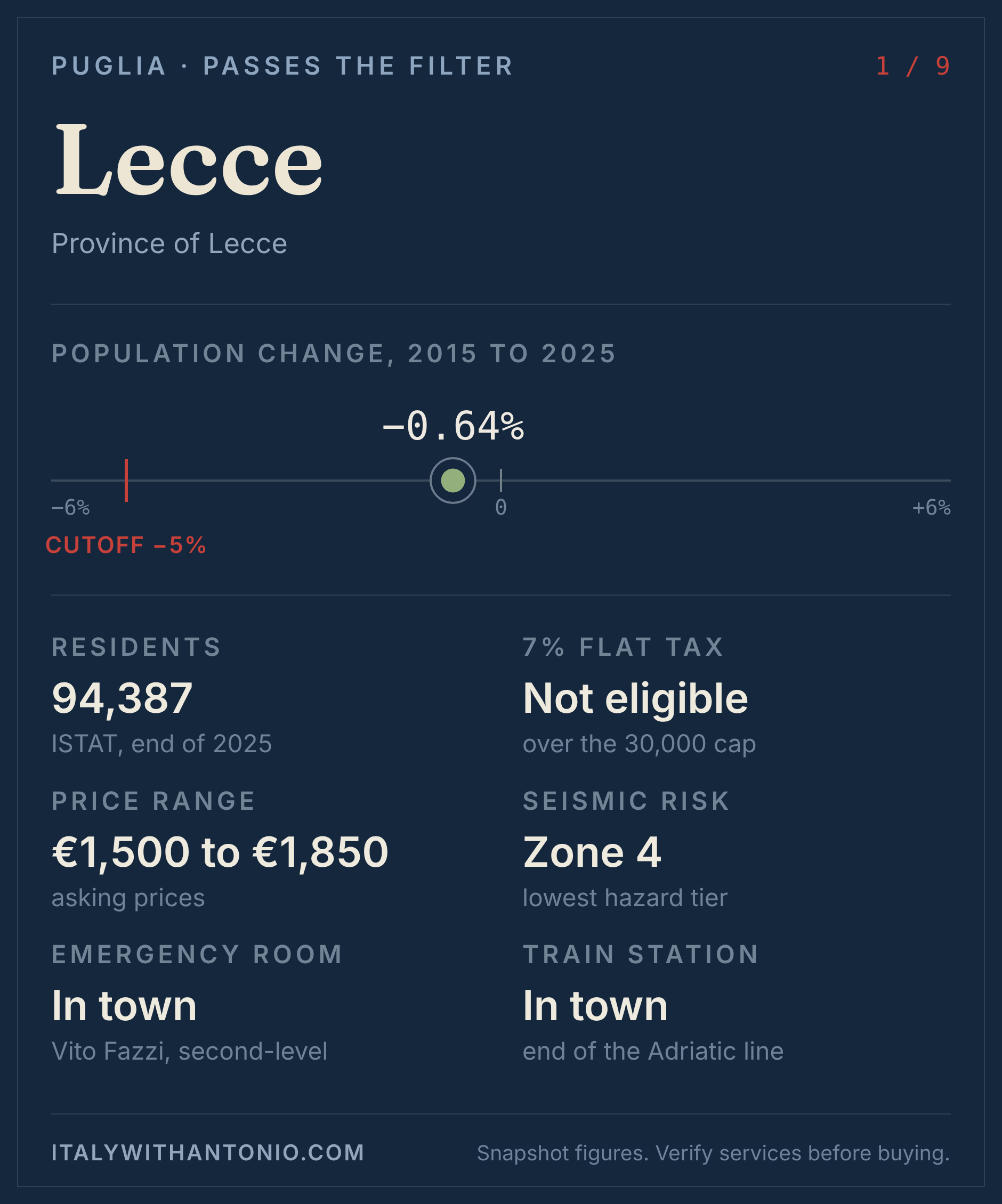
It’s also steady: -0.64% in a decade, while the region lost 4.4%. It has a second-level ER at the Vito Fazzi hospital and sits at the end of the main Adriatic railway. At around €1,650/m², it costs less than 60% of Polignano.
The downsides are crowds and distance: 421,633 tourist arrivals in 2025, and Bari a long way north. At 94,387 residents, it’s also as much city as this framework allows.
It’s for anyone who wants a proper city at the far end of Italy. If you look at only one town in Puglia, make it this one.
