


Italy with Antonio. Honest guides for moving to, traveling in, and understanding Italy from a native Italian. Three articles a week, with deeper resources for paid members (including the print-ready PDF and ePub downloads of this article). A Substack Bestseller. Join nearly 2,000 subscribers.
In 2025, Italy received eight billion visitors. Well, not quite. The real number is hard to calculate, so I’ll give you one I’m confident about instead: over half a billion overnight stays.
Rome leads the pack, of course, with 50 million. Milan: 18 million. Venice: 13 million. Florence: 11.5 million.
I’m known for finding interesting data about Italy, but these are not hard finds. Everyone writing about the country quotes these numbers as evidence that Italy is full. That overtourism is its cross to bear. Let’s call it the curse of being beautiful.
Italy is not full, though. Italy’s rim is. In the middle, it’s largely ignored by foreign visitors, and the gap between the two Italys is much larger than most assume.
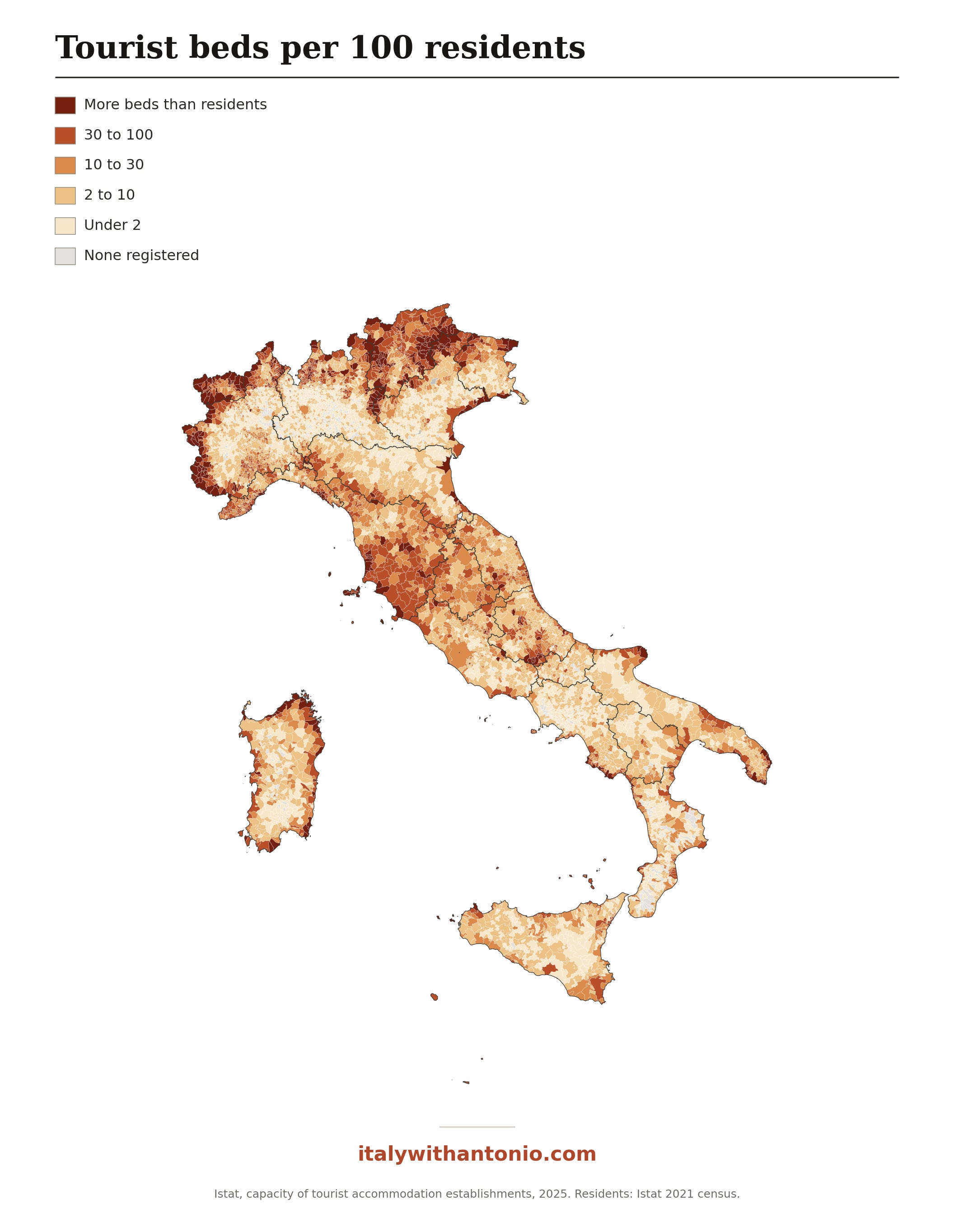
The map I generated shows all the Italian comuni (municipalities) according to the number of tourist beds available per hundred residents. The darkest areas are the ones with more beds for tourists than residents. I would argue that this is a defensible threshold for overtourism.
The pattern makes sense, but it is also somewhat counterintuitive. You would expect major cities like Rome, Venice, Milan, and Florence, despite their large resident populations, to dominate. They are certainly visible on the map, but they don’t stand out that much.
What stands out is the entire Alpine range, Tuscany as a whole, and the Ligurian and Romagna coastlines. In the south, the Amalfi Coast, the Gargano (at the top of Apulia), and the Salento (the “heel” of the country), as well as the perimeters of Sicily and Sardinia.
Still, it makes sense when you consider that the map shows a ratio whose denominator is the population. A village of 1,000 people in the Dolomites receiving 150,000 visitors a year needs far more beds per resident than a city of 2.75 million that receives tens of millions of overnight stays.
The rest of the country is, for the most part, pale. Not many people live there, and not many people visit, so the tourism infrastructure is thin, including the number of beds available.
In the whole country, there are 7.7 million tourist beds. Yet 2,249 comuni have fewer than two beds per hundred residents, and 450 have zero registered tourist accommodations.
Where tourism in Italy actually is
Istat counts accommodation capacity in every one of the 7,896 comuni. For 450 of them, the count is zero. But it publishes visitor figures for only 4,531. So 2,915 comuni (i.e., 7,896 - 4,531 - 450) have registered accommodations and do not appear in the published visitor statistics.
That is 37% of the country. Almost 3,000 comuni hold 151,026 tourist beds between them. The median one has 32 beds and 1,445 residents. Despite the available lodging, there is no measurable tourism. These places are not underrated or undiscovered by the masses. They are statistically invisible.
Volume is only one part of the equation
The volume of tourism is a valuable metric, but equally interesting is when tourists arrive.
At the national level, July and August alone account for 34% of all overnight stays. The median comune gets roughly 32% of its overnight stays during those two months. However, Sellia Marina in Calabria gets 83% of its overnight stays in that period. Taviano, Maruggio, and Salve in the Salento, and Vico del Gargano all exceed 72%.
So some towns can genuinely be quiet for 10 months and then receive an overwhelming number of visitors in eight weeks. Annual numbers mask all that.
And the data shows that some places have volumes of tourism that leave room for little else. For example, the resort town of Lignano Sabbiadoro has 1,407 tourist beds for every 100 residents. And the picturesque Limone sul Garda records 1,044 overnight stays per resident each year.
So Italy doesn’t have a tourism problem. It has a concentrated tourism problem. Tourism that overwhelms certain places, certain regions, and certain months of the year.
What these numbers cannot see
Full disclosure, there are two limitations to the data Istat offers us.
Overnight stays only count people who sleep in the given place. Day-trippers don’t count. Cruise passengers storming seaside cities don’t count either.
Consider the tourist beds as a floor, not an exact count. There are definitely unregistered short-term rentals, especially in the south, which are missing from the official data.
Neither of these two limitations changes the overall picture. The map still gives a good picture of the general level and location of tourism pressure in Italy.
The point
Overtourism appears in every conversation about Italy. Rightly so. But it’s important to understand that it’s also highly concentrated and seasonal.
Beyond the hot spots lies another Italy made of thousands of comuni with little tourism infrastructure, few visitors, and in many cases serious population decline.
Some are pleasantly overlooked. Hidden gems, really. Others are isolated, shrinking, and economically stagnant. In many cases, truly not worth the visit.
From a visitor’s perspective, the question you should be asking when considering a town off the beaten path is: why don’t tourists go there?
Sometimes the answer doesn’t invalidate the effort to get there. Hidden gems do exist. Sometimes the other tourists are right.
Sources and credits
Map data are credited on each image. Administrative boundaries are Istat’s, obtained via openpolis/geojson-italy and released under CC BY 4.0. Comune population and code lookups come from Open Data Sicilia’s comuni-italiani. Maps built in Python by me. All analysis, classification, and errors are mine.
Italy has so much to see and do. It would take three lifetimes. Incredible diversity of huge national parks—mountains, grasslands, forests, wetlands, coastlines. It's "Wilderness" with a capital "W." You might not see an Italian for years. For outdoors people, this is the place to go. I highly recommend Tim Jepson's Wild Italy: A Traveller's Guide, to start your vacation planning.
STOP TELLING THEM ABOUT THIS!!!!
Last thing I want is Umbria turned into a low-rent Tuscany.