


Italy with Antonio. Honest guides for moving to, traveling in, and understanding Italy from a native Italian. Three articles a week, with deeper resources for paid members (including the print-ready PDF and ePub downloads of this article). A Substack Bestseller. Join nearly 2,000 subscribers.
In Italy, soccer is religion. It’s hard to understand how much it shapes the country and public discourse if you didn’t grow up there.
When asked what they aspire to be, most Italian boys respond that they want to become soccer players.
Boys, regardless of inclination, will play soccer with their friends. I contracted osteomyelitis at the hospital as a newborn. I wasn’t supposed to live. I lived. Doctors didn’t think I would ever walk. I walked. But my knee and leg have hurt all my life, and even I played soccer. I wasn’t particularly good at it because of physical limitations, but, chubby and limping, I still played.
The old men at the bar reading the newspaper are often reading a pink one. Don’t mistake it for a sign of progressiveness. What they are reading is La Gazzetta dello Sport, a sports daily newspaper which has a heavy focus on soccer.
Italians adopt various forms of national gambling that are more or less socially acceptable and mainstream. For most of the last century, none was as popular as betting on soccer games with la schedina del Totocalcio, a card for guessing the outcomes of 13 Serie A and B games, Italy’s top two leagues. Fare 13 (literally: doing 13) meant winning a small fortune. It became shorthand for a jackpot, and it’s part of why the number 13 is actually considered lucky in Italy.
Today Italians are still overwhelmingly betting on soccer more than any other sport, but they do so through digital means such as apps on their phone, chasing the modern version of the 13, the multipla (guessing several matches but not necessarily 13).
Soccer is genuinely a big deal in Italy. You can’t go a day without someone mentioning it. Soccer players are worshiped.
A 30-year-old local soccer player started dating and married an 18-year-old girl in my high school. It didn’t cause a scandal in part because an age gap is less frowned upon in Italy, and in part because he was (I believe) a Serie C player. And in a small town, that’s a big deal, and it’s akin to celebrity status.
Baggio, Del Piero, Maldini, Totti, Maradona. They haven’t played in decades, and everybody in Italy still knows who they are.
Maradona is essentially a lay saint in Naples, including murals and shrines that put those of actual saints to shame.
In Paolo Sorrentino’s “The Hand of God,” one of the kids asks his brother if he’d rather choose Maradona being acquired by Naples’ soccer team or having sex with his attractive, exhibitionist aunt Patrizia. The teenager, hormones be damned, answers without hesitation that he’d rather have Maradona play for Naples. (Spoiler: in real life he did and won a Scudetto for Naples, the yearly championship in Serie A.)
Italy became bad at soccer
With so much love, attention, and frankly money thrown at soccer in Italy, it’s hard to explain how we became so bad at it.
On March 31, 2026, Italy failed to qualify for the FIFA World Cup by losing to Bosnia and Herzegovina on penalties. The third straight World Cup miss for Italy. No former champion has ever missed three in a row.
We didn’t lose to Brazil. We lost to Bosnia and Herzegovina. For context, Bosnia and Herzegovina was devastated by war just a few decades ago and has a smaller population than Tuscany.
It’s the equivalent of the United States failing to qualify for the Olympic basketball tournament. Or New Zealand’s All Blacks missing the Rugby World Cup. Or India missing the cricket one. Now imagine them doing it three times in a row. It’s genuinely shocking.
Essentially everybody in Italy is complaining about the national team and how badly we are doing in soccer. Get the priest, bad.
Yet, in the sports we underfund and more or less ignore, Italy is absolutely dominating.
Over the past two weeks or so, two European championships took place: the European Aquatics Championships in Paris and the European Athletics Championships in Birmingham.
Across 17 days, Italy won 23 continental titles. As we say in Italy, scusate se è poco (our apologies if it’s too little).
Italy dominates in the pool
In Paris, Sara Curtis, a 19-year-old girl, broke the world record in the 50-meter backstroke. She did it twice, the second time winning the final in an astonishing 26.56 seconds.
Simona Quadarella won the distance freestyle in the 400, 800, and 1,500 meters. Her 400-meter swim broke a European Championship record Federica Pellegrini had held since 2008.
Chiara Pellacani won five diving golds, the first diver ever, male or female, to take five in a single European Championship.
Ginevra Taddeucci won open-water gold in the Seine.
Italy dominates on the track
On the track, in Birmingham, Nadia Battocletti won the 5,000 and the 10,000 meters, the first runner ever to complete that doppietta (double) at two consecutive European Championships. You can watch her 5,000-meter run, in which she is in third place and, at some point, decides to say goodbye to the rest of the field by leaving them all behind.
Larissa Iapichino won the long jump with her opening attempt. 7.00 meters exactly, which made her the first Italian woman to take the outdoor European title in the event. By the way, buon sangue non mente (literally: good blood doesn’t lie), as she is the daughter of two-time world champion Fiona May. She’s trained by her father, a former national-level pole vaulter and long jumper.
And the men won too, in the pool and on the track. Nicolò Martinenghi took the 50 and 100 meters breaststroke. Leonardo Fabbri won the shot put, Gianmarco Tamberi won the high jump, Andy Diaz won the triple jump, and Massimo Stano won the race-walk marathon. Then Scotti, Sito, Soudassi, and Benati stole the 4x400 meters from Britain by 0.03 seconds during the final.
Italy took 43 medals in Paris, more than any other country in the world. It also finished at the top in athletics for the second championship in a row. In total, 23 European golds in 17 days. Most of them by women. Again, scusate se è poco.
Why Italy got bad at soccer
I posted some of these stats in a Substack note, and somebody asked me why Italy, who used to be so good at soccer, is struggling.
Jokingly, I said that we should blame the immigrants (enter the old man yelling at immigrants stereotype). But my theory genuinely has to do with importing foreign talent.
My gut feeling was that Italy has so much money for its league that it just buys the best available talent in the world instead of cultivating the one it has at home.
I’m a data guy, however, and I don’t like to have theories that are not backed by data (even if correlation doesn’t imply causation, of course). So I looked it up, crunched the numbers, and my theory appears to have supporting data.
The irony is that a country that keeps throwing money at a sport is unable to produce a decent team, specifically because of the money.
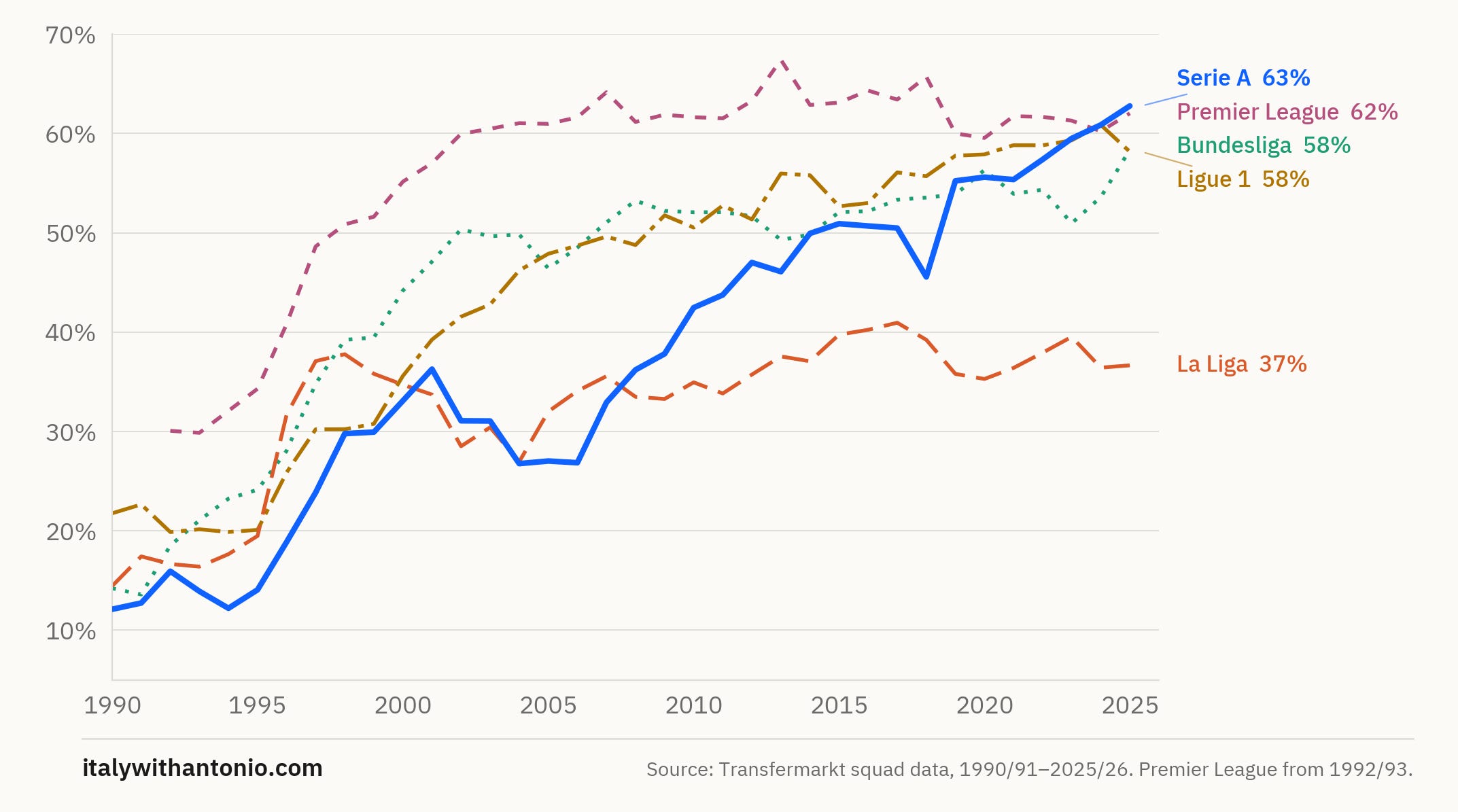
Foreign players now hold about 63% of all team spots in Serie A. It’s the biggest share out of the big five leagues in Europe.
Back in the 1990s, the Serie A was actually the most closed league in Europe. Close to 90% of players were native Italian.
Regulations changed, and that opened the floodgates. Italian teams sought the best talent they could find around the world, and money ensured they could acquire it.
So a 19-year-old Italian kid in Serie A will now play very little, no matter how talented. Italian under-21s get around 2% of total Serie A minutes, and many will not play at all for the entire season.
Demographically, the Italian league is one of the oldest in Europe. The average age is near 27. Managers are risk-averse and would rather deploy a proven 30-year-old foreign player than a promising teenager who might cost them the match.
In terms of local talent trained in Italy, we rank last among the major nations for money earned selling players. Remember Baggio, Del Piero, Maldini, Totti? We stopped making them.
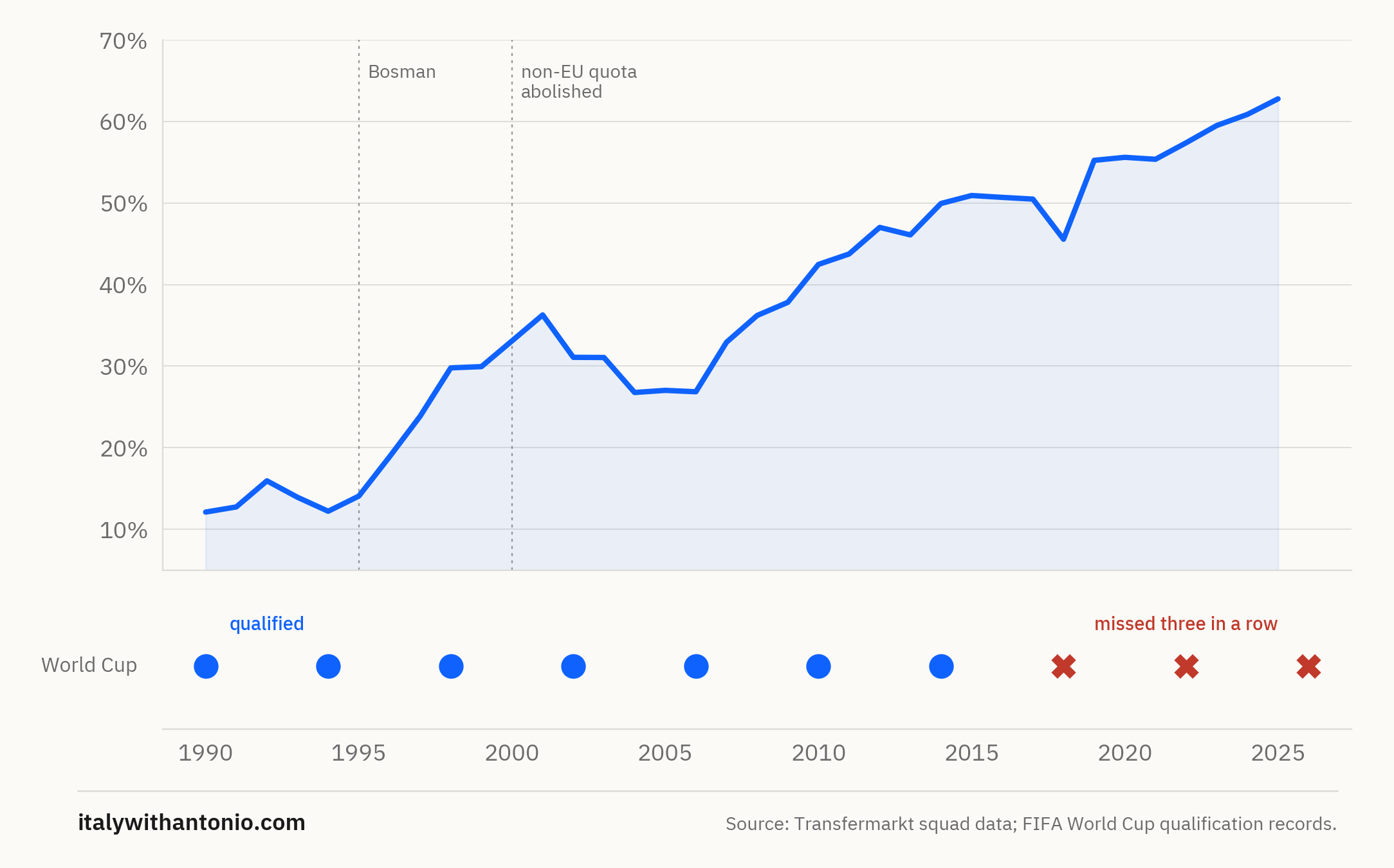
In the chart above, I placed the foreign share of Serie A players against the World Cup results. The pipeline of young Italian talents simply ran dry, and the results, or lack thereof, eventually showed up.
Of course, money is not the only culprit. There are other technical aspects that are specific to tactics, manager choices, and other factors.
But I contend that Serie A teams have a choice to make each summer: they can spend their money on a finished player dominating the field in some corner of the world, or they can bet on one grown at home. They take the former option most of the time.
The sports with no money
Go back to Paris and Birmingham and notice what those athletes share. Nobody bought them. Little money to invest. No foreign long jumper to import. Italians competing in these sports are all we’ve got, and we must make them as good as possible if we want to win medals.
And constraint tends to agree with Italy. I argued before that our country is usually better for what it lacks than for what it has in excess.
Give a swimming or athletics federation no money and a roster it can fill only with local athletes, and you get Sara Curtis. Give a club a global transfer market and millions to spend, and you get a bench full of foreigners and a native team that loses to Bosnia.
One last thing
If you are moving to Italy, or loving it from a distance, know that soccer is the national nervous system. Maybe one day we’ll learn to fully appreciate all these sports in which Italians shine despite the lack of resources and national support.
For the time being, though, know that when Italy does badly at soccer, the whole country reports that pain.
Right now some of us are celebrating Curtis or getting emotional at watching Battocletti take off.
Just know that at the bar, the old men are still arguing about soccer.
Interesting article. Having watched both the World Cup and the European Athletics Championships (sorry to say I missed the swimming but there are not enough hours in the day to watch all the sport on UK TV in July and August so something has to give) the absence of Italy from the former and excellence of its athletes at the latter was very stark. Congratulations to them all!
However I’m not sure I can entirely agree with your conclusions. As your helpful graph shows, the Premiership is only just behind Serie A in its percentage of non native players but (not wishing to rub this in in any way) we came third in the World Cup. We also fund our top athletes (and this includes a vast variety of sports from athletics itself to archery and curling) from the National Lottery Fund which has paid enormous dividends though not enough to overcome the fantastic Italian athletes and swimmers who it would appear have achieved their dreams on a shoestring budget.
So whilst I see your argument I’m not sure that it entirely explains the phenomenon you have described.
I’ve been saying this—to Italians in Italy, no less—for the last three years. Antonio, we share the same sentiments. And yours are backed by hard data. 👏🏻
I’m hoping with Italy’s national team’s regrouping and rebuilding a management team, will yield a team Italy was once known for: world-class winners.