


A Substack bestseller, Italy with Antonio offers honest guides for moving to, traveling in, and understanding Italy from a native Italian. A paid article every Monday and a free one every Thursday, with deeper resources for paid members, including print-ready PDF and ePub downloads. Join over 2,000 subscribers!
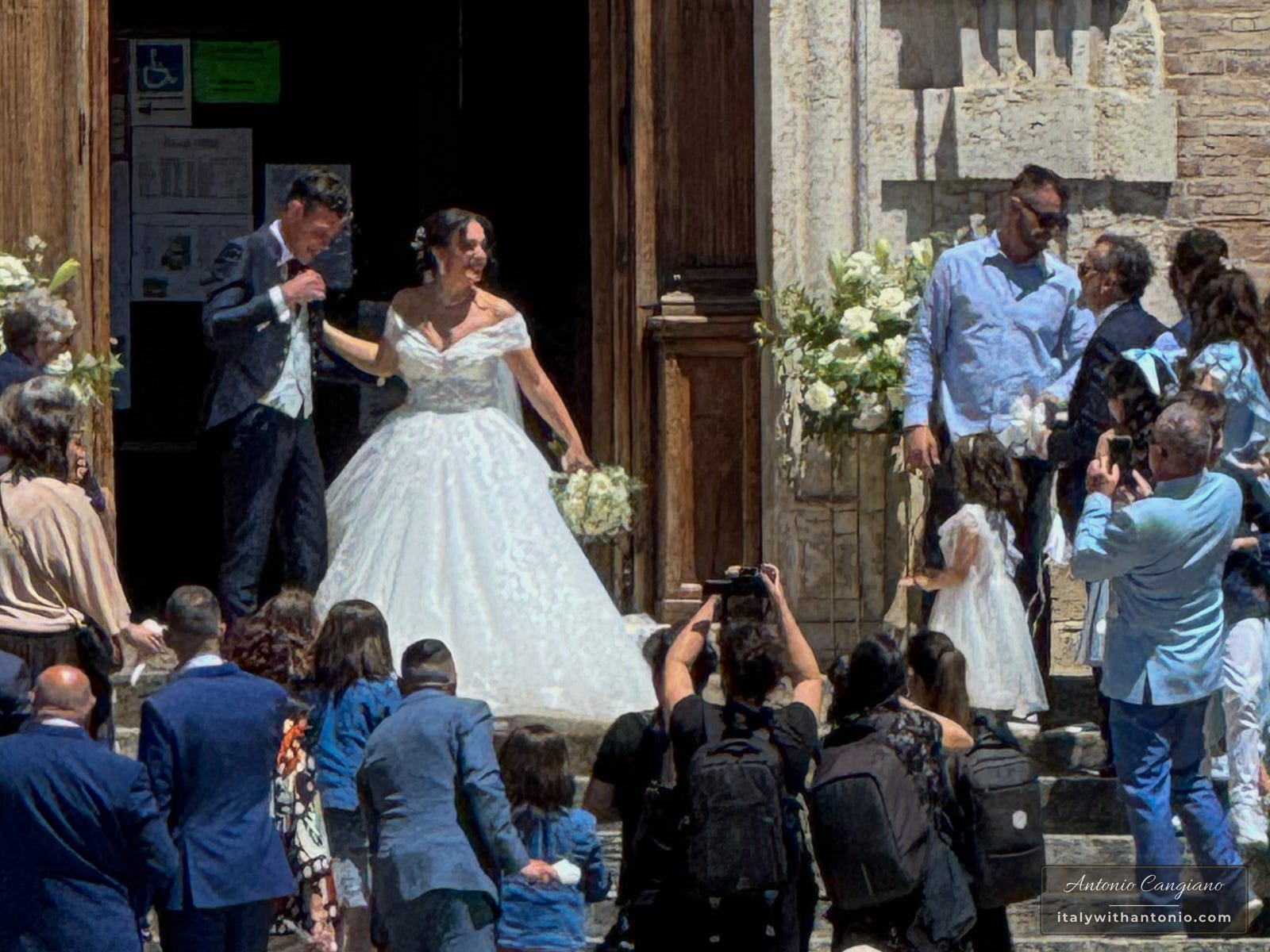
This Saturday, I’m getting married to Alicia. It will be in Canada, but it got me thinking about how weddings work back home.
I want to add the uncle one to this list of 11 traditions. That is the honored tradition of your uncle getting drunk at the wedding and causing a scene. But that might just be my dysfunctional Italian family and not a universal rule.
The following 11 are actually common ones in Italy. The north is more restrained and less superstitious than the south, but most apply across Italy.
Disclaimer: Italy is very regional, and it’s changing fast due to globalization. This means that for every point I make, someone can come and say, “We don’t do that, and I have been to many Italian weddings.”
1. Never on a Tuesday or Friday
We have an expression for this. “Di Venere e di Marte né si sposa né si parte.” So you’ll find Italian weddings rarely happen on venerdì (Friday) or on martedì (Tuesday). When setting a date for my own wedding, despite not being superstitious, I immediately ruled out those two options out of Italian habit. Saturday it is.
2. La serenata
The night before the wedding, the groom shows up beneath the bride’s window to serenade her. It starts quietly, but once she opens the window, the neighborhood might join in, and it turns into a small street party. Now, this will be seen as a cafonata (gaudy act) by some in the north, but in Sicily, Calabria, Puglia, and Campania, especially in villages, it is still very much a thing.
3. The bouquet is his gift
The groom pays for the bouquet. It’s the last gift to his fiancée before she becomes his wife. (Obviously she can pick it to match the wedding theme, but he pays for it.)
4. No gold, no mirror
The bride is not supposed to wear gold until the rings are exchanged. Superstition also says she shouldn’t see herself fully dressed in a mirror before the wedding unless she first removes one shoe, an earring, or a glove.
5. Rain is good luck
Another expression: “Sposa bagnata, sposa fortunata,” which in English translates to “wet bride, lucky bride.” I suspect this was invented to make brides less upset with the weather ruining their reception, but I’ll take it.
6. Confetti aren’t paper

In Italian, the word confetti doesn’t mean tiny colored pieces of paper thrown at the couple. (BTW, we throw rice instead.) They’re sugared almonds, usually given with a small favor called a bomboniera. In the south, bomboniere can get quite elaborate and stereotypically tacky. For weddings, it’s traditional to give guests five white confetti, each representing health, wealth, happiness, fertility, and long life. Odd numbers, as they shouldn’t be divided, just like the couple.
7. La busta
We have wedding registries in Italy, but many people still prefer to bring a busta (an envelope) with cash. The unwritten rule is that you should give at least the cost of your seat at lunch or dinner. It’s a debated topic, but it starts at 100 euros per person if you don’t want to look tirchio (stingy). More if you’re family or close friends. Less, if you’re broke or you’re there with your 5 children.
8. The lunch
Speaking of lunch, the wedding lunch (or dinner) tends to be epic in Italy. Antipasti (appetizers, multiple), two primi, a secondo, possibly two with a sorbet in between, cake, coffee, and likely a digestivo (a liqueur). They last hours and your shirt will feel like it’s about to burst at the seams. Especially in the south.
9. La tarantella
La tarantella is an old folk dance from the south inspired by old tales about convulsing and dancing off a spider’s bite. It is still used in many weddings in the south, often paired with more modern music. In many such weddings, guests will even hold hands in a circle around the couple, spinning faster and faster to the tempo of the song.
10. The cake
Tiered cakes are common now, but the classic Italian wedding cake is the millefoglie (a thousand layers) of puff pastry and cream, often topped with berries. Many weddings now also set up a confettata, a table of sugared almonds (including versions with a chocolate center instead of an almond).
11. The tie
Late in the evening, and certainly after all the photos that could be taken have been taken, the groom’s friends will sometimes cut the tie into small pieces and sell them to guests for a few euros, with the money going toward the honeymoon. (Possibly more common in the north than the south.) Which is why no groom in his right mind will wear one of the ties from my last series if he knows his friends have such plans.
I’ll let you know how many of these I manage to sneak in. And if it rains on Saturday, now you’ll know what to say to Alicia.
P.S. Heads up: I’ll be skipping three posts while I’m on my honeymoon. I’ll be back in your inbox on Thursday, October 15, hopefully with a few new stories.
I'm hopping a plane to Le Marche this Wednesday October 7 for two weeks of looking at real estate....too bad the wedding isn't in Italy! All the best Antonio!!
Tanti auguri, Antonio! I was wondering if it is common in Italy for weddings to take place during the week. There is a popular bar/beach club along the lungomare in my Sicilian town and I notice that this time of year during my sunset walks that there always seems to be a wedding couple taking golden hour photos with the wedding party and some guests having coffee or a spritz. It’s typically Monday, Wednesday and Thursdays when I take my walks.