


Italy with Antonio. Honest guides for moving to, traveling in, and understanding Italy from a native Italian. Three articles a week, with deeper resources for paid members (including the print-ready PDF and ePub downloads of this article). A Substack Bestseller. Join nearly 2,000 subscribers.
When people ask me where to move to Italy, I start with probing questions to understand who they are.
Because Italy has everything. You want the sea? Check. Mountains? Check. Isolation? Check. Bustling metropolis? Check. Cold weather? No problem. Hot weather? As much as you want.
So it’s highly individualized work to match the places in Italy with a client’s lifestyle and personality.
Still, for most people, the solution ends up fitting the profile of città di provincia. Places that are neither too big nor too small. Too big and your experience becomes too impersonal. You lose much of the Italian lifestyle appeal, including the person behind the bar counter who knows your order and casually flirts with you. Not to mention traffic and parking challenges. Too small and you start missing key services and entire afternoons, as you’ll need to day-trip to an actual city an hour away to get them.
The framework I devised to find said places is not overly strict. In fact, in some regions it finds too many eligible towns, and we have to apply more ad-hoc filters to make it manageable.
Not so with Calabria. It has 404 comuni, and even being a bit lax on the rules (more on this soon), only four make the cut. Welcome to the south.
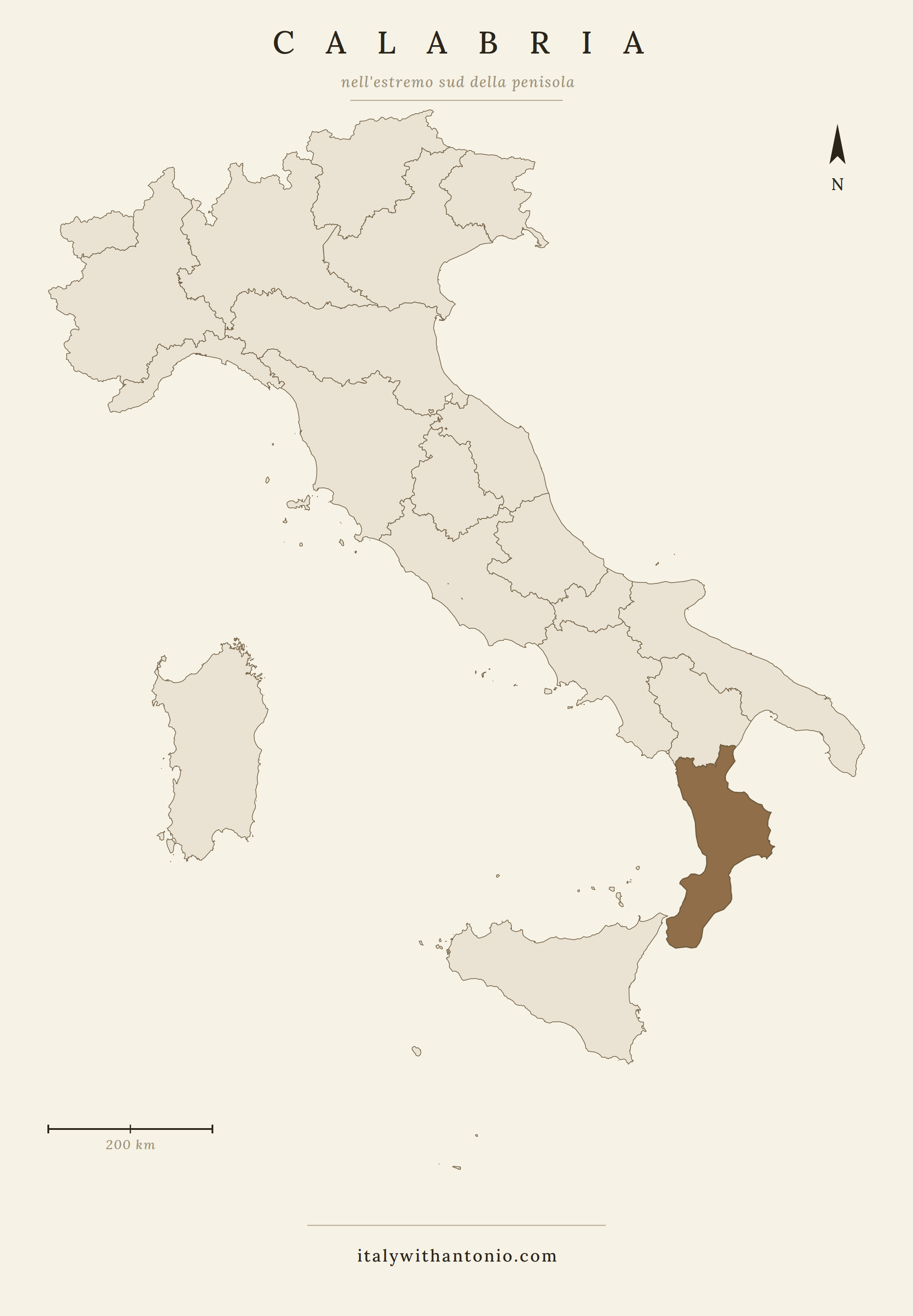
Calabria is a stunning region, but its problems, including spotty services, are very real. So I won’t lie to you and present you with a list of 15 postcard-perfect places, which Calabria has in spades. Instead, I’ll be (mostly) loyal to the approach we’ve taken across regions and surface the four towns that are actually workable for a resident who wants to live in Calabria without too many compromises.
Gun to my head telling me to live in Calabria, I would choose one of these four. And yes, we’ll address the elephant in the room, though it won’t be a filter.
What Calabria is actually like to live in
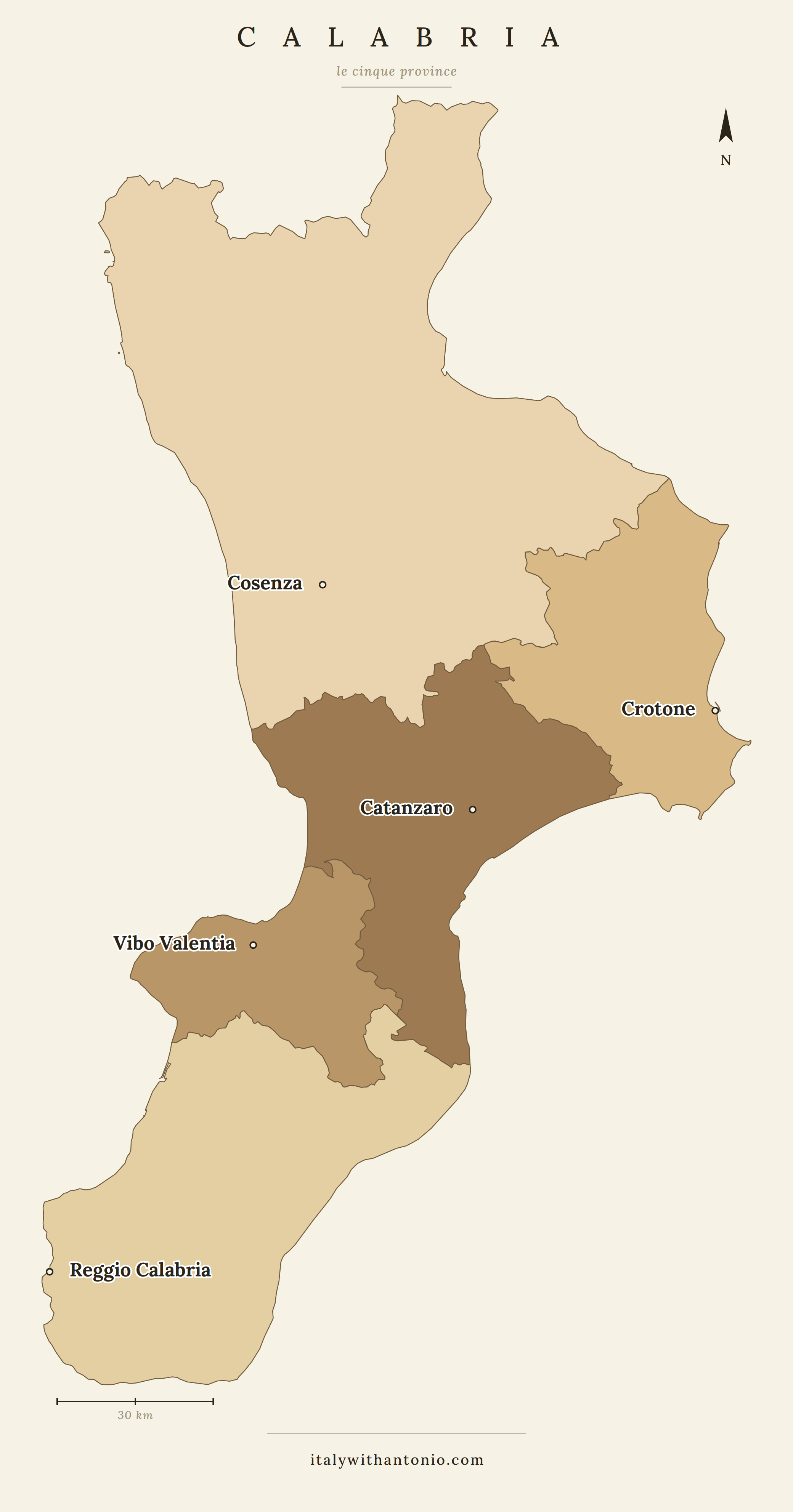
As mentioned, Calabria has 404 comuni (municipalities). They are spread across five provinces: Cosenza (150 comuni), Catanzaro (80), Vibo Valentia (50), Crotone (27), and the metropolitan city of Reggio Calabria (97).
Per Istat, the population is 1,834,646 as of the end of 2024. What’s remarkable is that its population has fallen every single year for over a decade.
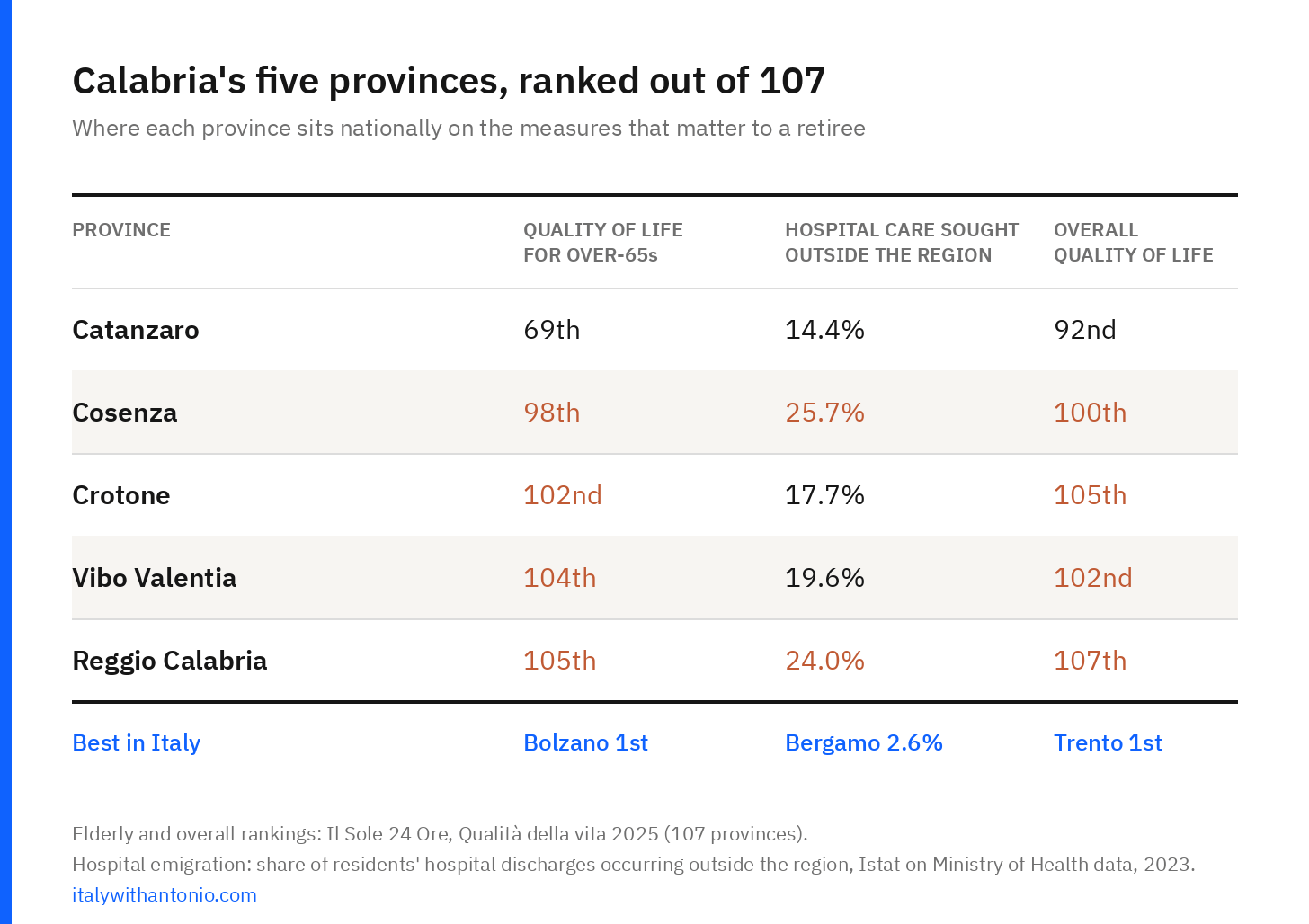
The Il Sole 24 Ore quality of life index for 2025 puts all five Calabrian provinces in the bottom sixteen.
Catanzaro is the least bad at 92nd. Reggio Calabria is 107th of 107, dead last, for the second year in a row.
If you drill down and look at the economic indicators, the situation is even more critical than the rankings would suggest. The record for lowest average employee pay in Italy belongs to Vibo Valentia, at a staggering €13,300 a year. Almost one third of Milan’s average.
The same province also holds the record for the slowest civil courts. The national average has proceedings conclude in over 345 days (already a very lengthy process). In the province of Vibo Valentia, they take about three times as long. That’s a preview of Calabria’s efficiency problem when dealing with public institutions.
Calabria has great Mediterranean weather. Its capital, Catanzaro, has remarkably mild winters, thanks to its latitude and location between two seas. In summer, the region gets properly hot as you’d expect from an area bordering Sicily. (That said, pick a place at altitude and your winters will be cold even in Calabria.)
My personal read of Calabria is that there is a large gap between visiting on vacation and actually living there. Perhaps more than anywhere else in the country.
Calabria is also home of the ’Ndrangheta, the most powerful mafia in the world. They run the show here. This has surprisingly little direct crime impact for most expats, and a huge impact for businesses and at the administration level, with the results we’ve already partially highlighted. Not a reason to skip Calabria, but be aware.
More bad news, I’m afraid, but Calabria also has the worst seismic risk profile of any region in the country. The entirety of the Reggio Calabria province is under Zone 1, the highest risk classification possible.
This is not a theoretical risk. In 1908, a massive earthquake (7.1-7.5 on the Richter scale) hit the cities of Messina and Reggio Calabria in the south of Italy (where the mainland almost touches Sicily). It remains, to date, the biggest natural disaster in Europe, killing an estimated 80,000 people.
If you do buy here, the region publishes seismic microzonation studies by comune. Read the one for the comune you’re considering and potentially budget for a structural engineer.
Regarding the language, assume you’ll need Italian. You’re not going to understand the local dialect for a long time, and that’s okay. As long as you know Italian, you’ll be able to communicate. Just don’t expect English, not even the basics.
And yes, Calabria is also beautiful: Blue Flag beaches, incredible food (a dream, if you love spicy food), friendly locals, Catholic traditions, art, history, and so on. I’m not dissing Calabria. It’s a mix of extreme pros and cons.
Two of my Italian-language students from Ontario bought a cheap house here on a whim. It isn't even on the coast, but somewhat inland, and yet they're extremely happy with their choice, their neighbors, and the limoncello they get to make from all the lemon trees on their land.
The 7% tax and shaky healthcare
Speaking of pros, as a region of the south, Calabria qualifies for the flat 7% tax regime for ten years. So any comune of 30,000 people or fewer qualifies for a pretty sweet deal for retirees.
Here is the catch. On Il Sole 24 Ore’s 2025 index, Calabria is the worst region for quality of life for senior citizens (65+). Reggio Calabria is the weakest of them at 105th out of 107. Vibo Valentia is 104th, Crotone 102nd, Cosenza 98th. Only Catanzaro places a bit better at 69th, and that is still the bottom half of the table.
Part of that story is the healthcare performance of the region. Every year the Ministry of Health scores each region from zero to 100 on prevention, hospital care, and district care. Calabria scored 77 on hospital care, 66 on prevention, and 52 on district care. The passing score is 60 across the board, and Calabria is the only region in Italy to fail.
Note that the hospital care score is actually remarkably decent for the south. Still, healthcare challenges obviously exist, as evidenced by the low district care score and the percentage of people seeking hospital care elsewhere.
District care means GPs, home care, chronic disease management, and community services. The staff that truly matters to a senior citizen daily.
The regional trauma network is built on eleven points, which leaves Piana di Gioia Tauro without a hospital capable of serving the 170K people in the area, and improvements there have been announced, redesigned, and ultimately delayed for years. So even access to a nearby ER is not a given.
The good news is that the towns that survive our framework all have an ER nearby, and that should particularly matter for those of you who are interested in the 7% tax deal. But the ER is for the day something goes wrong. District care is for the other 364 days, and it is the single thing Calabria is measurably worst in the country at.
Applying the filter to Calabria
The population filter does a lot of the heavy lifting for us. The 15,000 to 100,000 band leaves only 17 comuni out of 404.
The seismic filter halves the current pool. Eight comuni remain after removing those in Zone 1. The filter removed some major candidates, including Lamezia Terme, Cosenza, and Vibo Valentia.
All eight survivors shortlisted so far are in Zone 2. There are no Zone 3 or 4 comuni in Calabria.
The stability filter, in a region depopulating fast, leaves us down to only two comuni. I don’t want you to have to choose among two towns, so I’m relaxing one filter. I’m setting the depopulation to 7%, which is roughly the region’s rate, instead of the standard 5% we’ve been using. So for Calabria, the filter ensures depopulation at a rate lower than the region’s average.
That leaves us with the four towns below that don’t introduce any major compromises.
I didn’t drop the floor to 10,000 in a region where services are scarce even in larger centers. But if you’re seeking smaller places, the two that would have been admitted are Cirò Marina and Scalea. Both worth a look.
The candidates

1. Corigliano-Rossano
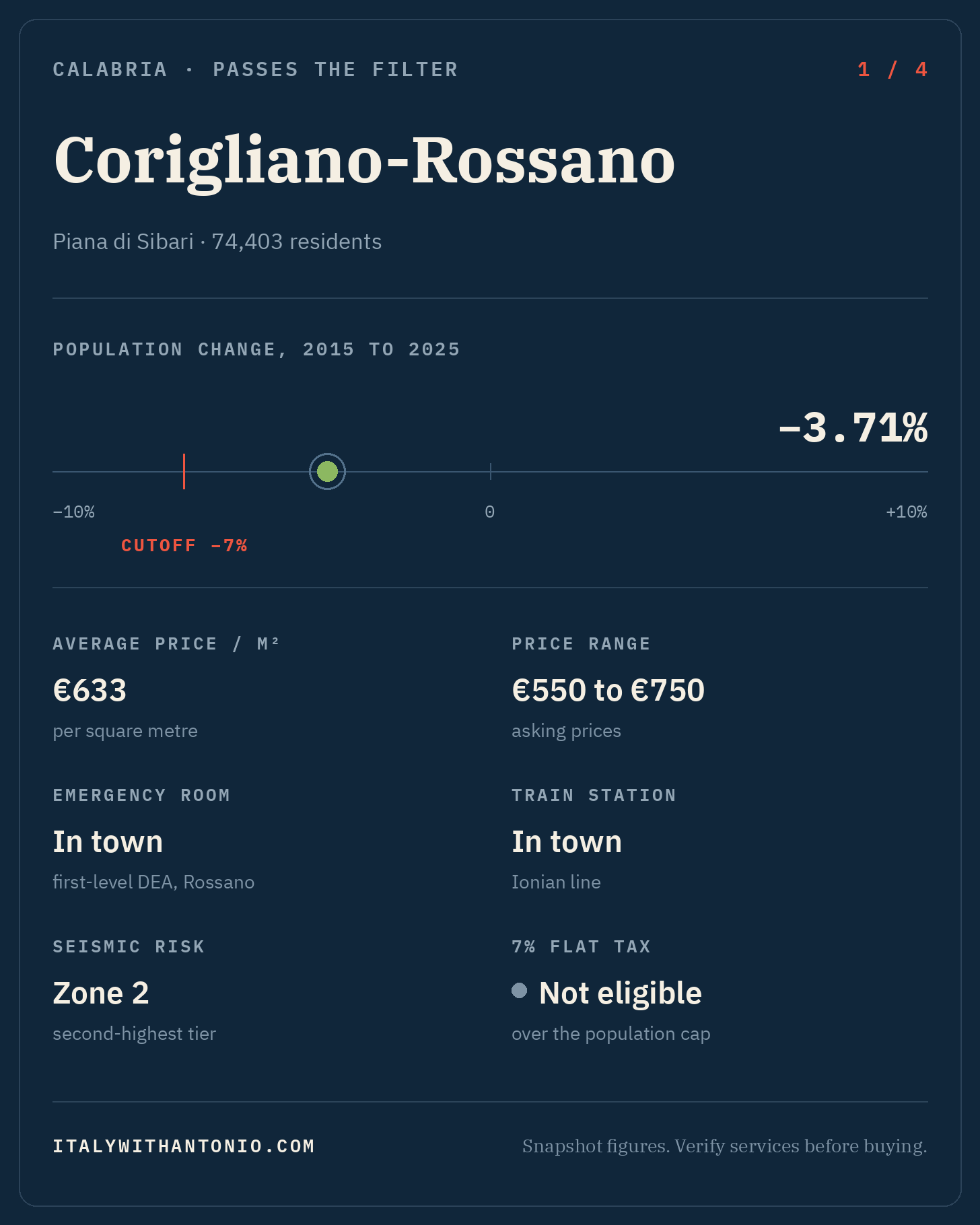
Corigliano-Rossano is the third-largest comune in Calabria, yet it’s virtually unknown outside the region. It was formed in 2018 when the comuni of Corigliano and Rossano merged.
It meets all the requirements of our filters with ease: a hospital with an ER, high schools, several grocery stores, Zone 2, and a depopulation rate that is essentially stable by Calabrian standards.
Plus, it’s well positioned geographically. You have a train station in town and 30 km of Ionian coast.
The real estate is €633 per square meter against a national average above €2,000. That’s €82K for a 1,400 sq ft / 130 sq m house. It’s one of the cheapest places where you can buy and still have access to services.
Opt for Rossano’s centro storico if you care about beauty and can live with stairs, humidity, and the need for a car. Buy on the flat for walkable access to amenities like the supermarket or the train station.
The coast empties outside the summer months, so rent there for a winter before you commit to buying.
