


A Substack bestseller, Italy with Antonio offers honest guides for moving to, traveling in, and understanding Italy from a native Italian. A paid article every Monday and a free one every Thursday, with deeper resources for paid members, including print-ready PDF and ePub downloads. Join over 2,500 subscribers!
Lombardy has more comuni (municipalities) than any other Italian region: 1,502. My set of filters usually does a good job on its own and gives us a shortlist of towns worth moving to. Here it needed additional help.
In fact, after population, earthquakes, stability and schools, 82 towns were still standing. That’s not a shortlist. Most were Milan's suburbs, dorm communities (places people sleep in and leave every morning). A list like that doesn't tell you where to live. It tells you where people commute to Milan from.
So for Lombardy I added a rule: the town has to be a place people commute to, not from. With this new filter, twenty pass. Eight are provincial capitals (the other four capitals are excluded because they are too big for our framework).
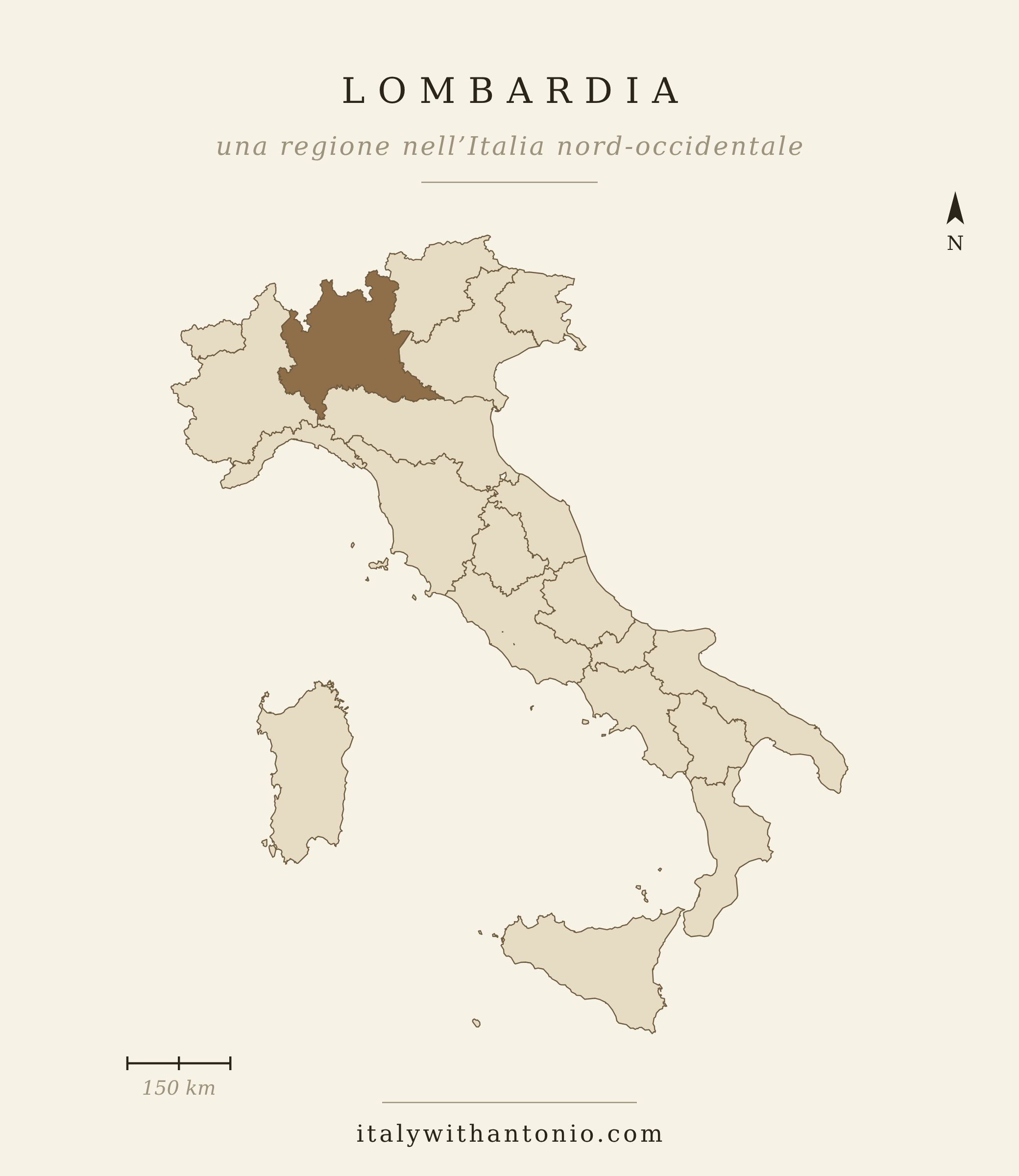
What is living in Lombardy actually like?
Lombardy has 10,065,694 residents (ISTAT, start of 2026), the most of any region. There are eleven provinces plus the Metropolitan City of Milan, which replaced the province of Milan in 2015. For most readers, a province mostly means the capital whose Questura (police headquarters) renews your residence permit.
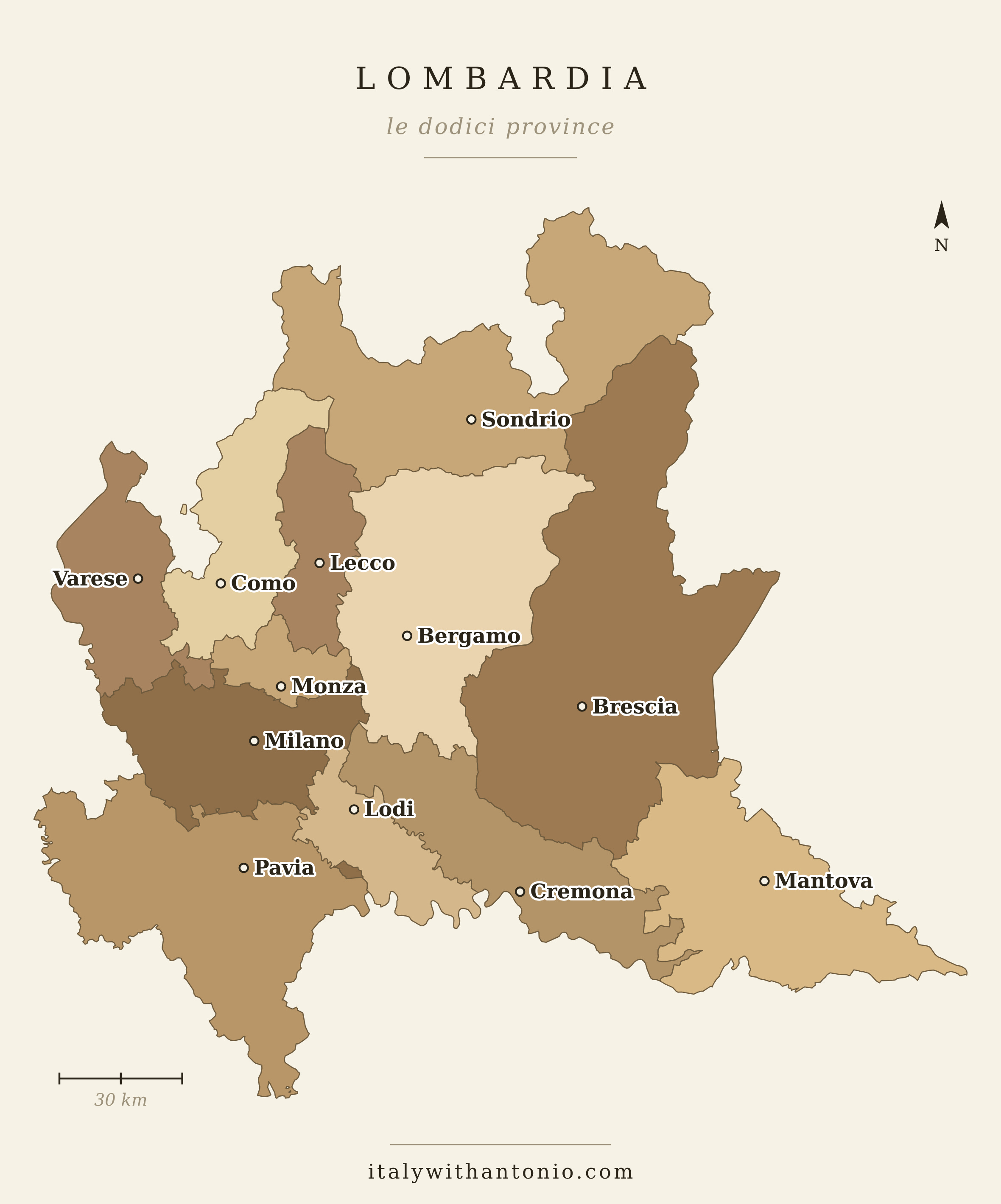
Lombardy is where Italy stereotypically works. Lombardy's employment rate was 69.6% in 2025, against 62.5% for Italy as a whole.
Quality of life is high and slipping. In Il Sole 24 Ore's 2025 ranking, Bergamo's province came 5th of 107 and Milan's 8th, but ten of Lombardy's twelve provinces lost ground. Pavia was last in the region, at 56th.
The plain is foggy in winter and muggy in summer. The lakes are milder, the Alps colder. English works in Milan's offices and gets thinner with every kilometer from them. In fact, in Milan, many people will randomly mix English words or their adaptations into regular Italian to sound cool. The rest of the country just finds it silly.
Lombardy is expensive by Italian standards, and Milan proper is prohibitively so.
That said, prices fall fast once you leave Milan. The regional average is €2,819/m² on immobiliare.it (October 2026). Milan asks €5,667 and the ski town of Livigno €7,168, the most in the region.
Olmeneta, a farming village near Cremona, lists at €281. Don’t get too excited. You don’t want to live there anyway.
Why I added a rule for Lombardy
The usual filter leaves 82 towns here, 35 of them in Milan's commuting area alone. Most of the rest orbit Bergamo, Brescia, Como or Busto Arsizio. Segrate, next to Linate airport, grew 7.21% in ten years and has 37,194 residents. It doesn't have a high school.
ISTAT divides Italy into local labour markets (sistemi locali del lavoro), drawn from census data on where people live and where they work. Each one has a hub: the town the commuters travel to. Lombardy has 42.
My extra rule keeps only towns that are hubs of their own. It removes the dormitories, and every one of the 29 towns without a high school went with them.
It also removes some good towns that sit in a bigger town's orbit: Legnano, Gallarate, Saronno, Treviglio, Chiari, Merate and Codogno. If one of them appeals, run the rest of the filter yourself. Most would do fine. I’m being quite selective here for those without pre-existing town affections, but don’t let that rule out a comune you were already considering.
The catch is the air, the floods and the trains
Earthquakes first, because everyone asks. Lombardy has no Zone 1 comune. The highest is Zone 2, and all 57 such comuni are east of Brescia, around Lake Garda and the Valle Sabbia.
The May 2012 Emilia earthquakes reached the south of Mantova province, and Suzzara was on the official damage list. The state of emergency ended in 2025. So earthquakes, generally speaking, aren’t a real concern in this region.
The air is the real problem. The Po Valley is a basin that traps smog. Milan logged 66 days over the EU daily limit for fine particulates (PM10) in 2025, second worst in Italy.
Among the provincial capitals, Cremona had the worst yearly averages (31 µg/m³ of PM10, 22 of the finer PM2.5). Varese had the best (18 and 13). The WHO guideline for PM2.5 is 5. Hills and lakes help, but nowhere here is clean.
Then the water. Lake Como floods its own main square: in November 2023 it ran 45 centimetres into Piazza Cavour, over the temporary barriers. Along the Po River (the longest Italian river), Casalmaggiore and Viadana live behind levees. My filter doesn't screen for floods, so check the specific address you’re considering for historical exposure to floods.
And the trains. The network around Milan is dense and busy. Further out, works can cut a town off for years: Mantova has had no direct train to Milan since January 2024.
Organized crime is present in the region's economy, but councils rarely fall to it. The first one dissolved for mafia infiltration was Sedriano, near Milan, in 2013. None of my twenty survivors has been.
Regular crime is a major concern in Milan, which has 7,017.5 reported crimes per 100,000 inhabitants. It wasn’t great when I lived there 25 years ago, and it has gotten much worse since. The Metropolitan City of Milan literally has the worst crime rate in Italy.
Applying the filter to Lombardy
The framework is the usual one: 15,000 to 100,000 residents, no Zone 1 or devastated-tier cratere (the official earthquake zone), a full ER within 25 minutes, a high school and a full supermarket in the comune, fiber to the home, and a ten-year population decline under 5%. As mentioned earlier, for Lombardy only, the town must also be the hub of its own labour market.
Of the 1,502 comuni, 1,387 are under 15,000 residents and four are over 100,000: Milan, Brescia, Monza and Bergamo. That leaves 111.
Seismic risk removes nobody. Neither does stability: the weakest town in the band, Como, lost 3.40%. Lombardy is the place people from other regions go for work. It’s a region that is for sure not depopulating. The hub rule, however, removes 91.
Every survivor has a full ER within 12 minutes, fifteen of them in town. Every one has a high school, supermarkets and some fiber. No relaxation needed.
I'm profiling eleven; the other nine follow by area. Prices are immobiliare.it asking prices for September or October 2026. Train times are the fastest weekday trains to any Milan station, from Trenitalia's planner.
The best places to live in Lombardy
1. Lecco

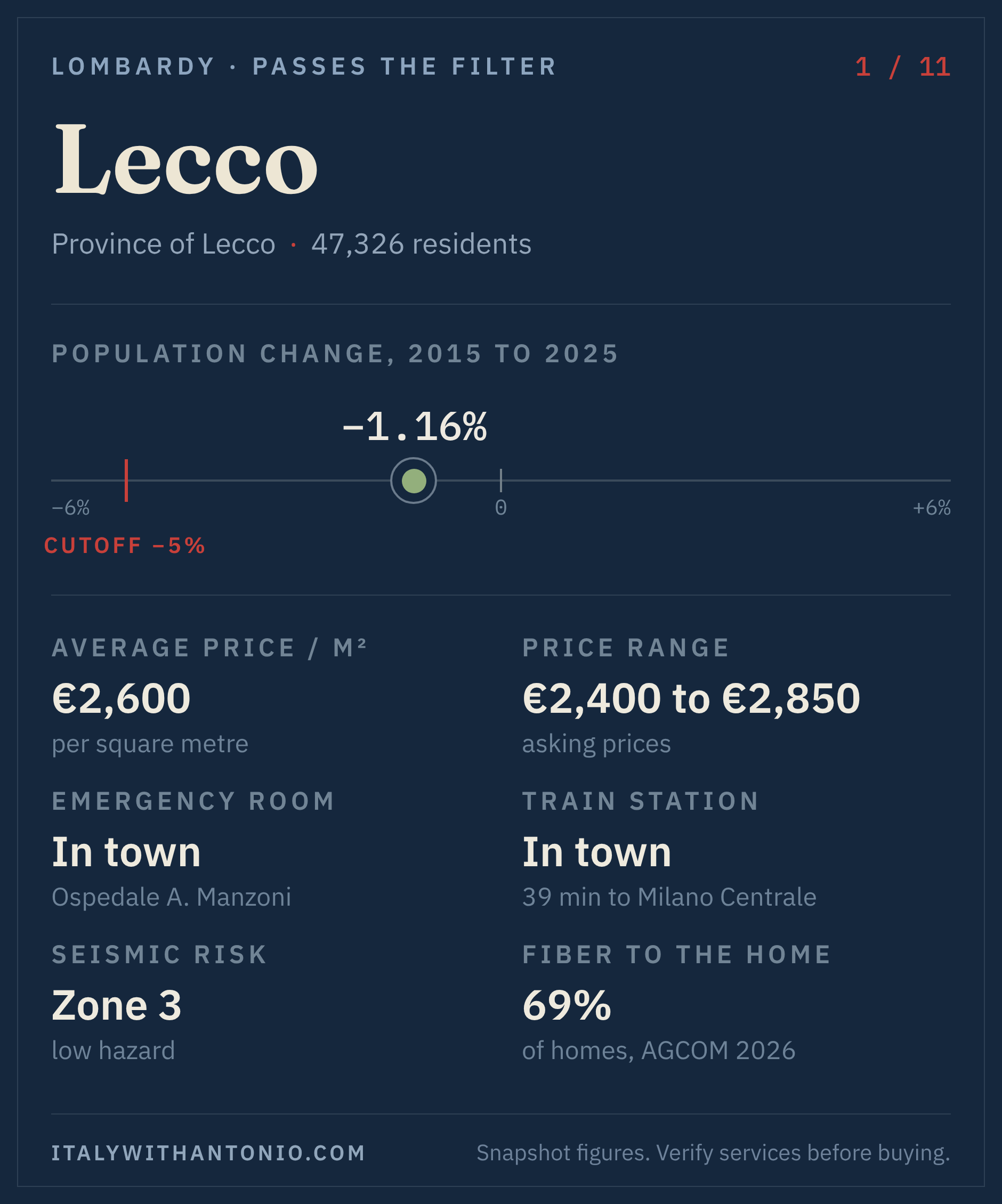
Lecco sits where the eastern arm of Lake Como narrows back into the Adda river, under the jagged ridge of the Resegone. Manzoni set I promessi sposi (The Betrothed) here, the novel every Italian kid reads at school.
Its province came 15th in Italy for quality of life, and its air is the second cleanest among Lombardy's capitals. It has its own hospital ER, the Manzoni. Trains reach Milano Centrale in 39 minutes at best, about an hour on a typical one.
Homes cost around €2,600/m², a fifth less than Como at the other end of the lake.
The downsides: fiber reaches only 69% of homes, and the town lost 1.16% of its residents in ten years. It's also the third most expensive town on my list.
It's for people who want a lake, mountains and Milan within an hour. Como's quieter, cheaper sibling. If I were personally considering a place to live in Lombardy, Lecco would be high on my list.
