


Italy with Antonio. Honest guides for moving to, traveling in, and understanding Italy from a native Italian. Three articles a week, with deeper resources for paid members. Join 1,500+ subscribers.
This article is part of a series of posts that help you find cities to relocate to in Italy. We do so by applying strict filters to screen out most unsuitable towns and cities within a given region.
What survives are livable cities that are neither too big nor too small. It’s the kind of framework I would use if I were to choose a town in Italy myself.
Marche and Tuscany are already done. In this article, we’ll deep dive into Veneto.
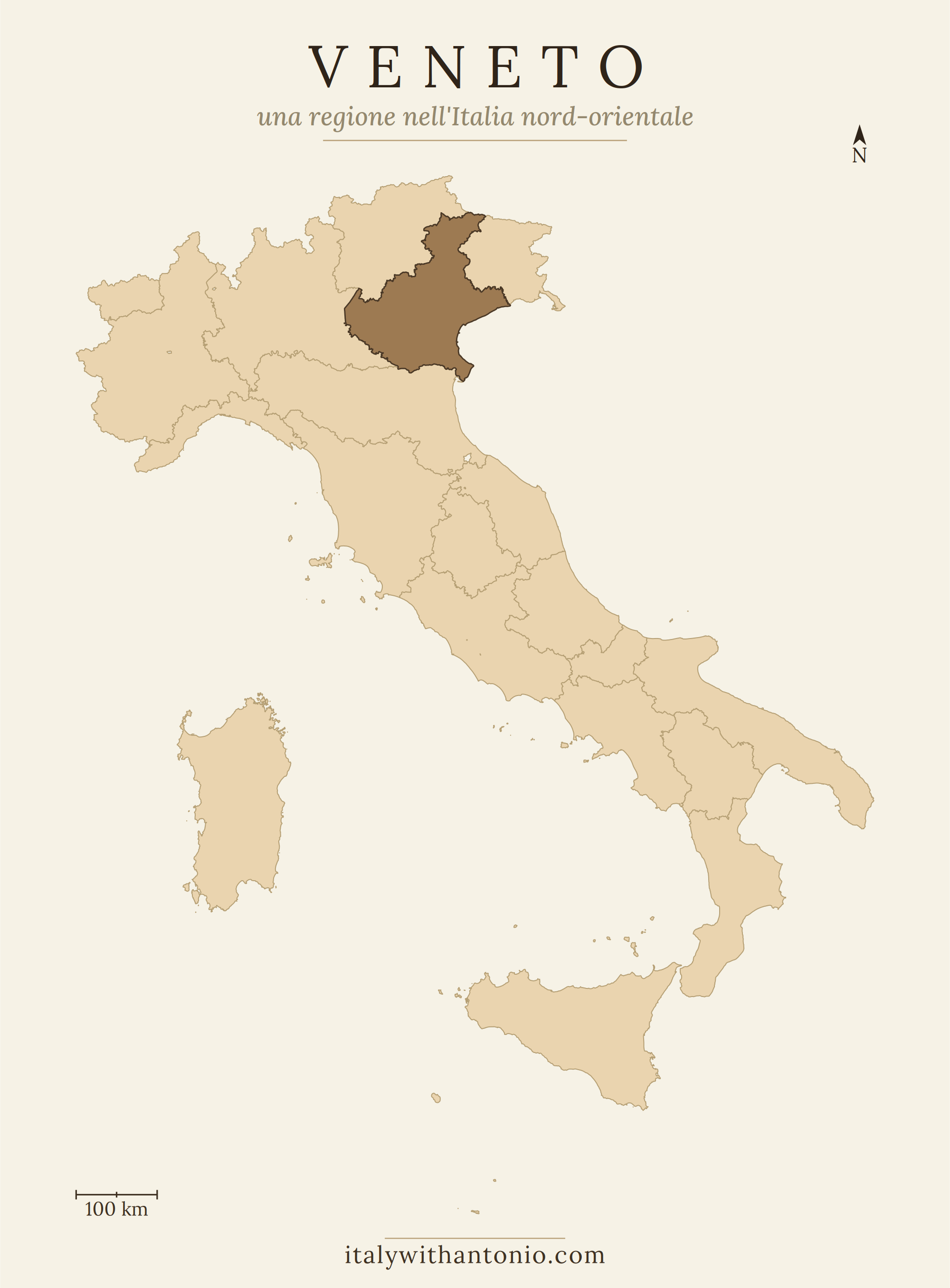
What Veneto is actually like to live in
4.9 million people call Veneto home. They mostly do so with pride, embracing their heritage, traditions, and dialect.
The Veneto economy is solid. The GDP per capita is well above the Italian average, and unemployment is well below it.
The northeast industrial model works well. It’s a web of small and medium-sized manufacturers clustered by sector around specific locations.
For example, eyewear is in Cadore, textile and gold around Vicenza, furniture around Treviso, and outdoor sportswear in Montebelluna (also in the province of Treviso).
Everyone under 60 knows and speaks standard Italian. You’ll hear the local dialect more than you would in many other regions, especially west of Venezia (Venice) and from the elderly. You do not need to speak it or learn it. However, outside of Venezia and Verona, you’ll need Italian for even basic communication.
I’ll keep it very short for you: Veneto is one of the best regions of Italy, flat out.
Remember the quality of life index by Il Sole 24 Ore? In 2025, here is how each province did (out of 107 provinces):
Venezia (53)
Verona (7)
Padova (9)
Vicenza (18)
Treviso (6)
Belluno (33)
Rovigo (63)
Three provinces in the top 10! That’s remarkable.
The quality of life in Veneto is unquestionably high. The people are hardworking and friendly (by Northern standards), and the food and wine are top-notch. You’ll also find dramatic landscapes, a wealth of art, and all the services you could possibly need.
There are only two real concerns.
Air quality. Veneto sits in the Pianura Padana (the Po Valley), one of Europe’s worst hotspots for air quality. The main plain cities (Padova, Venezia, Vicenza, Verona, Treviso) all routinely blow past the WHO limits. From November through February, the fog looks romantic, but it’s pollution wearing a costume. The foothills of the mountain breathe measurably better.
Flooding. Most of the region doesn’t need to worry about earthquakes, but flooding is a concern. Any city in proximity to the Adige, Piave, or Brenta rivers (not to mention the lagoons near Venezia) carries some flooding risk.
The Pedemontana is the foothill zone along the base of the pre-Alps, and it’s arguably the sweet spot of the region. You get higher ground, cleaner air, beautiful views, and real towns. The deep plain is cheaper and flatter, but you’ll pay for it in air quality and flood risk. The mountains would be great for air quality, but most of their comuni get cut out by the seismic filter.
These considerations help you apply an informal filter to the surviving comuni.
Applying the filters to Veneto
If you read the original framework post, I warned you that some regions are chock full of suitable comuni (municipalities). Veneto is a prime example of such regions.
We start with 563 comuni, spread across the metropolitan city of Venezia and the other six provinces (Belluno, Padova, Rovigo, Treviso, Verona, and Vicenza).
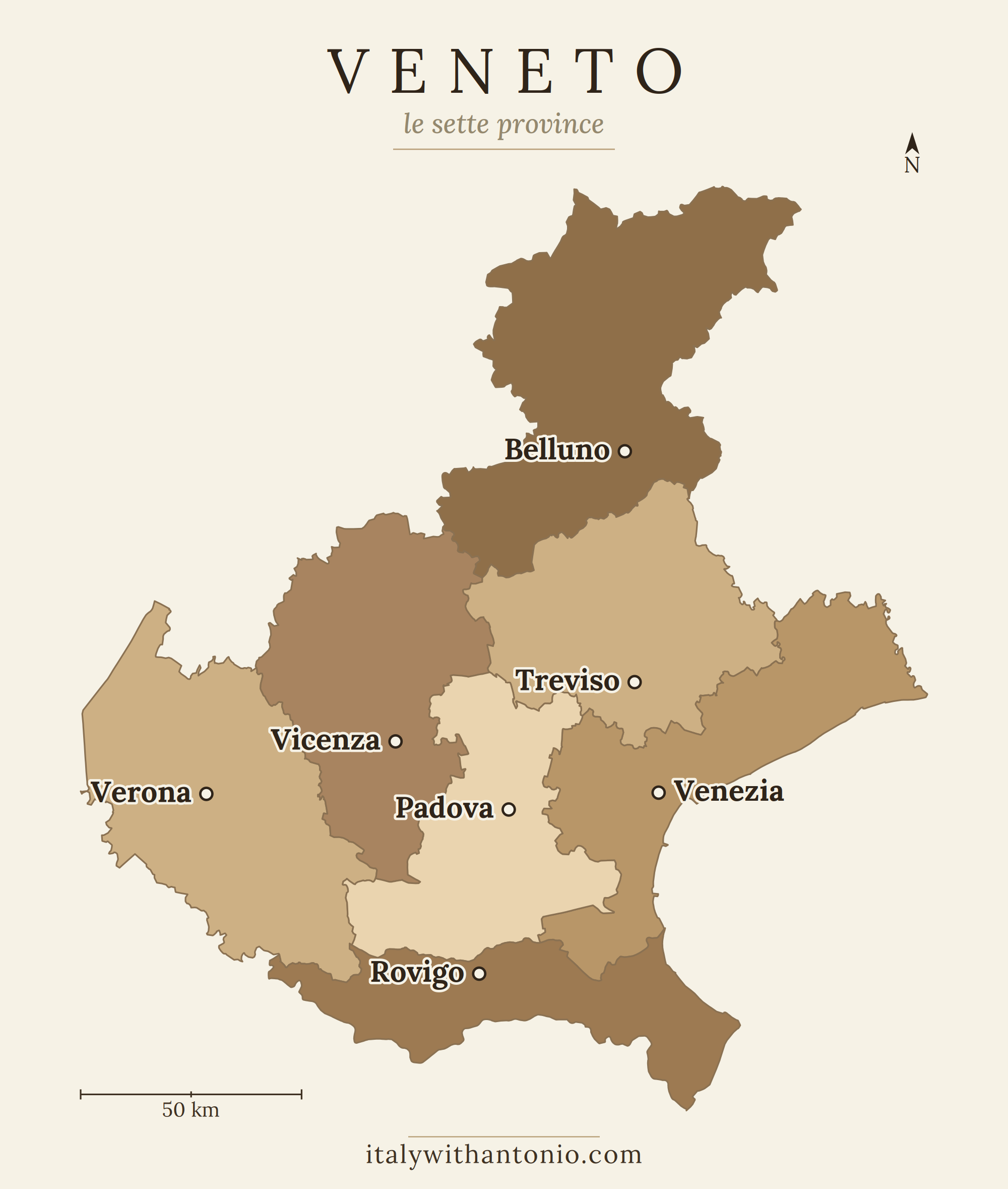
Applying the population filter (i.e., between 15,000 and 100,000 residents) narrows it down to 59 suitable candidates. In most regions, the population floor and ceiling do most of the work. Not in Veneto.
It’s worth noting that the 100K cap, in particular, removes the four big capitals: Verona, Venezia, Padova, and Vicenza. The latter is just past the top end of our range, at roughly 110K people. So consider Vicenza as well, if you don’t mind a larger urban center.
Veneto also has excellent services. Every town in our size range has a high school, a full supermarket, fiber internet, and an ER within 25 minutes. Services don’t filter anything in the efficient northeast.
Population stability doesn’t help much either. Cities this size, in Veneto, are not emptying. Of the 59 survivors, only Chioggia and Adria fail the ten-year depopulation test (at 5.15% and 5.89%, respectively, just past the 5% threshold we set).
We are down to 57. Apply the seismic Zone 1 filter, and we lose Belluno and Vittorio Veneto. 55!
The optional train station and being 30 minutes away from a provincial capital don’t filter anything here, either. Veneto is well-connected.
But I’m not going to hand you a list of 55 towns. It’d be barely any help in deciding where to live in Veneto.
So I’m applying a special criterion only reserved for regions this generous: the dormitory filter. We are going to cut out the comuni which are genuine dorm communities for the largest cities they are attached to. They are effectively first-ring suburbs, often without a town center of their own.
I admit this last filter rests a bit on personal judgment rather than a statistical lookup. I’ll name the 21 towns that were cut by this filter at the end so that you can argue with each call, if you wish.
At the end of all this screening, we are left with 34 towns. I will give you the full list, but feature ten that are worthy of particular consideration for one reason or another.
Note: all prices shown are apartment asking prices from the main portals as of spring 2026. Keyword: asking. Expect to pay closer to the floor than the ceiling of the price range, in practice.
1. Bassano del Grappa (Vicenza)

Bassano del Grappa is the flagship among the foothill towns. A real working city of 42,000 people, with a historical covered wooden bridge (rebuilt a few times), the Brenta passing through it, and the Monte Grappa as a backdrop.
The air is some of the cleanest in Veneto, the economy is real (grappa, ceramics, and light industry), and the population is steady (only down 2.45% over the past decade).
It isn’t cheap at around €1,800-2,200 per square meter. That's well above the provincial average of about €1,600, but it's the kind of picturesque, high-quality town that warrants the premium.
