


Italy with Antonio. Honest guides for moving to, traveling in, and understanding Italy from a native Italian. Three articles a week, with deeper resources for paid members. Join 1,500+ subscribers.
This post is part of a series of articles meant to help you find Italian towns worth moving to.
We apply strict filters, region by region, and see what comes out of the other end of the sieve. The survivors are typically livable cities, neither too big nor too small. Towns and cities that are generally worthy of consideration. It is the framework I would use to choose a town myself.
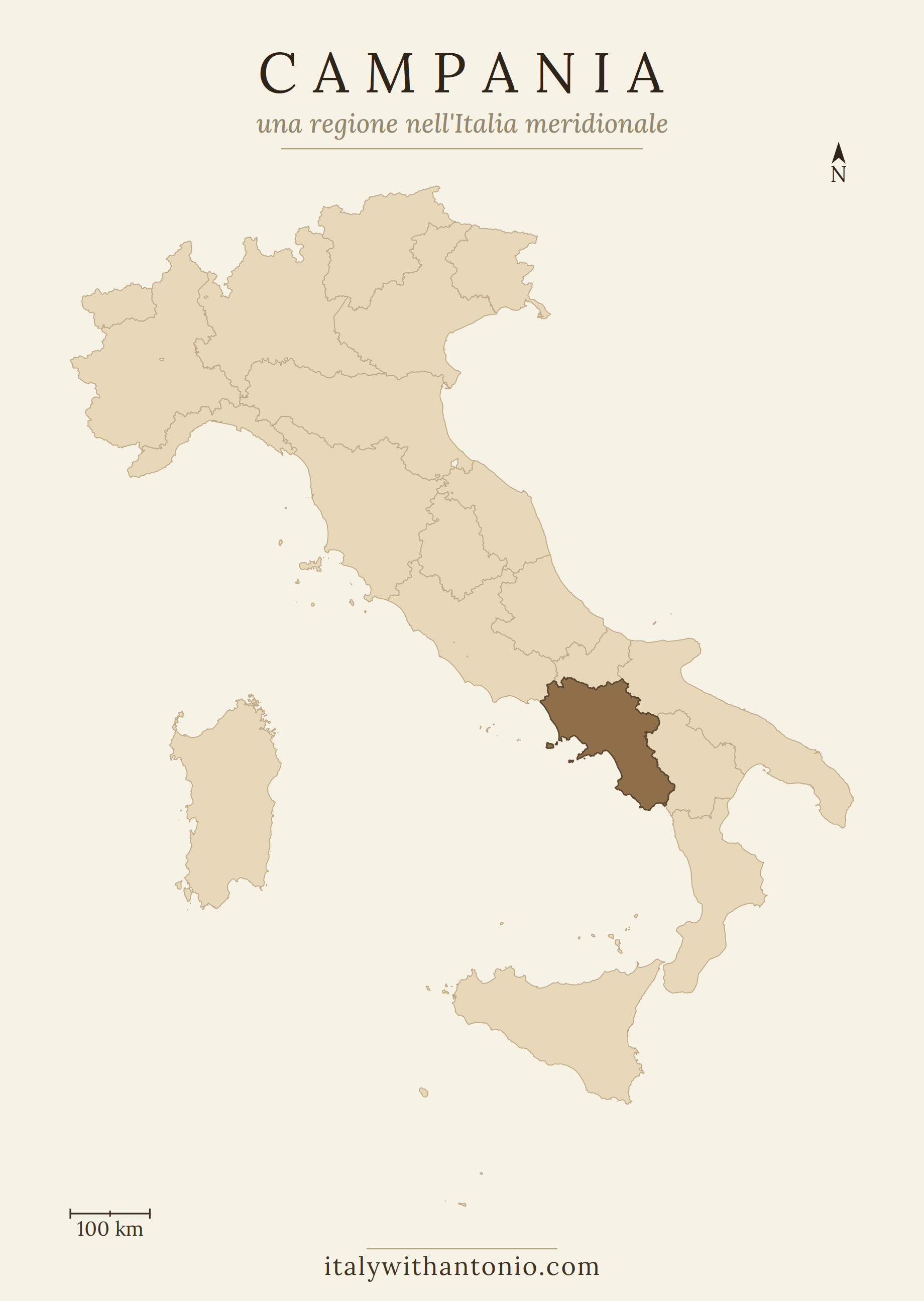
So far, I covered Marche, Tuscany, and Veneto. Today, we are discussing Campania: the region of Napoli (Naples) and the Costiera Amalfitana (Amalfi Coast).
Where to live in Campania turns out to be a tougher question than the postcards suggest.
A disclaimer
I’m biased when it comes to Campania, and it’s not just the food. My entire family is from near Napoli.
I love the region despite its many flaws. My parents spoke to us in Neapolitan at home, and I grew up on Neapolitan songs and movies. I still have more relatives in Ischia (near Napoli) than in Roma or the Marche.
There is a romantic part of me that would move there. I won’t let it affect my judgment. This series is about applying rigorous filters to each region, so I’ll tell you the good, the bad, and the ugly, even for regions I’m partial to.
What it’s actually like to live in Campania
Campania has 550 comuni (municipalities) and about 5.6 million people, one of the most crowded regions in the country.
Nearly three million of those people live near Napoli. So the region is certainly densely populated, but in a lopsided way.
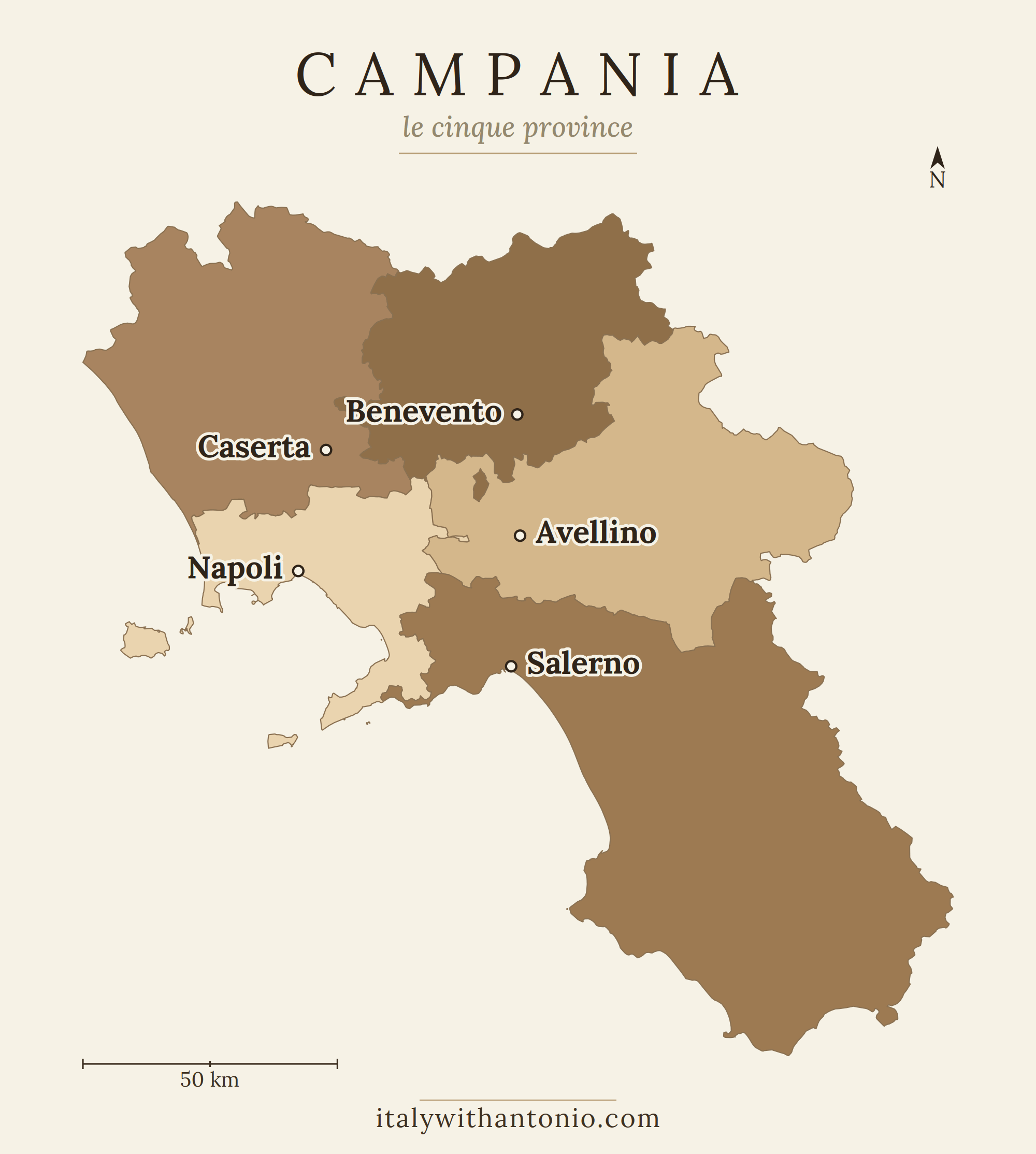
Along with its capital Napoli (one of 15 metropolitan cities), Campania has four additional traditional provinces: Caserta, Benevento, Avellino, and Salerno.
Campania has the Tyrrhenian Sea, a beautiful climate (especially near the coast), and amazing food (some of the best in the whole country). The people are warm, friendly, and genuinely funny.
Dialect is heavily used around these parts, but the hospitable nature of the local population means they'll do their best to speak Italian with you. You’ll need Italian outside of tourism hotspots, and over time, you’ll pick up some of the local dialect. Integration in this region should not be particularly challenging.
But it’s not all sunshine and rainbows. We are in the south, after all. There are problems. Big ones. So I’ll spend a little more time than I normally would to warn you about them before you pack your bags and move there. I’ll even introduce some ad hoc filters to spare you the worst this region has to offer.
First and foremost, Campania’s unemployment rates are among the highest in Italy. Youth unemployment around Napoli is 43%. The national average is 16.9%.
If you show up with retirement income or a remote job, this is mostly background noise. If you arrive hoping to work locally, these statistics should give you ample pause.
And so should the rankings of the Campania provinces in Il Sole 24 Ore’s latest quality-of-life table (for 2025):
Caserta (101)
Benevento (76)
Napoli (104)
Avellino (77)
Salerno (90)
Those rankings are out of 107 provinces. So all five “provinces” are in the bottom third, and Napoli is almost dead last (a dishonor that consistently belongs to Reggio Calabria).
Residents can’t get jobs and don’t feel safe, and this is reflected in the provinces’ rankings. Sadly, there are bigger, related issues that deserve their own section.
The Camorra, the fires, and the water
I cannot in good conscience write about living in Campania without mentioning the Camorra. The Napoli-based mafia is not a highly hierarchical structure but rather a group of fighting clans sustaining themselves through pizzo (protection money), drug trafficking, public contracts, waste, and counterfeiting.
Let’s go beyond what you see on Gomorrah and look at what the Camorra actually means for you. If you are an ordinary resident with a salary or working remotely, the Camorra is not going to be a major problem. They affect everything in the territory and the local economy, don’t get me wrong, but they won’t shake you down on your way to the local bar.
If you open a cash business, on the other hand, you can count on a member of the local clan coming knocking and asking for a monthly protection payment or “else.”
Yet, for you, a retiree or remote worker, the waste management is the bigger problem. For decades, various clans dumped and buried toxic waste across the region, particularly on the plain between Napoli and Caserta. This stretch is known as Terra dei Fuochi (Land of Fires) because of the burnings used to destroy waste.
Years of contamination have led to well-documented high rates of cancer in this zone. In January 2025, the European Court of Human Rights found Italy in violation of the right to life for its decades-long failure to address toxic waste contamination across the Terra dei Fuochi zone. If you find cheap real estate around those parts, that’s the reason.
And then there is water quality. The Domizio coast (in northern Caserta) has a long record of bathing bans. The Sarno river is among the most polluted rivers in Europe. Il golfo di Napoli has polluted, busy waters.
If you go south down to Salerno, the coast cleans up nicely, and you’ll even find Blue Flag beaches. The good news is that most of the towns that survive our filters cluster around that area.
The expanded filters
For Campania, I used the core filters we always use: a town between 15,000 and 100,000 inhabitants, an ER within 25 minutes, a high school in town, a full supermarket, fiber internet, outside of a seismic Zone 1, and not depopulating fast (up to a maximum 5.0% loss over the past decade).
The population and depopulation filters do the heavy lifting here. Southern Italy is emptying. Remember the lack of jobs? The youth are leaving for better opportunities in the north of Italy or outside the country altogether.
The world-famous Sorrento? It's beautiful but has lost almost 10% of its population over the past decade.
All these criteria screen out most cities in Campania, but not quite enough to hand you a list.
On top of these standard filters, in generous regions, I have also applied the optional filters: train station in town and within 30 minutes of a provincial capital. Here, they do virtually nothing to further screen the candidate cities.
Instead, I added three extra filters that help you distinguish livable from problematic towns.
1. Terra dei fuochi
I excluded any comune on the official list of Terra dei fuochi municipalities. I will simply not send you to a town controlled by the Camorra with toxic waste all around you. Yes, real estate is incredibly cheap there. It’s still not worth it.
2. Volcanoes
You’re likely familiar with the story of Pompei and Ercolano. The volcano that caused all that? It’s still there.
Our original filters focused on seismic risk, since it’s a much more common issue across Italy. But in Campania, volcanic activity is a key concern, and I must introduce a special filter to exclude the most critical areas.
Campania has two zone rosse (red zones, mandatory evacuation areas). I treat them as if they were seismic Zone 1, because the risk profile is similar.
The Vesuvius red zone removes 17 towns by itself, including Torre del Greco, Portici, Ercolano, Pompei, and Torre Annunziata.
The second red zone is Campi Flegrei (Phlegraean Fields), a supervolcano that has shown a lot of activity lately, including consistent ground uplift (bradyseism). This removes Pozzuoli, Bacoli, and Quarto.
The latter in particular is at risk not only from volcanic activity but also from earthquakes. I am not sending anyone to live on top of that.
3. The towns that pass every test and still aren't places
The third special filter is qualitative rather than quantitative, but it exists because I’m very familiar with the Campania region and I don’t want to steer you in the wrong direction.
A town fails this filter if it is swallowed up into a “district” (technically, a so-called conurbation) rather than a place. I’m talking about dense rings around major Campanian cities.
These include the ring north of Napoli (Casoria, Afragola, Arzano), the Agro Aversano around Aversa, the Caserta belt, the Agro Nocerino-Sarnese, and the Nocera-Pagani-Angri-Sarno corridor toward Salerno.
Even if these comuni pass most filters, they are still not cities in the way this whole framework intends them.
A bit of backstory will clarify the issue. Napoli grew fast after World War II. The overflow had to go somewhere. And it ended up on the flat farmland on the outskirts through abusivismo edilizio (build first, get it condoned later), with the roads and sewers arriving many years later.
Eventually, these became comuni, all very similar to each other. The boundaries between them were fields at some point. Eventually, housing went up, and the line between comuni with different names became blurry. A road sign indicating the boundary was the only distinctive feature between one town and the next.
In Italian, we call this saldatura urbana (the welding of separate towns into one mass). Move there, and you inherit the density, traffic, bad air, and the Camorra’s footprint of a big city. In exchange, you get… none of the payoffs of a real city like Napoli or Salerno, or a real città di provincia.
Speaking of big cities, it might be worth briefly mentioning what rules out all the capital cities in Campania:
Napoli and Salerno: too big (population ceiling).
Benevento (seismic zone 1).
Avellino and Caserta: (depopulation).
Eight comuni survived all this, six on the mainland and two on an island. Let’s review them.
7% tax
Campania is a region in the south, and as such, it’s eligible for the 7% special tax regime for retirees and those with passive income. I will include which towns are eligible within the details of each one.
1. Montoro
Province: Avellino (AV)
Population: 19,437
Seismic risk: Zone 2
Stability: -1.00% (2014-2024)
Price range: €850-1,050/m²
7% eligible: Yes
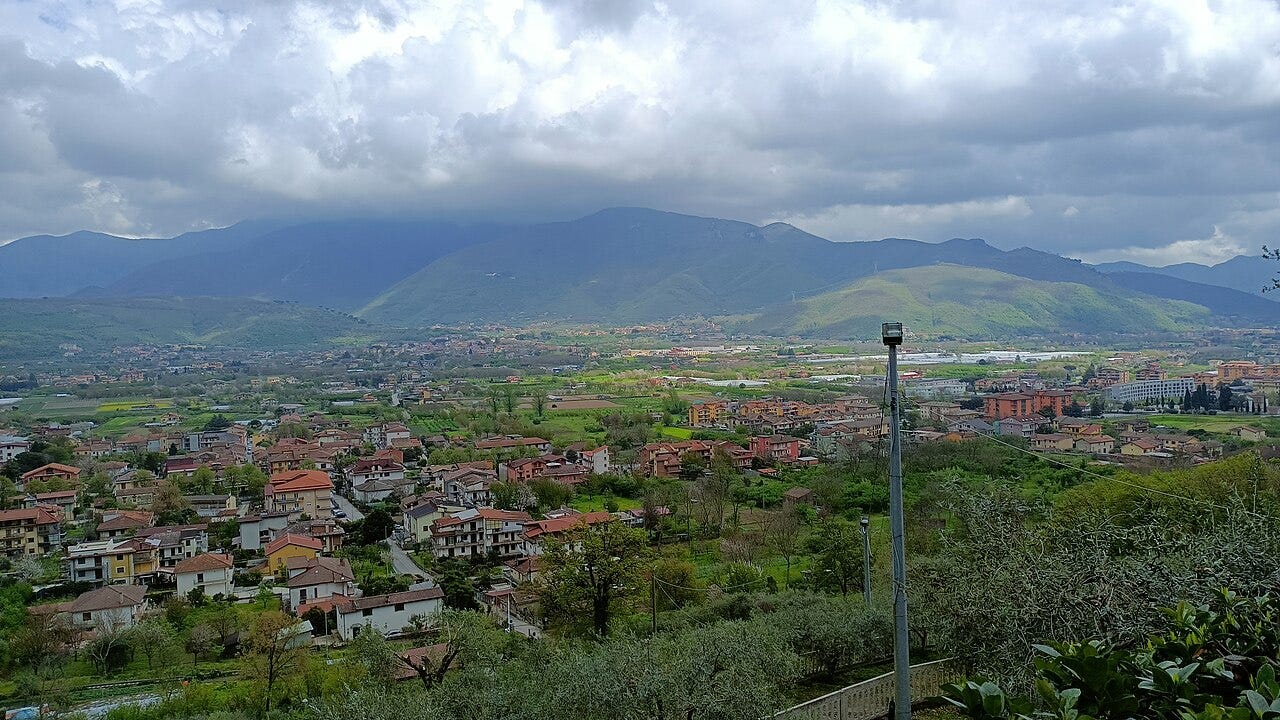
Montoro is an agglomerate of fifteen villages, scattered across the Irno valley, between Avellino and Salerno.
It’s not particularly pretty, but it’s functional. You get cheap property, a quick commute to both Avellino and Salerno, all the services of a larger comune, without much of the chaos.
The real downside is that it’s not really an historic town with a beautiful piazza. And on occasion, you’ll catch the smell of the Solofra tanneries a few kilometers away.
In my mind, Montoro is a consideration if you need a tranquil, well-positioned area that is not affected by major issues and can still be had for sub-€1,000 per square meter.
You’re choosing convenience over character, and your wallet is rewarded for it.
You might think, “Didn’t we just exclude towns that were welded together”? The main difference is that the ones we filtered out are fused to a major city; Montoro is its own group of villages in their own valley. Close to Avellino and Salerno, but not attached to either.
