


A Substack bestseller, Italy with Antonio offers honest guides for moving to, traveling in, and understanding Italy from a native Italian. A paid article every Monday and a free one every Thursday, with deeper resources for paid members, including print-ready PDF and ePub downloads. Join over 2,000 subscribers!
Ask my filter where to live in Emilia-Romagna, and out of 330 comuni (municipalities), 33 remain standing. That’s more than Liguria, Calabria and Friuli-Venezia Giulia produced combined.
So this time the hard part is choosing, and the questions that settle it aren’t even on my livability checklist. Did your street flood in 2023? And can you live with fog?
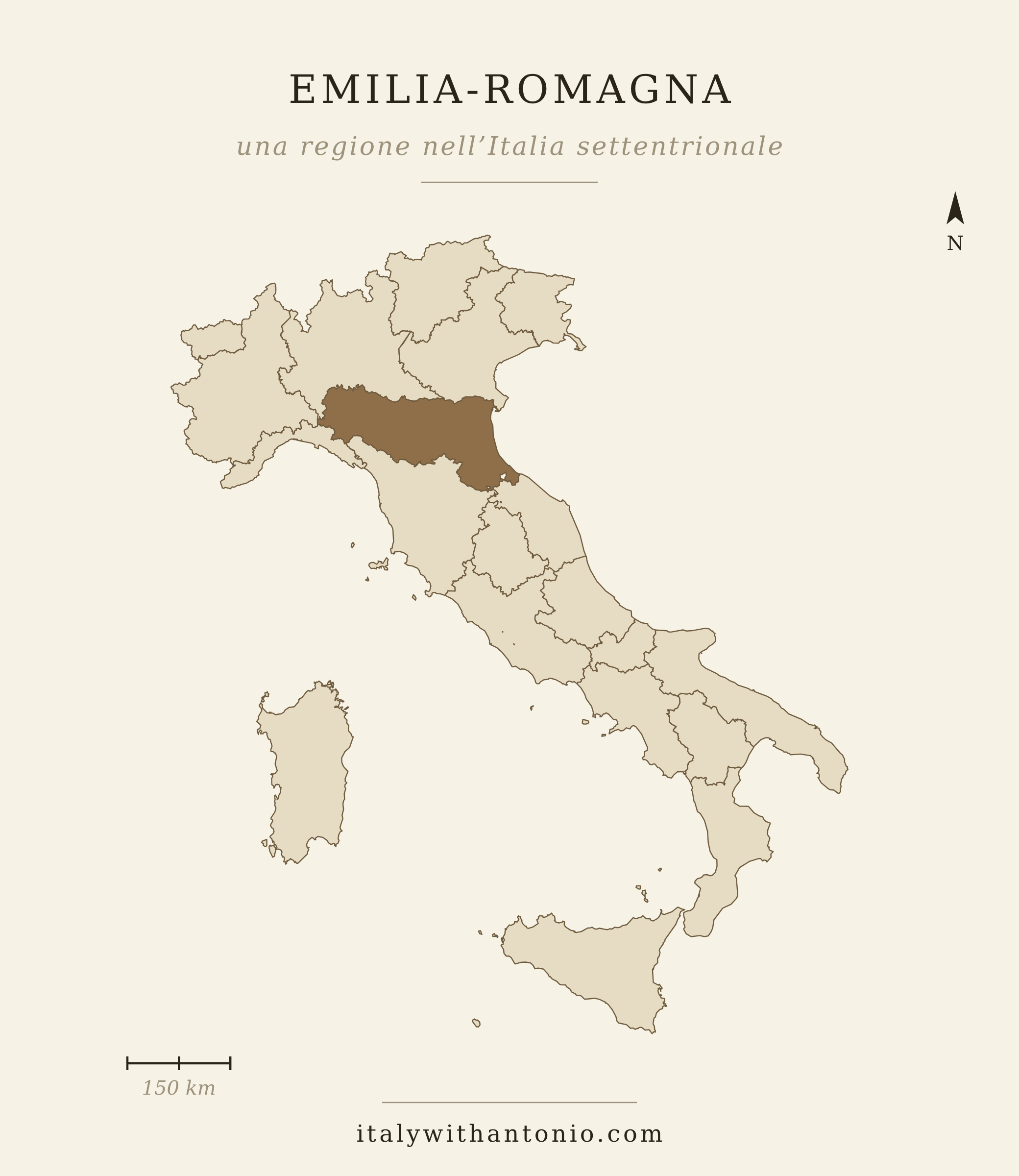
What is living in Emilia-Romagna actually like?
Emilia-Romagna has 330 comuni and 4,477,009 residents (ISTAT, start of 2026), spread across eight provinces plus the metropolitan city of Bologna. Don’t lose sleep over the provinces, though. Since 2014, Italian provinces have been second-tier bodies chosen by local councillors, so for you a province mostly means the capital whose Questura (police headquarters) renews your residence permit.
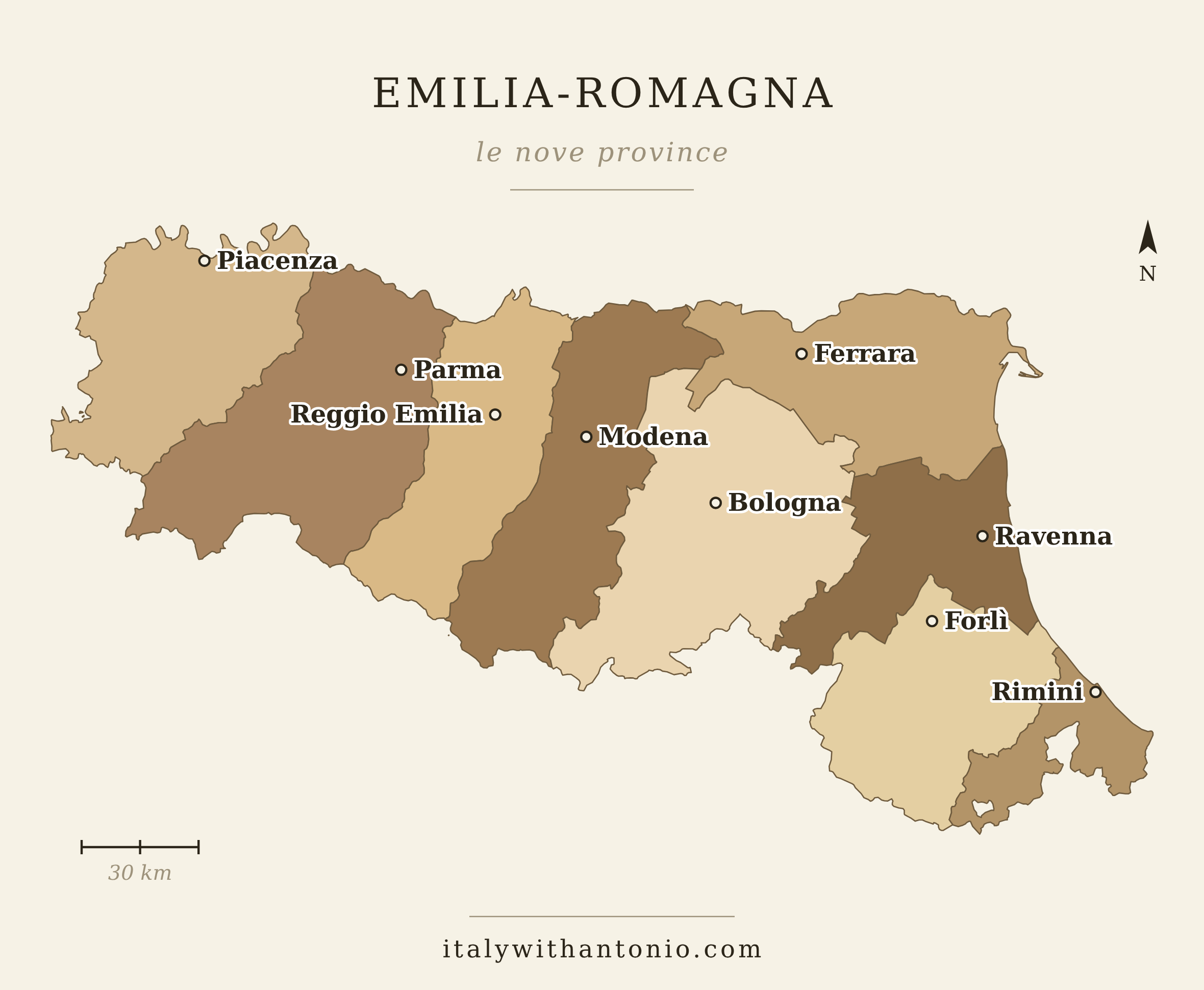
It’s really two regions sharing a hyphen. Emilia runs from Piacenza to Bologna along the old Via Emilia, and it’s the land of factories, prosciutto, and Parmigiano. Romagna is the louder, beach-minded east. Ask either one, and they’ll tell you the other is the problematic one.
The real draw is the economy. Employment reached 71.4% in 2025, against 62.5% nationally (ISTAT), and that’s why the region grew 0.88% over a decade when much of Italy emptied.
Il Sole 24 Ore’s 2025 Qualità della vita ranking tells the same story: Bologna comes 4th out of 107 provinces, Parma 10th, Forlì-Cesena 11th and Modena 12th. The laggards are Rimini (51st) and Ferrara (52nd), which means the bottom of the class here is still in the middle of the national table.
People from Emilia-Romagna tend to be friendly and open. In my experience, some of the nicest people you’ll meet in Italy. And the food… let’s just say, it’s arguably the best region in the whole country for that, though the south puts up a good fight.
Now for the catch, and it’s one you breathe. Most of the region is Po Valley: flat, walled in by mountains and packed with livestock farms, so dirty air settles in and stays. In Legambiente’s Mal’Aria 2026 report, every provincial capital averaged 13 to 18 µg/m³ of fine particulates (PM2.5) in 2025, against a WHO guideline of 5.
The climate won’t win you over either. Summers are humid, with a July average high of 31.4°C in Bologna, and winters are grey. Where I grew up, in central Italy, fog was an occasional visitor. On this plain, it can move in and stay for days. As for the language, English will get you through a Bologna university bar and not much further. Learn Italian. (My site, Linguetto, can help.)
Then there’s the price of all this prosperity. The regional average is €2,203/m² on immobiliare.it (October 2026), but Bologna asks €3,824 and Riccione, on the sea, €4,561.
At the other extreme, Cerignale, an Apennine village near Piacenza, lists at €347. There’s a reason for that, and we’ll get to it.
The real hazard is water, not earthquakes
A lot of people assume Emilia-Romagna became earthquake country in 2012. Mostly, it isn’t. Under the regional classification, not a single comune is in Zone 1: 109 are in Zone 2 and 221 in Zone 3.
The 2012 quake also matters a little less every year. The state of emergency ended in 2025, private reconstruction is complete, and 15 comuni remain in the cratere (the official earthquake zone) for public buildings and monuments. These are working towns with scaffolding on a few landmarks, so Carpi, Mirandola, Cento, and Finale Emilia pass the seismic filter, and I’ll flag it whenever one of them comes up.
Water is another story. Emilia-Romagna flooded four times in 18 months: twice in May 2023, then again in September and October 2024. The May 2023 floods alone killed 17 people and caused about €8.5 billion in damage.
The same names keep coming up: Faenza, Lugo, Bagnacavallo, Budrio, Medicina, Molinella. And Pianoro, where a stream killed a 20-year-old in October 2024.
My filter doesn’t screen for floods, and it can’t, because flood risk changes street by street. The same town can have streets that stayed dry and streets that went under.
So check the exact address, not the town. Ask whether the building flooded in 2023 or 2024. Nobody will take offence, because around here it’s as normal a question as asking about the heating. And if you’re near a river, buy upstairs.
Why a hospital in town doesn’t mean an ER in town
This next one catches even people who’ve done their homework. Since late 2023, the Region has been opening CAUs (centri di assistenza e urgenza, walk-in clinics for minor urgent problems), and in several small hospitals the CAU has taken the ER’s place. Correggio lost its ER in December 2023, and Fiorenzuola d’Arda in June 2024.
A CAU will stitch a cut. It won’t handle a stroke. Great in a pinch, not for anything serious.
Castelfranco Emilia, Finale Emilia, Budrio, Cervia, Cesenatico, Cattolica, and Santarcangelo all have a CAU and no ER. Scandiano still has an ER, but it keeps daytime hours only, so plan your emergencies accordingly.
Most of these towns still pass, because there’s a full ER elsewhere within 25 minutes. Three towns in my population band don’t: Medicina and Copparo are 30 minutes away from one, Molinella 27.
Applying the filter to Emilia-Romagna
The framework is the usual one: 15,000 to 100,000 residents, no Zone 1 or devastated-tier cratere, a full ER within 25 minutes, a high school and a full supermarket in the comune, fiber to the home available in town, and a ten-year population decline under 5%.
Of the 330 comuni, 273 have fewer than 15,000 residents. Nine have more than 100,000, and they happen to be exactly the nine provincial capitals, so not one capital qualifies. (Okay, technically Cesena is a co-capital and barely squeezes in.) That leaves 48.
For a while, nothing happens. Seismic risk removes nobody. Neither does the depopulation test: the weakest town in the band, Copparo, lost 4.63%, which is just inside my, admittedly arbitrary, line. Every town has a supermarket and at least some fiber.
The ER filter takes out three towns, as mentioned. Then high schools, of all things, do the real cutting, because the suburbs grew faster than the schools did. Twelve towns of 15,000 to 35,000 people have none.
Formigine has 34,496 residents and not a single high school.
Obviously, with such abundance (33 survivors), I didn’t need to relax a single criterion. I’m profiling 11 comuni, chosen for their spread across the region and because each one does something the others don’t. The other 22 are listed, grouped by area. Prices are immobiliare.it asking prices for each town’s latest month, August to October 2026.
The best places to live in Emilia-Romagna
1. Carpi

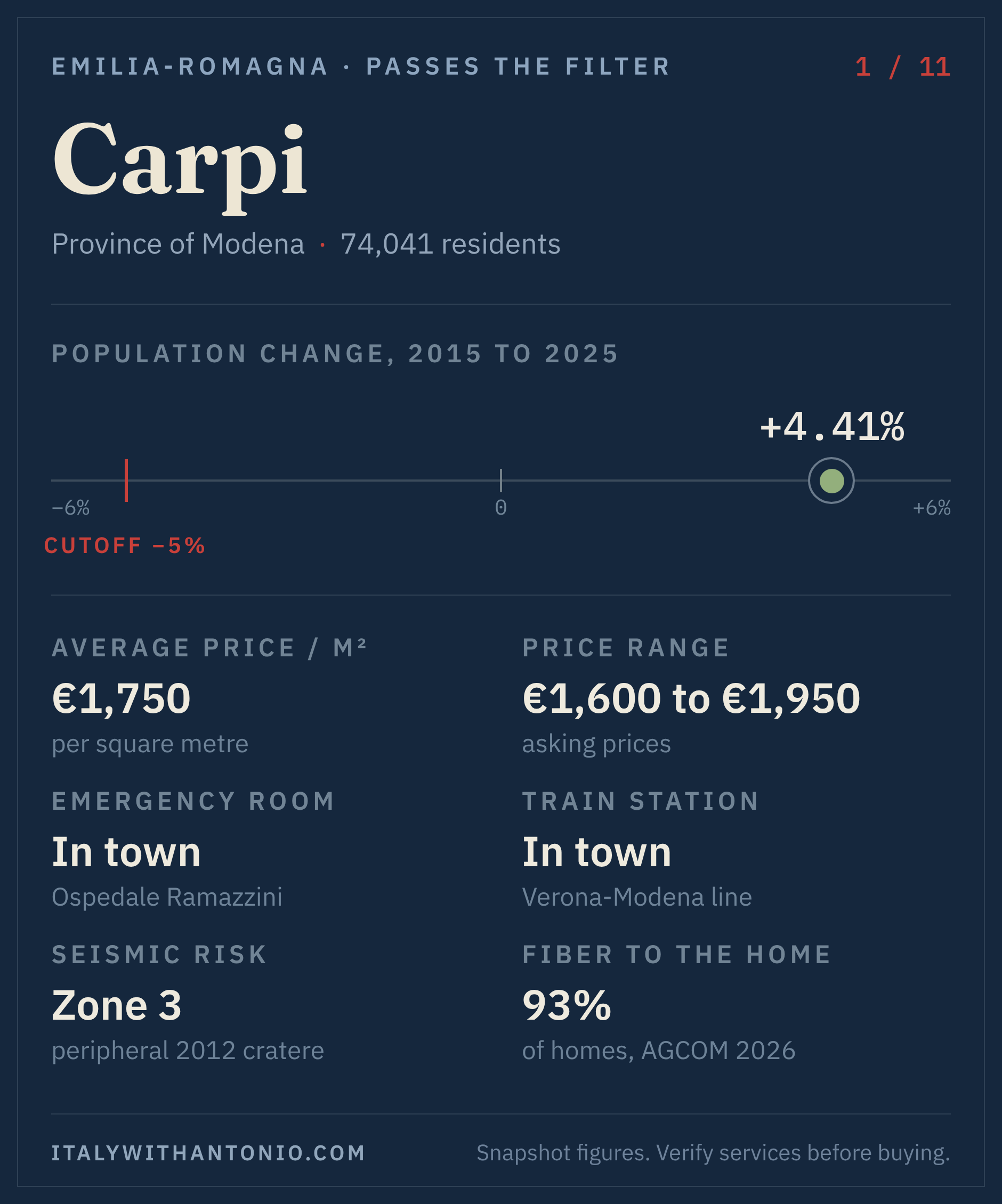
Carpi is a knitwear town that got rich, wobbled, and kept going. Its district still counts 596 garment firms and about €1.3 billion in turnover, with Liu Jo and Twin-Set among them.
The centrepiece is Piazza dei Martiri, one of Italy’s largest squares, framed by a castle, a cathedral and a 52-arch portico. It’s the kind of square that makes you wonder what a town this size is doing with it. On the practical side, Carpi has its own ER, a train station, and homes at around €1,750/m², less than half of Bologna’s price.
What you can’t escape is the Po Valley’s fog and air. As for the 2012 cratere status, these days it means some heritage work, not a broken town.
Carpi suits people who want a real city with a real job market, minus the big-city price. People keep choosing it, and I can’t say they’re wrong.
