


Italy with Antonio. Honest guides for moving to, traveling in, and understanding Italy from a native Italian. Three articles a week, with deeper resources for paid members (including the print-ready PDF and ePub downloads of this article). Join 1,500+ subscribers.
This article is part of a series in which I investigate Italian towns to relocate to. So far we’ve covered:
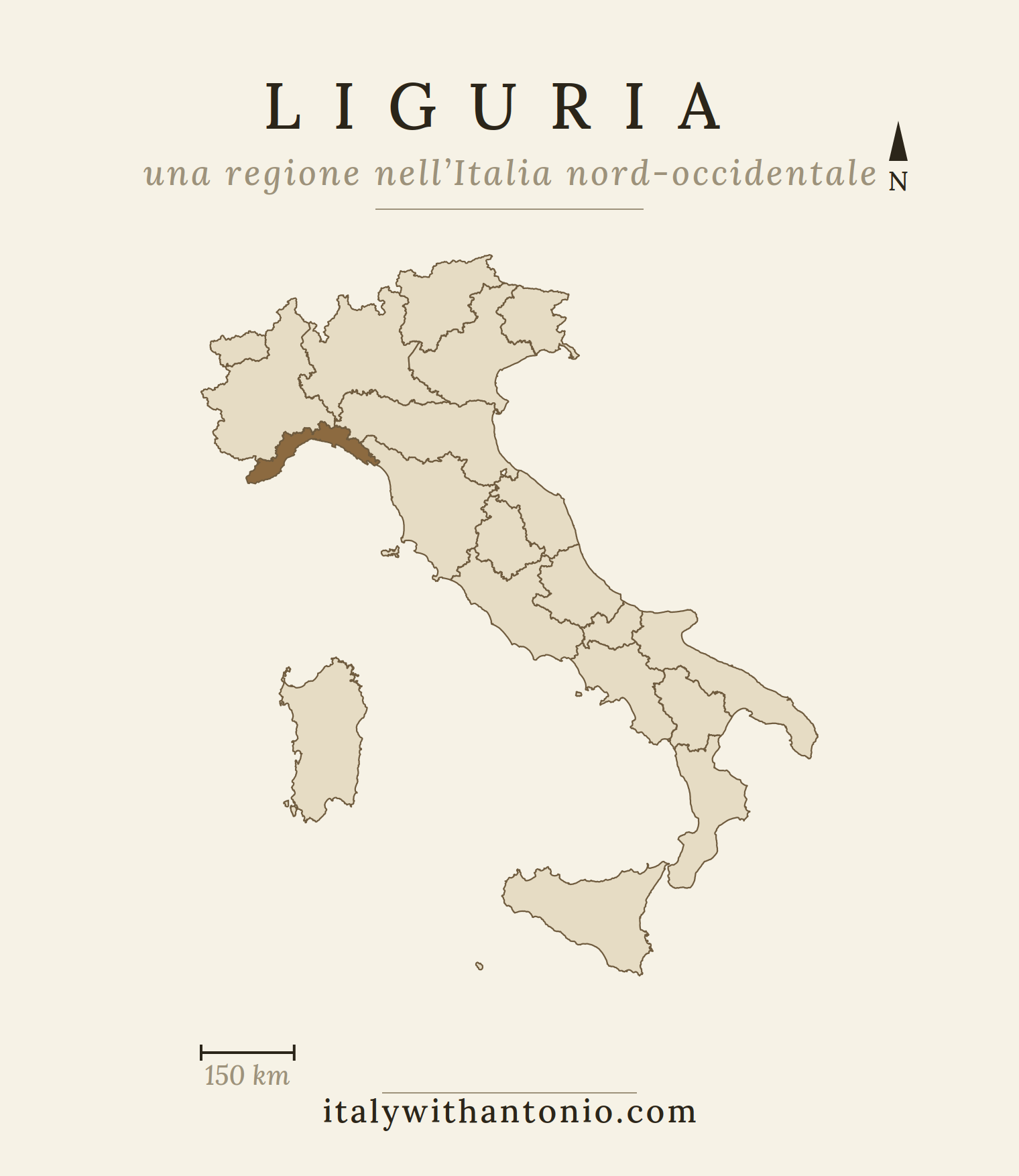
Today we’re applying our framework to Liguria.
The screening includes several filters. Comuni (municipalities) must:
Have a population between 15,000 and 100,000. Not too big, not too small.
Not be in a Zone 1 seismic area or a recent cratere (the reconstruction zone after an earthquake).
Have a full supermarket in town for groceries.
Have a high school in town.
Have a full ER within a 25-minute drive.
Have fast internet (fiber optic).
Have a depopulation rate below 5% over the past 10 years.
In most regions, it takes a few of these criteria to knock the list down to a manageable size. Not in Liguria. The very first filter, population, takes out 224 out of 234 comuni. One is too big (Genova); the rest are all too small.
Liguria is simply full of small villages and towns. Almost a third of all comuni there have fewer than a thousand people.
Of the 10 remaining comuni, nine pass the rest of the filters as well. We’re going to cover each of them.
Disclaimer
The numbers here are a snapshot of publicly available data at the time of writing and may change. Treat the figures I mention, and the list of towns itself, as a starting point. Always verify important factors like the ER, schools, and transport before you buy.
What Liguria is actually like to live in
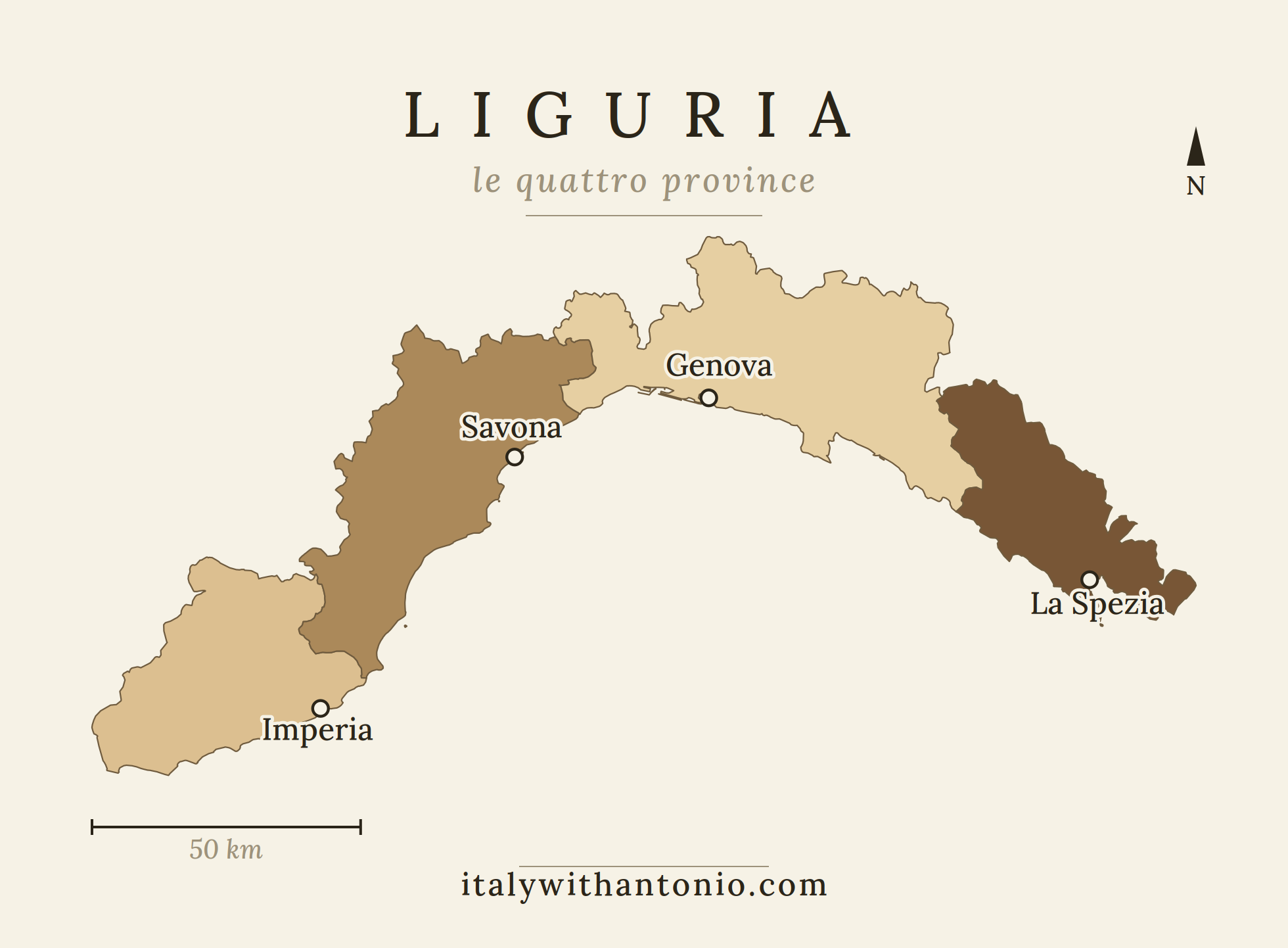
Liguria is the third smallest region in Italy size-wise, after Valle d’Aosta and Molise. It’s a 350 km strip of land compressed between the sea and the Piemonte mountains. It has four provinces, though Genova is technically a città metropolitana, the authority that replaced the old province. It’s also the region's capital.
Namely, its four “provinces” are:
Genova (67 comuni)
Savona (69 comuni)
Imperia (66 comuni)
La Spezia (32 comuni)
Genova, the city, holds on its own 37.4% of the region’s 1.5 million residents. The metropolitan city (so Genova proper plus surrounding areas) accounts for more than 50% of Liguria’s population.
In terms of demographics, Liguria is the oldest region in Italy. The average age is 49.6, and the old-age index is a staggering 283.3. What that means is that for every 100 children under 15, 283 people are over 65.
In 2024, the region recorded 21,072 deaths against 8,380 births. Despite this negative delta, the population rose by 1,003. All because of immigration.
For what it’s worth, medium-sized cities like the ones we are looking at tend to have the youngest people and lowest death rates within Liguria. I’m sending you to the healthiest slice of the strip.
Cristoforo Colombo was from here, which might tip you off to the real engine of the region: ports, ships, tourism, and turkey dinners. The last one is a joke, but the naval industry is serious business: Genova’s port, Costa Crociere’s head office in Genova and its cruise terminal at Savona, and Fincantieri at La Spezia, if we are name-dropping. The GDP per capita is near €30,000, average for the North, but far from Milan levels.
The quality of life is generally okay, but nothing to write home about. La Spezia 42nd, Genova 43rd, Savona 65th, and Imperia 80th out of 107. Imperia’s ranking is actually remarkably low, as it’s dead last among northern provinces.
Language-wise, outside of central Genova, assume you’ll need Italian. Since Liguria borders France, as you move west, knowledge of French will actually help you out more than English will. Though this isn’t Aosta, don’t expect bilingualism.
Earthquakes are not a critical issue in Liguria. There are no Zone 1 comuni or crateri, even though 30 Zone 2 comuni in the Imperia province do exist.
So our seismic filter does nothing in Liguria. What you need to worry about are landslides. ISPRA estimates 54.9% of the population in Liguria is at risk of landslides. That’s 823K people, an unpleasant record unmatched by any other Italian region. Genova, in particular, holds the city record, and it has flooded repeatedly, most notoriously in 1970, 2011, and 2014.
Check the ISPRA’s IdroGeo map for your specific address before you make an offer on a house.
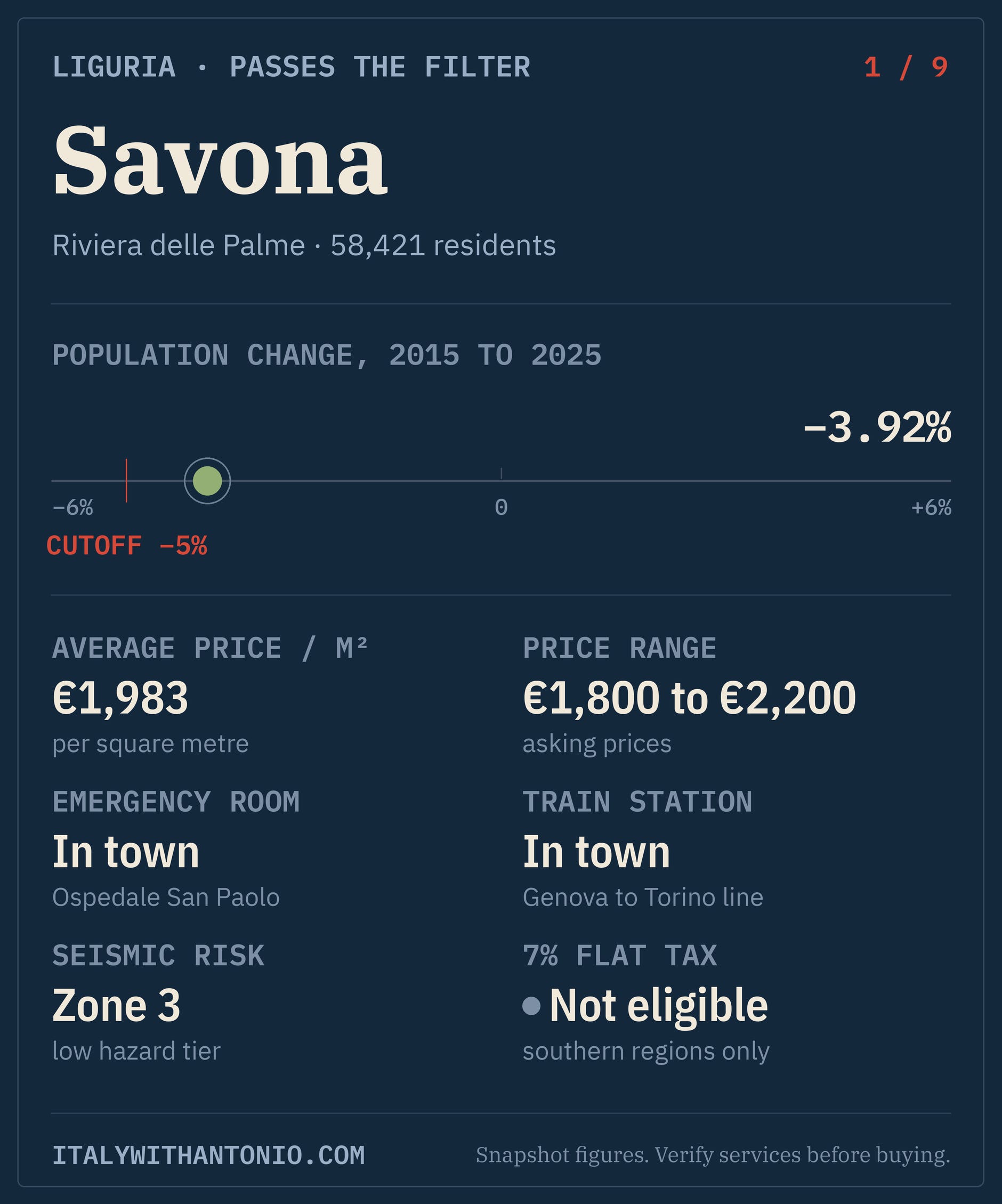
Depopulation is an issue in Liguria. It mostly affects smaller comuni, however. In fact, of the ten comuni that survive the population filter, only one gets excluded due to its depopulation level (Sestri Levante with a 7.38% drop).
Average prices are a lie in Liguria
More than in most other regions, Liguria’s average prices are close to useless. There is a massive gap between coastal resort towns and the interior. Liguria has many affordable places, but its average (€2,549 per square meter) tells you it’s the third most expensive region in Italy. Don’t believe it. Even Genova at €1,503 per square meter is quite affordable for a large city by the sea, with a metro, an airport, and a university.
From a services perspective, Liguria does well, as all northern regions do. The only service you need to watch out for is fiber internet access. It’s one of the last regions with less than 70% coverage. A quick check for the specific house address you’re considering will ensure you are not making Elon Musk richer by buying his Starlink satellite internet service.
Finally, Liguria is in the north, and there are no comuni on the crateri list, so the 7% tax regime for retirees doesn’t apply here.
Here are the nine comuni worth considering for relocation in Liguria.
1. Savona
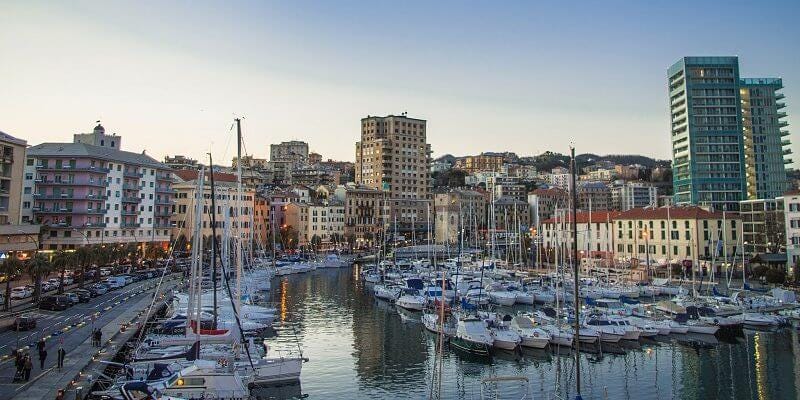
Savona, the city, is an important port on the Ligurian Sea with a medieval historic center. It’s also the cheapest place on this list.
An average of €1,983 per square meter gets you a decent-sized city with real infrastructure, a solid hospital in town, many supermarkets, and direct trains to both Genova and Torino.
Il Sole 24 Ore’s latest rankings placed it 11th for culture and leisure, punching well above its weight for a city this size.
The good news sort of stops here: said rankings also placed it 65th out of 107 provinces overall, and 91st for justice and security. So it’s a city of culture and crime. (Mind you, Italy has relatively low levels of serious crime.)
The port gets quite busy as well, which is good for business, but it does mean that many cruise passengers can disembark en masse and temporarily fill the old city with tourists. Costa Crociere uses this port, and over 750K cruise passengers stop by each year.
Think of the waterfront as a working port with cranes and cruise terminals, rather than a peaceful boardwalk.
Still, a genuinely reasonable choice for the right person.

