


Italy with Antonio. Honest guides for moving to, traveling in, and understanding Italy from a native Italian. Three articles a week, with deeper resources for paid members. Join 1,500+ subscribers.
This post is part of a series of articles meant to help you find Italian towns worth moving to.
So far I covered:
This time around, we’ll explore Abruzzo.
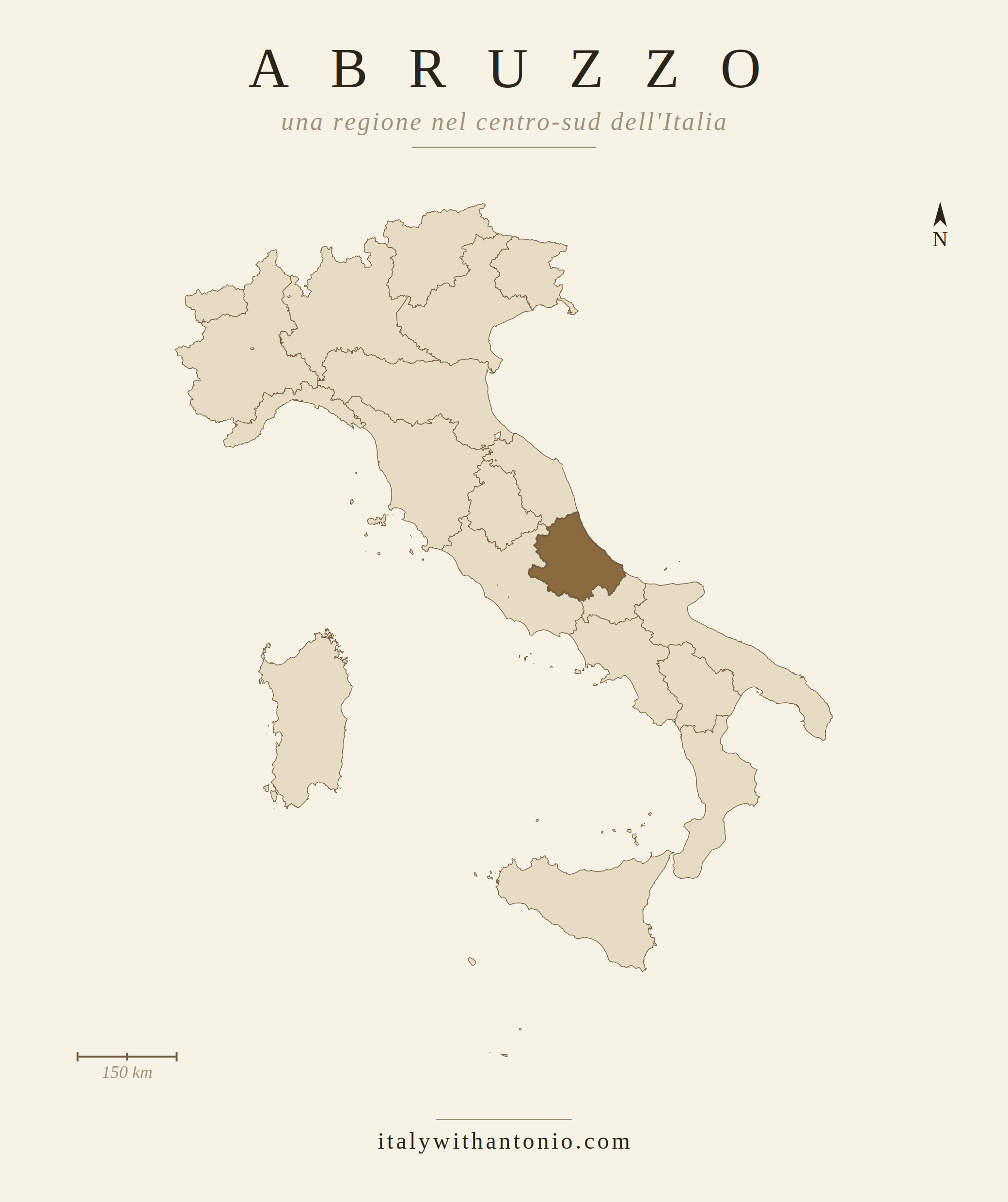
In this series, we apply strict filters, region by region, and see what comes out. The surviving municipalities are usually livable cities, neither too big nor too small. It is the framework I would use myself if moving back to Italy today.
Our framework does something interesting to Abruzzo: it completely erases the mountains.
Don’t get me wrong, the mountains are arguably the most beautiful part of Abruzzo. The real issue is that we are looking at potential relocation spots and when the postcards and the safe choices are far apart, we must opt for the latter.
The eight surviving cities in Abruzzo are all coastal. Let’s put on our swimming goggles and dive in.
What Abruzzo is like
Abruzzo has 305 comuni (municipalities). Actually, make that 303 since Pescara is about to swallow two neighbors in 2027.
It’s home to 1.27 million people, spread across four provinces: L’Aquila, Teramo, Pescara, and Chieti. That relatively small number of people is going down each year.
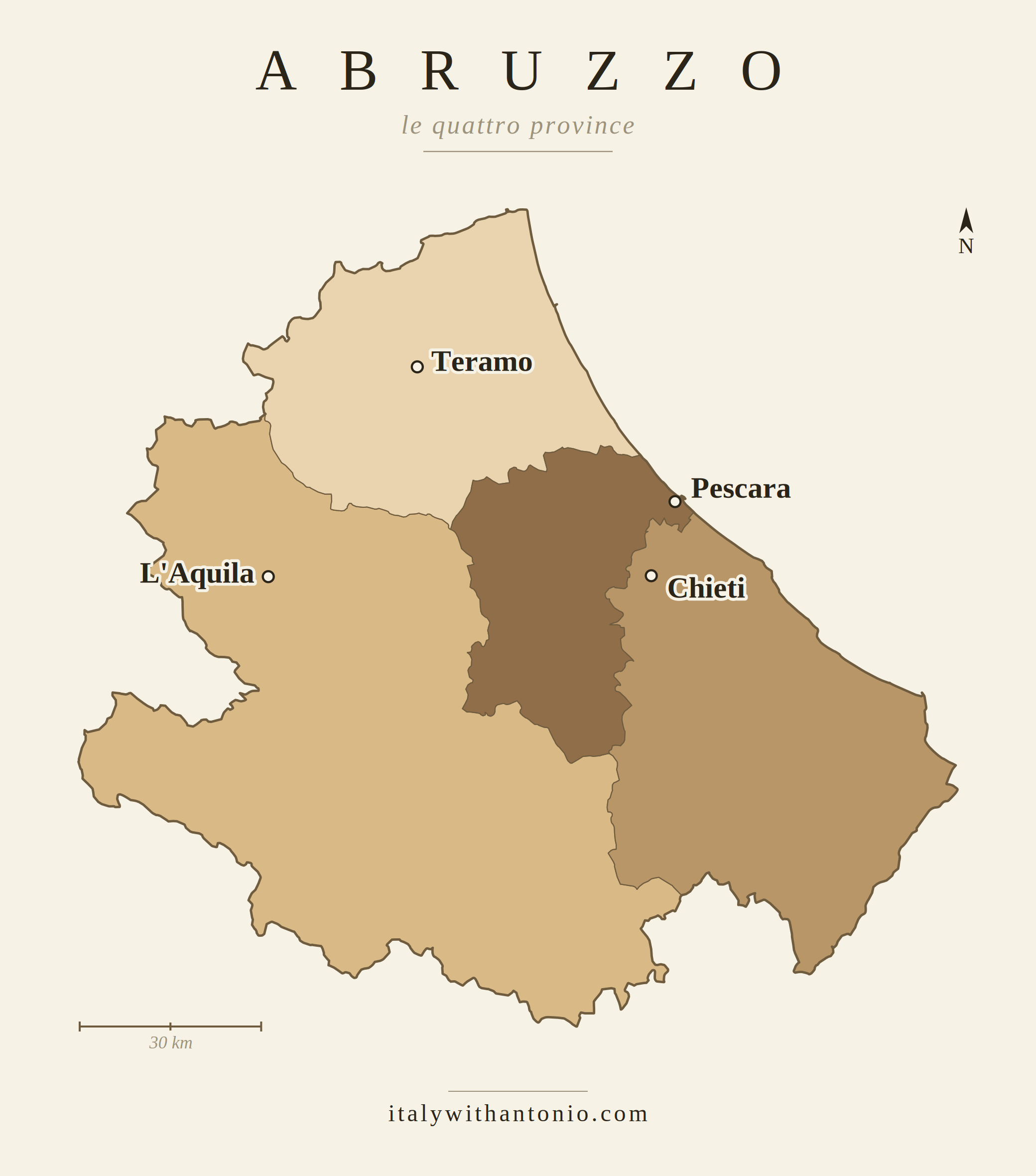
Whether Abruzzo is central or southern Italy is a contested topic. Geographically, it is central. Culturally and economically, it is slightly more southern. My take is that it’s both.
The 7% tax haven
What matters more is that Abruzzo qualifies for the 7% retiree/passive income tax like southern regions do. It’s a fantastic fiscal deal, so I’ll be pointing out which towns on our list qualify for it.
It’s worth mentioning that Abruzzo has the most participants in the program. The number of people who took advantage of it to date is relatively small (hundreds, not thousands), but Abruzzo was their first choice. In fact, it has more people retiring there (on this tax haven program) than Campania, Calabria, Basilicata, and Molise combined! That should tell you something about the region’s value proposition.
Two regions in one
Abruzzo is essentially two regions in one. Coastal Abruzzo is the one spread along the Adriatic, with its flat sandy beaches, warm climate, busy summer, and jobs.
Behind it, the gorgeous Abruzzo of the high Apennines, the Gran Sasso and the Maiella. Postcard-worthy. A dream if you like the mountains and hiking.
For most people, living in Abruzzo means living in the first one. The second one, despite L’Aquila being the regional capital, is best reserved for visiting.
“Antonio, let me get this straight: I get the beaches, the mountains, the 7% tax rate if retiring there; where is the catch?” I hear you ask.
There are two honest catches.
Seismic risk
The first is that Abruzzo is one of the worst regions of Italy for seismic risk.
This is not theoretical. In 1915, in Avezzano (L’Aquila), 30,000 people died in a single morning. In 2009, a 6.3 magnitude earthquake killed 308 people in L’Aquila itself. The region’s own capital is still rebuilding fifteen years later. In 2016 and 2017, the Teramo mountains were hit hard. And in January 2017, an avalanche caused by an earthquake buried a luxury hotel in Rigopiano, killing 29 people.
Thankfully, we have our seismic filter in place. It will eliminate all of the riskier places for you. And if that means getting rid of the mountains, so be it.
The economy
The second catch is the economy.
Tourism is real but mostly seasonal. There is some light manufacturing in the north and an auto industry around Atessa, where Stellantis runs the biggest van factory in Europe.
Most of my readers won’t be able to rely on local jobs. I suspect you’ll either retire here, move with passive income, or work remotely from a laptop.
So for you, the lack of jobs mostly shows up as a cheap cost of living. It’s an unfair advantage, but as long as you pay your taxes, you are helping a depopulating region, and the locals won’t resent you for it. I have seen countless testimonies of people who moved to Abruzzo, and they are almost universally happy.
Quality of life
Because of Abruzzo’s few jobs and business opportunities, all four provinces score middle of the pack or worse on Il Sole 24 Ore’s quality-of-life index.
Namely:
Teramo (68th)
Pescara (40th)
L’Aquila (69th)
Chieti (62nd)
Out of 107 provinces. Pescara in particular ranks respectably, on top of being first in Italy for cultural shows per capita.
By the way, language-wise, don’t expect Abruzzo to speak English. You might hear it on occasion in Pescara in August, but this is squarely Italian-is-a-must territory.
Crime
Abruzzo is safe, but a small degree of visible crime does exist. For example, Pescara is 31st in the country for crime, with car theft being particularly prominent there.
Teramo is 53rd (5th for prostitution exploitation). Chieti, 79th (3rd for loan-sharking, but it’s a very small sample of only four reported crimes).
L’Aquila is 86th but 3rd for attempted homicide and 10th for smuggling.
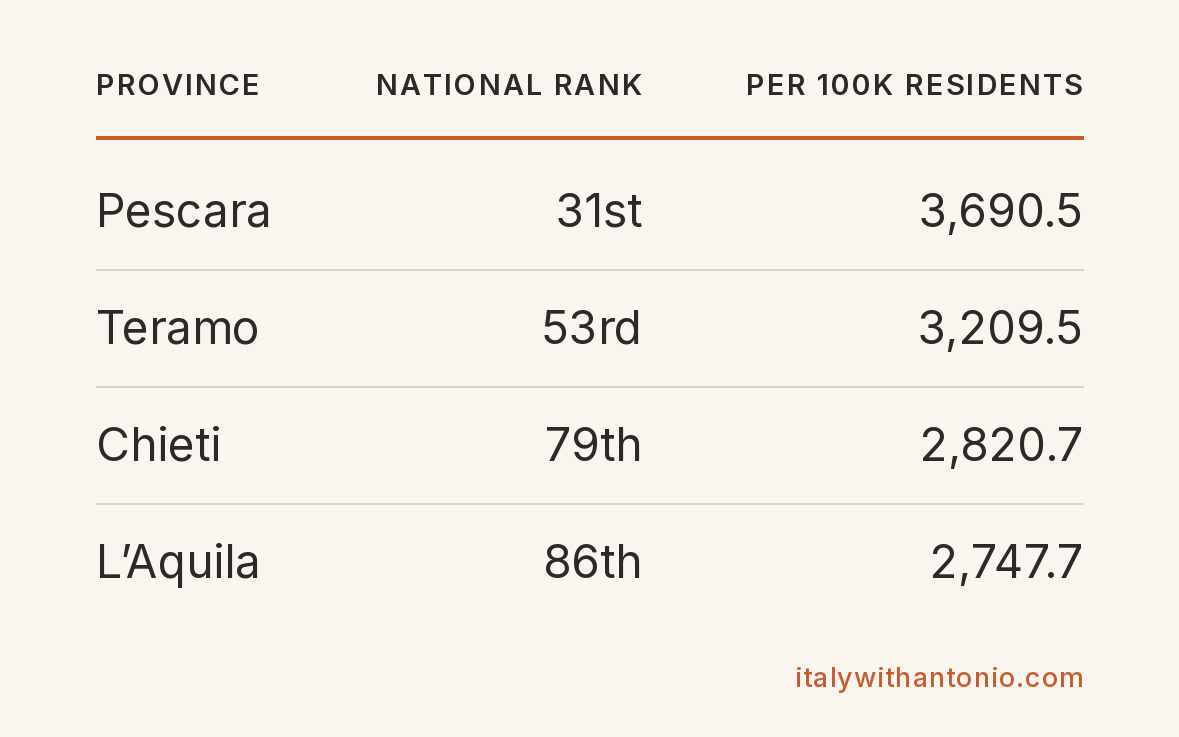
On the whole, crime is not a major concern here.
Climate and Cost
As we were saying, Abruzzo really is two regions in one. The mountains are cold and snowy. L’Aquila is one of the coldest regional capitals in Italy, and Roccaraso is a legitimate ski town.
Conversely, the coast is mild in winter, and hot and humid in the summer.
As you can expect, it’s more expensive than the interior. That said, by Italian standards, Abruzzo remains cheap. Even coastal Abruzzo. Asking prices for the Chieti coast rarely clear €1,700 per square meter. The regional average looks big because it’s inflated by ski resorts demanding north of €2,700 per square meter.
I personally see the coast as the preferable option, plus the whole “house won’t fall on me during an earthquake” thing it has going for it.
And always remember that the asking prices you see on the portals are rarely what the sellers end up getting. It’s a buyer’s market. Especially in Abruzzo. Offer 20% below listing price and move from there.
Running the filter on Abruzzo
Abruzzo is not densely (or very) populated, so the population filter does most of the screening for us. Apply the 15,000-100,000 range and 288 comuni get dropped in one pass.
Pescara has over 100,000 people, and Montesilvano and Spoltore are joining it in January 2027, so all three are out.
Abruzzo really is four cities, and then small towns and semi-empty villages.
The seismic filter kills L’Aquila, Avezzano, and the incredibly charming Sulmona on the spot. You can go live there if you want, but do so with open eyes. Pay attention to the seismic retrofitting measures of a given property you’re considering.
The depopulation filter takes out most of the remaining comuni that won’t ultimately make the cut. Chieti is down 7.2% since 2014, well above the 5% filter threshold. Teramo down 6.2%. Ortona, 6.9%.
What we are left with is eight towns, all on or beside the coast.
Renting on the coast
In general, it’s best to rent first and then figure out if the town is worth investing in. However, coastal towns can be frustrating due to regularly priced rentals being limited to the off-season. In the summer, rental prices skyrocket, with many landlords opting for short-term rentals. That said, with eight towns to choose from, you’ll certainly find enough suitable properties to rent before you decide to buy.
1. Vasto (Chieti)

Trabocchi are fishing platforms built on wooden stilts over the sea.
Province: Chieti (CH)
Population: 40,400
Seismic risk: Zone 3
Stability: 0%
Price range: €1,300-2,200/m² (average: ~€1,640)
7% eligible: No (over 30k)
Vasto is coastal but doesn’t simply behave like a resort. It’s closer to being an actual city. At over 40,000 people, you start to have the advantages of larger towns, including self-sufficiency and services like a first-level hospital and ER. You also get seismic Zone 3, the lowest hazard level available in the region.
The downside for retired and passive income folks is that it’s too big to qualify for the 7% tax rate. But if you are still working, its size is mostly an advantage for you.
Like many cities on the Adriatic Sea, Vasto is somewhat seasonal. It has an old center on a hilltop that remains stable and a newer coastal marina area that gets busy during the summer months. Choose according to taste and budget. The seafront can be quite a bit more expensive than the old town.
