


Italy with Antonio. Honest guides for moving to, traveling in, and understanding Italy from a native Italian. Three articles a week, with deeper resources for paid members (including the print-ready PDF and ePub downloads of this article). Join 1,500+ subscribers.
Umbria is a region in central Italy. It sits between Tuscany and Marche, sharing some of the landscape and cultural characteristics of both.
The pitch is this: it’s cheaper than Tuscany by a wide margin, and you get fewer crowds. If you love great food and wine, nature, and medieval towns, you can’t go wrong with Umbria. It’s called the green heart of Italy and, for the most part, it’s a slice of peace.
The price to pay is the lack of coastline (beautiful Lake Trasimeno notwithstanding), shaky ground, and young people leaving.
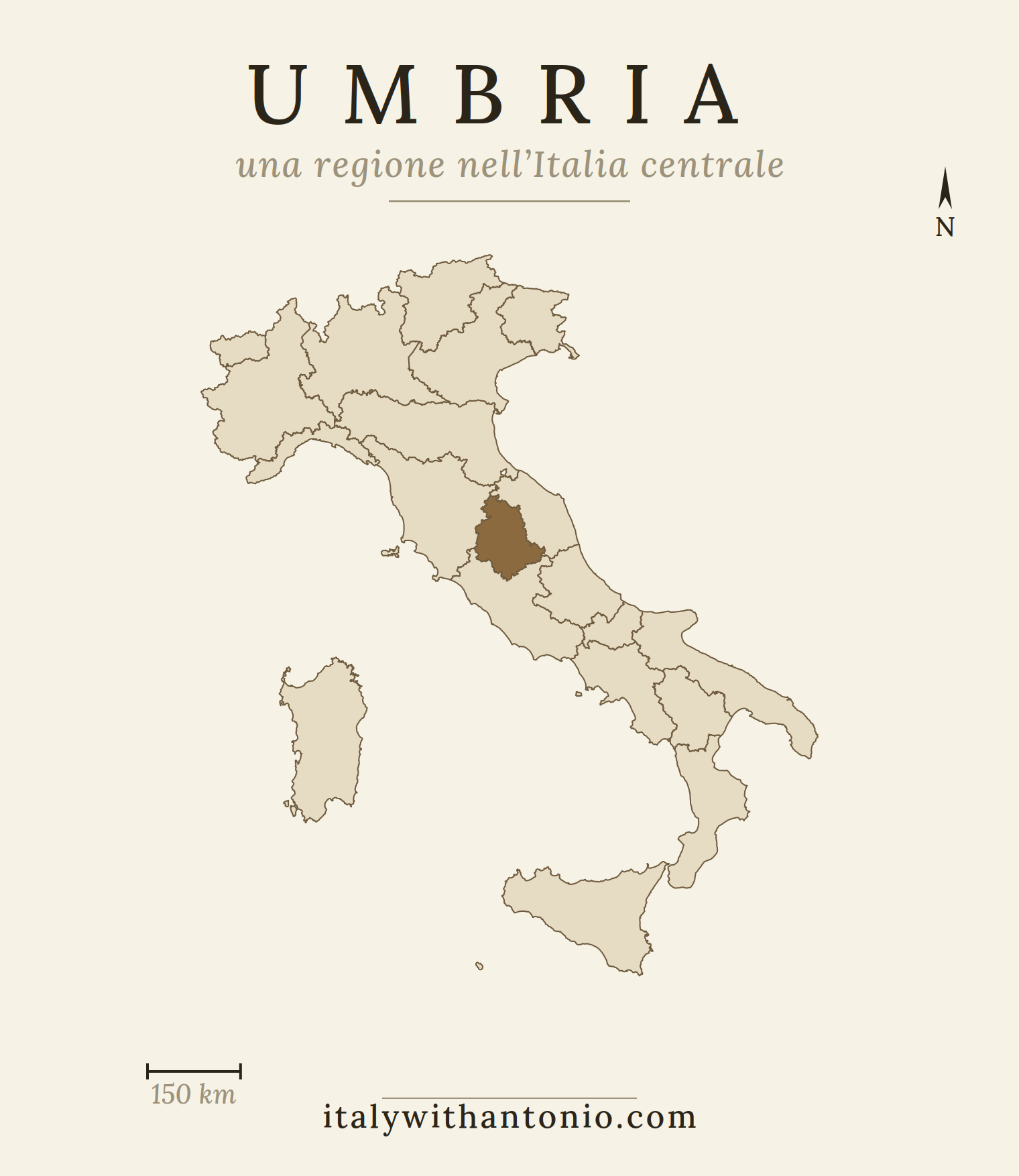
This is part of my series evaluating Italian towns for relocation by applying objective filters. So far we’ve covered Marche, Tuscany, Veneto, Campania, Abruzzo, and Piedmont. Today, we’re covering Umbria.
When I delved into Piedmont, we started with 1180 comuni (municipalities) and reached 40 candidates by applying our usual criteria. We actually deployed an extra filter to get to a more manageable shortlist of 20 towns.
Umbria has the opposite problem. We are starting with only 92 comuni, so instead of adding filters, we’ll relax one and end up with five livable candidates.
Assisi makes the cut. Some of the other famous names like Spoleto, Orvieto, and Gubbio do not. In Umbria, three filters do virtually all of the work: population, seismic risk, and depopulation.
Disclaimer
The numbers here are a snapshot of publicly available data at the time of writing, and they can change. Treat the figures I mention, and the list of towns itself, as a starting point. Always verify important factors like the ER, schools, and transport before you buy.
What Umbria is actually like to live in
Umbria has roughly 850,000 people spread across just two provinces: Perugia, the capital of the region, and Terni.
Perugia is a proper full-sized city that stays vibrant thanks to its two universities. It’s big on art, history, and chocolate. Terni is a strange one. It combines an industrial steel legacy with a romantic side (St. Valentine was born here) and Roman roots (the Cascate delle Marmore, built by the Romans, are the tallest manmade waterfalls in Europe).
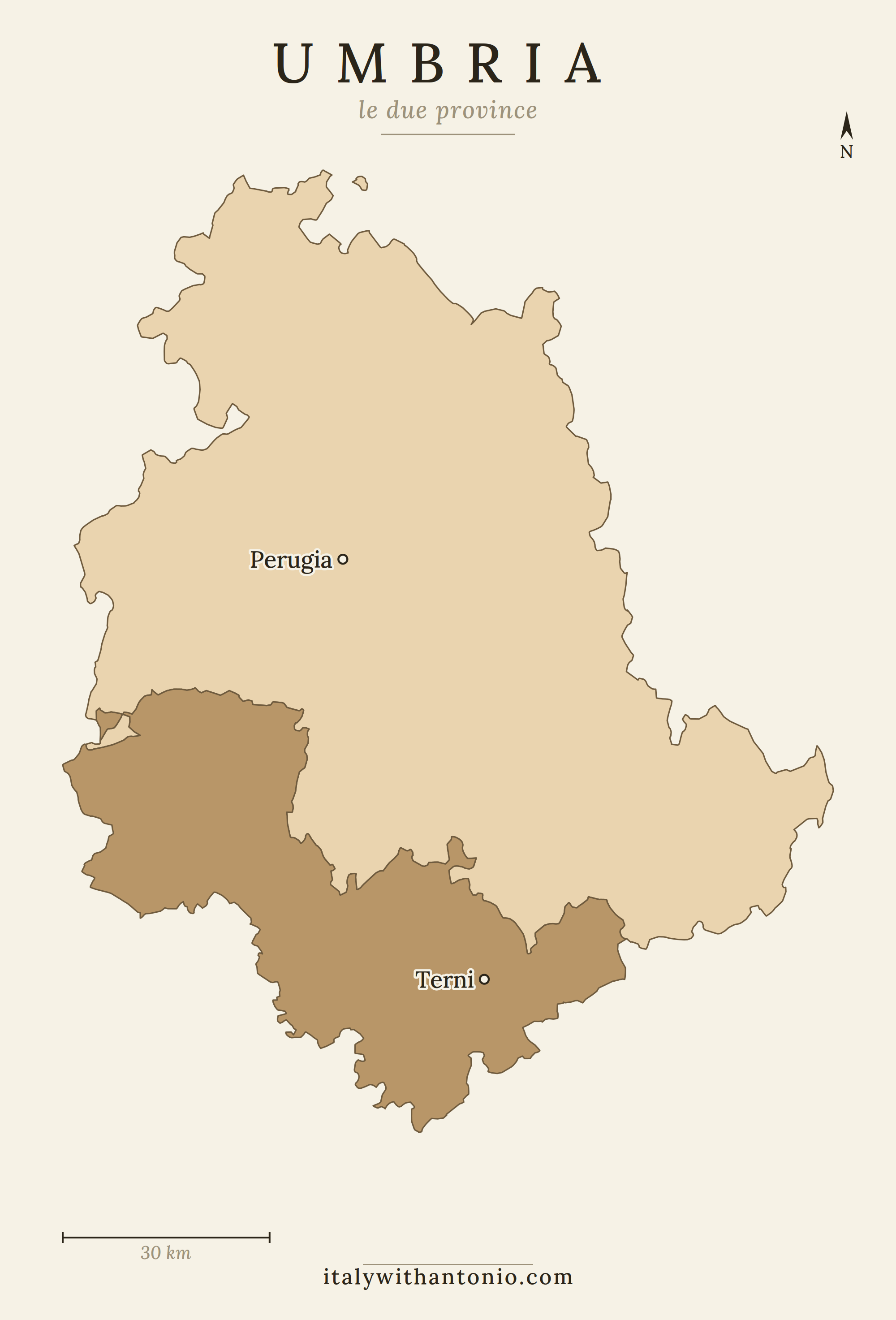
Il Sole 24 Ore’s 2025 quality-of-life index placed Perugia 37th out of 107 provinces and Terni 48th. ItaliaOggi, using a different method, put Perugia 40th and Terni 45th. Both indices agree: they sit comfortably in the middle of the table, which is fitting for a region in the center of the country.
If we dig further, more useful details emerge. Perugia does well on climate, demography, health, and education. It fails on theft and workplace safety. Terni is cheap, fourth in Italy for rental costs, but people are leaving, and it’s almost dead last for climate (literally 106th out of 107). Its frequent extreme heatwaves make it unbearable in summer. (As I write this, the temperature there is 37ºC / 99ºF at 5 PM.)
The region is also split from a seismic risk perspective. 18 comuni sit in Zone 1, the riskiest tier (most along the eastern edge). Notable examples include Foligno, Spoleto, Trevi, and Campello. All of these are excluded as candidates.
Local jobs outside of the two provincial capitals are few and carry modest wages. You move to Umbria for the slow life, ideally with your own source of income, not for a career.
The one genuine upside is that Umbria became the third Italian region to finish the government rural-fiber project, reaching 77 small comuni. So remote work from Umbria is a viable option without having to get Starlink.
English-wise, Italy is last in the EU, and Umbria is mid-pack at best in Italy. You can expect some English while shopping in Perugia or visiting Assisi, but plan to speak Italian for everything else (Linguetto can help).
Being a region of the center, Umbria doesn’t qualify for the southern 7% retiree tax regime. The few comuni that would are those included in the crateri list. In other words, it’s an incentive to get you to live in areas massively affected by the 2016 earthquakes. We exclude such towns by design in our framework, so no town on our shortlist qualifies for the 7% program.
Where to live in Umbria: running the filter
As a recap, our filters are: a town of 15,000 to 100,000 residents, no seismic Zone 1, a full emergency room within a 25-minute drive, a high school inside the comune, supermarkets and fiber, and a population that hasn’t declined 5% or more in a decade (ISTAT counts, 2014 to 2024).
For Umbria, this aggressive filtering leaves us with a very small shortlist, so I relaxed the population floor from 15,000 to 10,000 and checked that the resulting additional list still had all the services you’d need. One of them did.
Starting with 92 comuni, we lose 75 to size: Perugia (162k residents) and Terni (106k residents) are too big, and 73 are below 10,000 people.
Foligno and Spoleto are the right size but excluded, as mentioned above, on account of their Zone 1 seismic classification. Corciano and San Giustino have no high school of their own and are out.
Depopulation is where the screening gets serious. Many viable candidates are emptying, including towns well known for their beauty: Orvieto, Todi, Narni, Gubbio, Città di Castello, etc. All above the 5% decline threshold.
Let’s review the five that survive every filter.
1. Assisi
Province: Perugia (PG)
Population: 27,400
Seismic risk: Zone 2
Stability: -2.82% (2014-2024)
Price range: €1,050-2,500/m² (avg €1,474)
7% eligible: No
ER: In town
Train station: In town
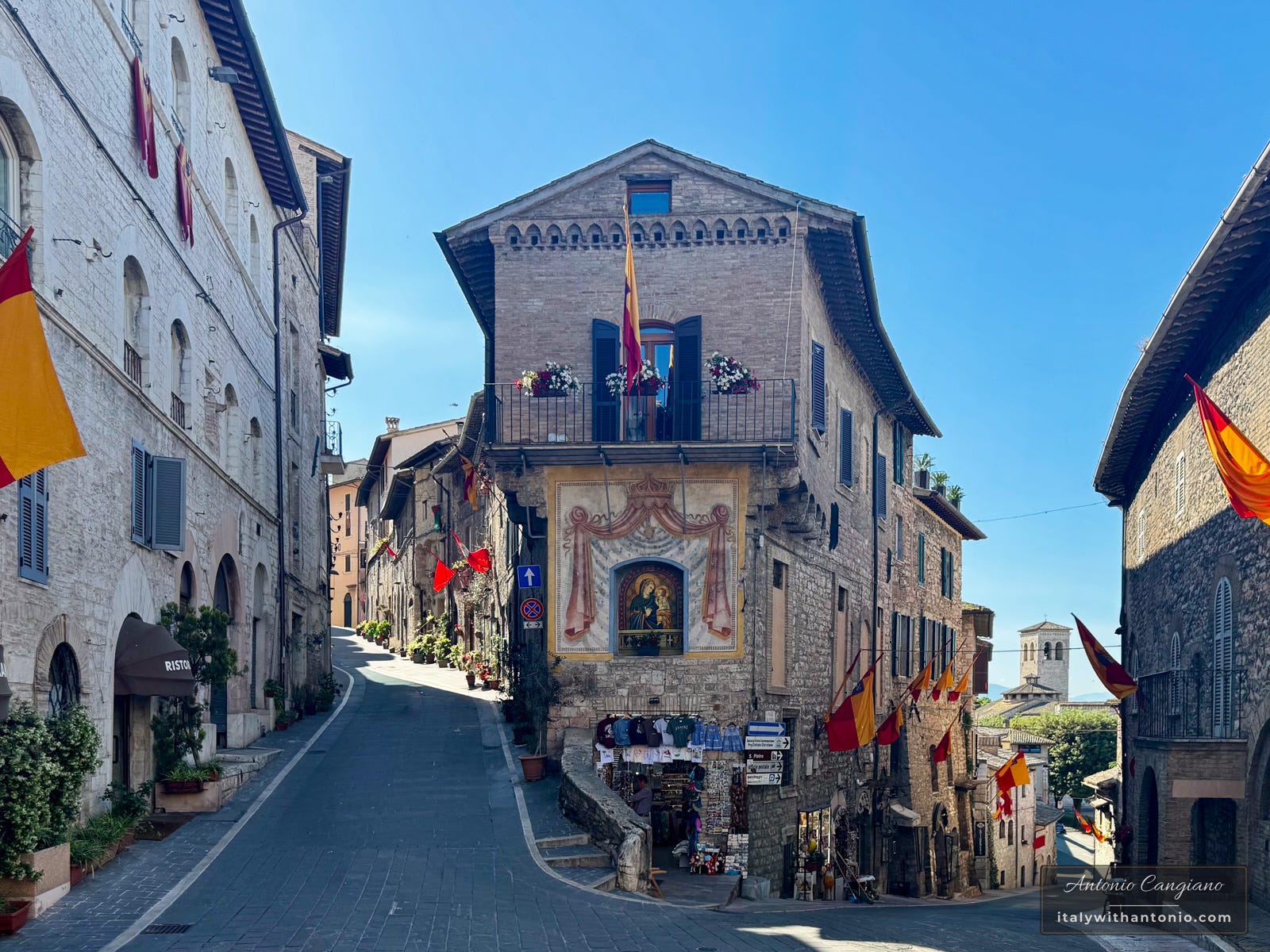
Assisi is the most obvious choice on the list. Just the right size, well-known, beautiful, well-serviced, and, in the center, many shopkeepers speak basic English.
Before you get too excited, a clarification is in order. The comune of Assisi has several frazioni (hamlets), the most well-known of which is Santa Maria degli Angeli on the flat, where the train and the Flixbus drop you off.
When you see relatively cheap real estate prices (around €1,400 a meter), you’re dealing with properties in the hamlets on the flat. The Assisi center on the hill will push you to €2,500 per square meter, sometimes more.
The hilltop Assisi is also a major tourist destination. Think over 5 million people a year, a mini Florence. Many of the visitors are pilgrims devoted to Saint Francis, Saint Clare, and more recently Saint Carlo Acutis.
My fiancée Alicia called it Catholic Disneyland, and it does have that feeling. A city fully catered to its Catholic visitors, including sacramentals in every other shop.
I recently re-visited it in May during the 800th-anniversary year of the death of Saint Francis, and it was as charming as ever. That said, I think overtourism has changed the city, making it more transactional and less hospitable than nearby Umbrian towns.
It’s a city that punches well above its weight in terms of services. The hospital has a real ER, and it’s good. There are schools all the way through liceo (the better high schools). The train station is on the plain, but it’s in town and well connected to Perugia. Frequent trains get you there in 20 minutes. The population has been stable for a decade.
Budget and tolerance for tourism would determine where you’d live in Assisi. If you can splurge and don’t mind the crowds, the hilltop is enchanting. If you prefer more peace and cheaper housing, Santa Maria degli Angeli or one of the many other hamlets is the way to go.
